


The 90-second version
The biggest new-logo deal we have ever had on the table in my regions runs on a map: every country, every tool, much of it still in Excel. And on a champion who knows his path to every stakeholder.
Protective is my word of the week. I cancelled my leadership meeting to give my leaders time back. Most leaders I see find saying no so hard that they just do not do it enough.
We built a hub of 14 agents for our sellers, 13 live, each one on a stage of the buying cycle. Everything I learn with AI, I apply in my day job. This is what that looks like.
The European read: a buyer in several countries often runs several versions of the same process. Map it per country, and run the agents in the buyer’s language.
The thread: protect what matters, then go all in on it.
Read time: ~8 min

13 agents live, 3 deals on the podium, 1 meeting cancelled
Last week I asked everyone on one deal to wipe their agenda. The same week I wiped a meeting off my leaders’ agenda. Same call, twice: protect the time for what matters. Then go all in on it.
Hi, it is Koen Stam and welcome to GTMcraft OS: The European GTM Operator. This newsletter is built from 100,000+ GTM signals collected from 100+ operators and founders, combined with 13+ years of my own lessons and failures from the trenches. I write at the intersection of go-to-market practice and AI-powered systems for founders and GTM operators scaling their next 2M, 5M or 10M ARR.
Lesson 1: our biggest deal on the table, and a map of everything still in Excel
On Wednesday we went back to the customer for a second visit. It is the biggest new-logo deal we have ever had on the table in one of my regions, and a big part of our Q4 number. Everything is on the table. So I asked everyone involved to wipe their agenda.
4 years ago, when I joined, we had an SMB motion and a mid-market motion across a few countries. We said: focus on one country first, mainly SMB and small mid-market. When we see the first signs of success, we go upmarket, step by step. That is the gate. This deal is what step by step looks like 4 years later.
Anita leads it. She joined 6 years ago and grew faster every year. 3 times President’s Club. Last year she owned the 3 biggest deals in our region. Number 1, number 2 and number 3. She has the podium. This one is almost 1.8 times bigger than the previous record.
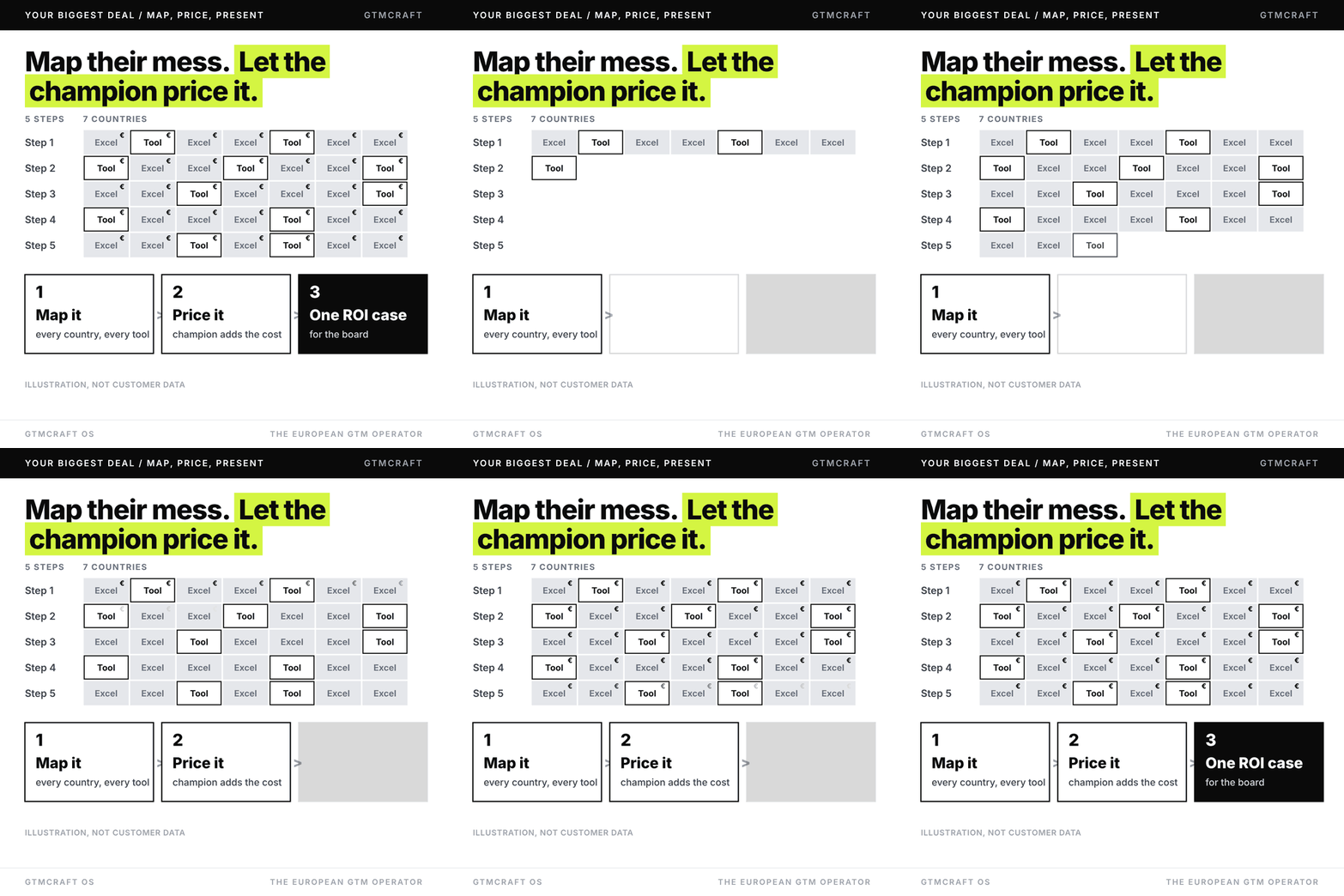
She made a map of the customer’s current environment. The 7 countries they operate in on one axis. Every tool in the process we sell into on the other. The current state was one big cluttered field: some tools, nothing central, a lot of Excel. That costs manual time, causes errors, and does not give the directors the overview they need at the moment it matters.
In the room was the board of directors. In a room like that, one question decides it: does the champion truly defend the project, and does it show we built it together? It did. The board saw Anita’s map as something collaborative, because the champion gave us those insights and the cost of every current tool. That is how we could show a real ROI case, only possible with the champion’s full help. All communication on the deal runs through one project page in Trumpet, the digital sales room we share with the customer, and its AI helps us keep every stakeholder updated. That is what all matters.
My take: a deal this size is never won by one seller. On Friday in the Revenue Room I told a founding AE the same thing from the other side: you are not alone in building this pipeline. Your founders should prospect as much as you do. On our deal we do it in full team collaboration, and that includes the champion. What I relearned on this one: your champion has to know his path through the different teams to the different stakeholders: bring them together, update them on time, challenge them on time. That is a skill set most sellers do not have, or not enough of. And beyond winning the deal, it is very beautiful to visit customers and truly understand where they are today.
The European read: a buyer in several countries often runs several versions of the same process, each with its own tools. Map it per country before you price it, and ask whose budget each country sits in.
Do first: for your 3 biggest open deals, write the champion’s path: which teams, which stakeholders. Then ask the champion when each one last heard from him. A blank line is your next call. Founder fallback: your 1 biggest deal, 20 minutes, even alone.
Do this week: draw the buyer’s current state before your next meeting: countries on one axis, every tool or spreadsheet on the other. Ask the champion for the cost of each. Bring it and let him correct it live. Founder fallback: one page, by hand.
Do this month: agree which deal size clears the team’s agenda, and who plays which role in the room. Founder fallback: you and your 1 seller, 2 roles, written down before the visit.
The rule: the bigger the deal, the more the champion sells without you. Teach him the path.
You know it worked when: each of your 3 biggest deals has a champion who can name every stakeholder, and when they last heard from him. That is the coverage that moves win rate on your biggest deals. Founder read: your biggest deal has a map the champion corrected, with the cost of each current tool.
The play: How to move upmarket without breaking your SMB motion, in 5 steps. It earns each step up with a gate, so the bigger deals do not starve the motion that pays today.

Lesson 2: protective is a leadership skill
If I had to give last week one word, it is protective.
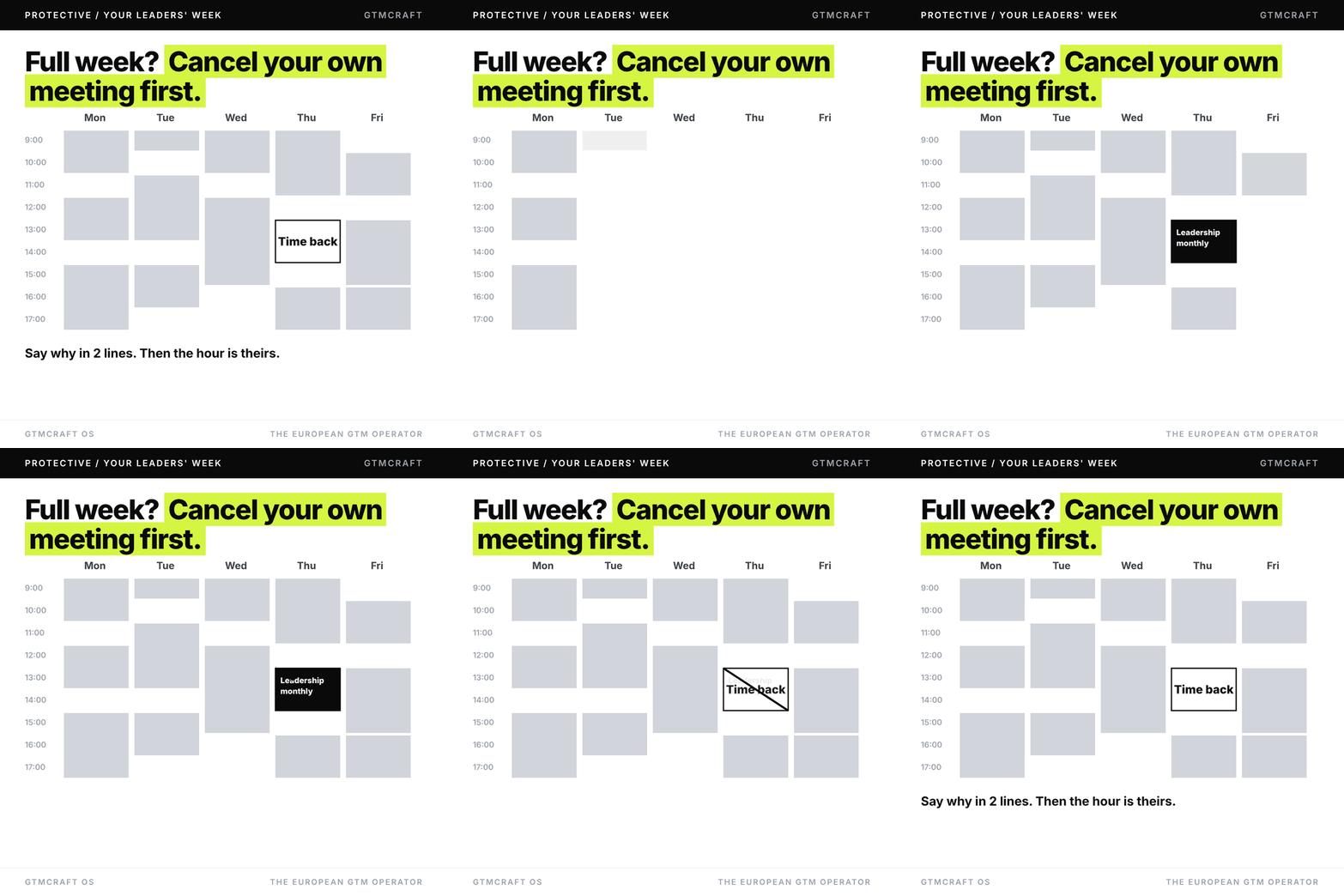
There is so much going on right now, including next year’s planning. So I cancelled the monthly meeting with all my leaders. Just time back.
My take: you yourself need to be the example. Every moment you can give back to your team members, to your managers, or to your ICs, depending on the size of your business, you need to lead by example. Protective of your own agenda. Protective of your time. Protective of where you say yes and where you say no. Most leaders I see either lack that skill, or find saying no so difficult that they just do not do it enough. It is the best thing you can do.
The European read: when your leaders sit in different countries, a monthly meeting also costs someone the worst time slot, a travel day or a meeting in their second language. Count that cost too.
Do first: open your calendar for the next 4 weeks and mark every recurring meeting where people mainly report. Pick 1 and cancel it this week. Founder fallback: no leadership team yet? Cancel 1 internal meeting of your own and spend the hour with a customer.
Do this week: tell your team why, in 2 lines. What they get back, and what you expect from that time. Founder fallback: one message in your team chat.
Do this month: the time you gave back has to land somewhere. My 1:1s are my leaders’ time: they own that meeting, and that is where we make decisions. Their 1:1s belong to their direct reports, the same way. The update goes in writing before, the hour goes to the calls only that person can make. Founder fallback: your 1:1 with your first seller, same rule.
The rule: when the week is full, cancel your own meeting first. Give the time back, and say why.
You know it worked when: your leaders can say what they did with the time you gave back, and every 1:1 ends with a decision. Founder read: 1 hour a week moved from an internal meeting to a customer.
The play: How to make your 1:1s produce decisions, not updates, in 5 steps. The update moves to writing, so the hour goes to the calls only you two can make.

Lesson 3: 13 agents live, each one on a stage of the buying cycle
Some people are passionate about sports, or about a musical instrument. Mine is go-to-market. And everything I learn with AI, I apply in my day job.
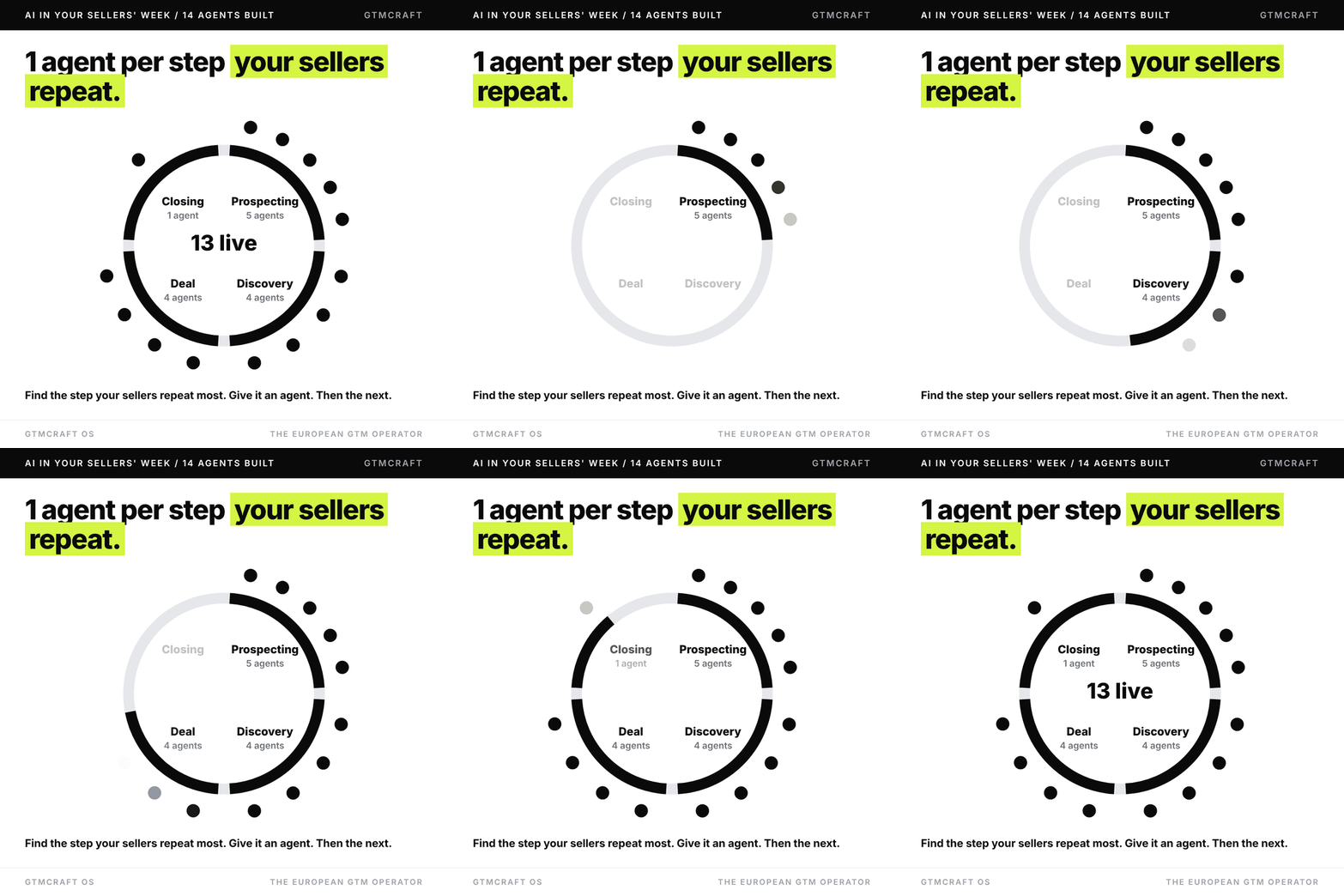
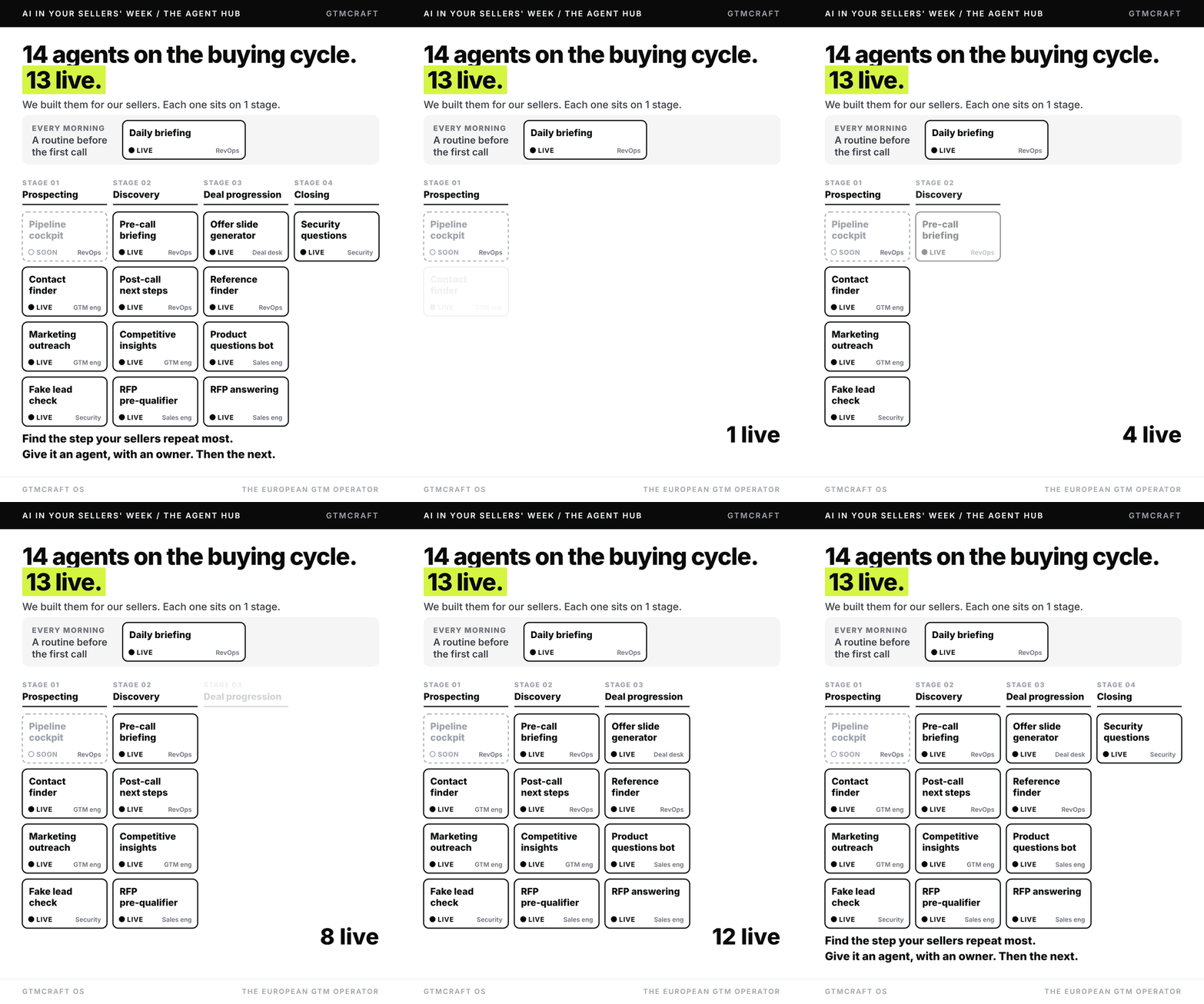
For our sellers we built a hub of 14 agents. 13 are live. Each one sits on a stage of the buying cycle:
Prospecting and pipeline: a daily briefing, a pipeline cockpit, a contact finder, outreach drafts, and a fake-lead check.
Discovery and qualification: a pre-call briefing, post-call next steps against our qualification framework, competitive insights, and an RFP pre-qualifier.
Deal progression: an offer slide generator, a reference customer finder, a product questions bot for the sales engineers, and an RFP answering assistant.
Closing and handoff: a security questions assistant.
Same call as cancelling my meeting: every task an agent takes over is time a seller gives back to a customer, like the one Anita mapped.
My take: most founders, founder-operators and GTM operators I meet are still not using the speed of development AI gives us today. I write everything by voice with Wispr Flow, this newsletter included. I build my own outbound campaigns in Claude, and they land as workflows in Expandi. Still the basics, and I will share the lessons as I go. The hub is the same idea at team scale. My rule: find the step your sellers repeat most, and give it an agent. Then the next one. In the coming Revenue Room sessions I will share more of exactly this.
The European read: build an agent once, run it per market. The offer slide, the reference finder and the RFP answers have to work in the buyer’s language, with a reference from the buyer’s own country.
Do first: write down your buying stages. Next to each, write the 1 task your sellers repeat most. Founder fallback: your own last 5 deals, and the task you did 5 times.
Do this week: pick the most repeated task and build 1 agent for it. Cannot pick? Start with the pre-call briefing: it runs before every call, so you know within a week if it helps. Founder fallback: one prompt you run before every call, saved and reused.
Do this month: 1 agent per stage, each with an owner who checks its output every week. Founder fallback: 2 stages, you own both.
The rule: 1 stage, 1 repeated task, 1 agent with an owner. Then the next stage.
You know it worked when: every stage of your buying cycle has at least 1 agent with a named owner, and your sellers use it without being asked. The number that moves is seller time back on the steps they repeat. Founder read: your pre-call briefing runs before every call.
The play: How to embed AI into one revenue motion end to end, in 5 steps. It takes 1 motion from first touch to signature before you add the next. Want your own AI to map your buying cycle and find the first agent? That is the job of the GTMcraft Operator Brain, below.
Save this. 3 lessons from my week, each with a play you can run today.
Send it to 1 founder whose biggest deal still lives in one seller’s head.
Why this matters now
Monday 4 January 2027 is 8 weeks from today, 56 days. Whatever is in place on that Monday starts the year with your team: the agent, the meeting you cancelled, the map of your biggest deal. Whatever is not becomes a Q1 project. Start with the map this week.
3 questions for the room
Who in your biggest deal knows the path to every stakeholder, and is it your champion or your seller?
Which recurring meeting would nobody miss if you cancelled it this week?
Which stage of your buying cycle still runs without a single agent?
Go deeper with GTMcraft Operator Brain
Scale on plays and skills, not prompts. This play and 250+ more are free and live in GTMcraft OS on Notion.
The GTMcraft Operator Brain is the connection, and you can buy it on its own: EUR 297 a year. Every play, every lesson and every source behind them, inside your own AI and next to your own deals. 6 libraries: podcasts, newsletters, LinkedIn posts refreshed daily, playbooks, human skills and AI skills. The aim is simple: 5 to 10 percent better execution on the number you own. Connect it once and ask it which Q4 deals have power, and which need that meeting by 13 November.
The first 50 keys went out this weekend.
Get your GTMcraft Operator Brain key, EUR 297 a year, or reply Operator Brain to this email.

The Revenue Room
8 people, 1 quarter. European B2B SaaS founders and GTM leaders who own the number. I tell you what I would do in your seat, you run it. A hotline with an answer within 48 hours, a case-led call every 2 weeks, and 1 private session with me.
The Q4 room started on 23 October. The Q1 2027 room opens in January. Reply JANUARY to this email to hear first, and bring your 2 coverage numbers to the first call.
Master your human GTM skills AI can’t replace inside GTMcraft,
Koen
Your (human) GTM Coach
—
PS. Co-written by Wispr Flow + my GTMcraft Newsletter Skill + Claude Opus 5.5; edited & approved by Koen
Cancelling your own leadership meeting to give people time back is a small thing that says a lot. When a big deal is on, most of us add meetings, which is usually the opposite of what the people working it need.
Asking the champion when each stakeholder last heard from him is a great test. "A blank line is your next call" is going to stick with me.
On deals this size I'd add the people the champion doesn't mention. Procurement, legal and security often turn up late, and by then they've usually formed a view from whatever they read on their own. That's where account-level advertising earns its place on a big deal: keeping the vendor's name in front of the parts of the buying group that sales can't reach directly yet.
The per-country point applies on the media side too. A target account in seven countries is often seven different buying groups behind one company name.
When Anita mapped the seven countries, did the champion know everyone involved in each, or did the map turn up people he hadn't mentioned?