

TL;DR
Personal GTM OS Highlight:
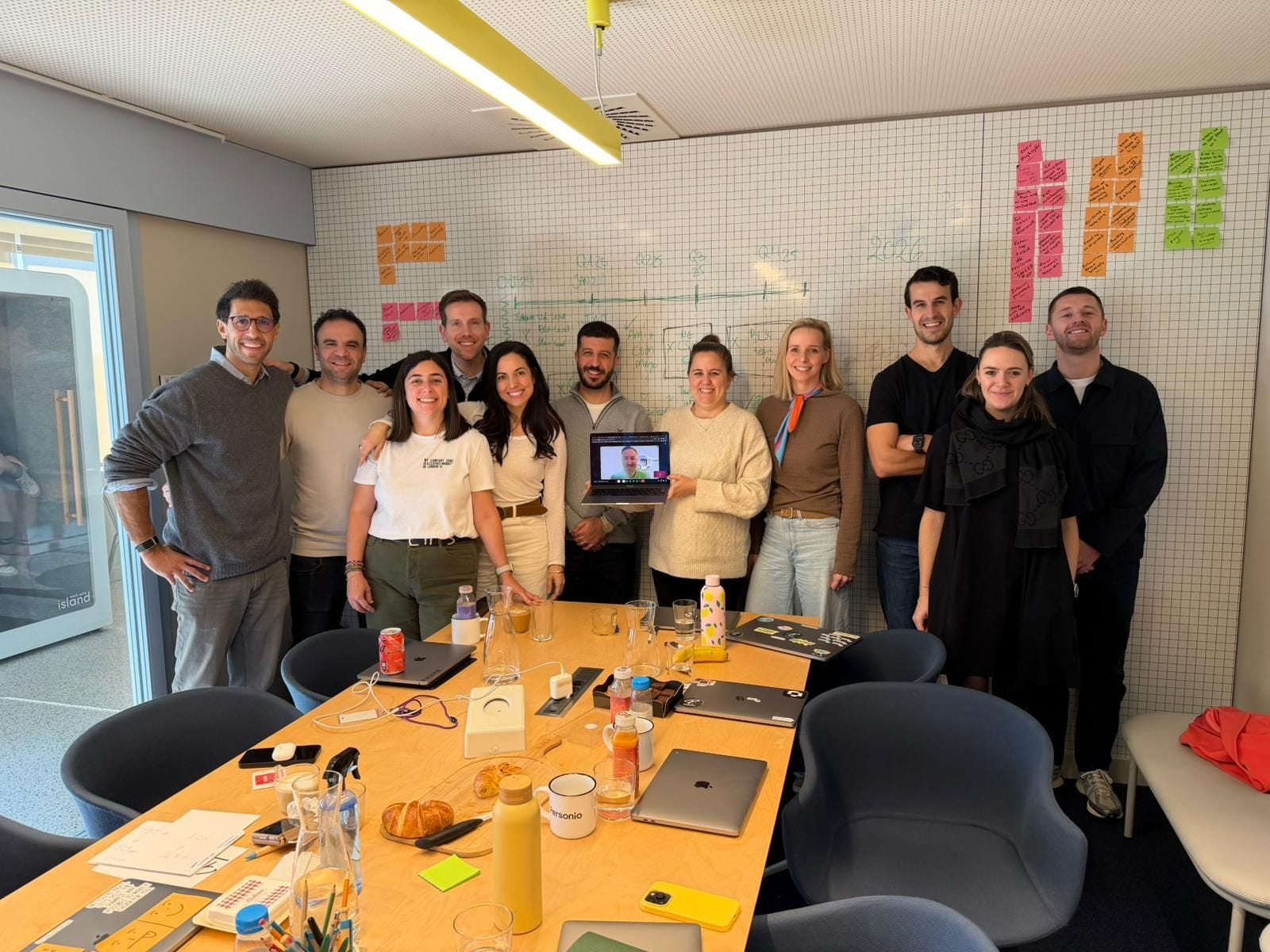
Last week in Madrid, our international leadership team met to align for 2026. We did not start with plans; we started with people. Each leader shared what shaped them before discussing goals. The result was faster trust, clearer focus, and one shared mission across every function. Alignment is not built in Excel. It is built through shared understanding.GTM OS Update:
This week’s release is The Connection Kit. It contains three short leadership exercises to build alignment before planning: check-ins for presence, meaningful introductions, and reflection on 2025. Run them before your next planning session to shift the tone from debate to collaboration. When trust comes first, execution improves naturally.Playbook of the Week:
The Cross-Functional Collaboration System. Seven plays that align GTM, CS, and Product around one operating rhythm. From Shared ICP Ownership and Unified Revenue Visibility to Customer-Led Growth and AI-Augmented Collaboration, this playbook turns alignment into a measurable advantage.Why It Matters:
2026 will reward alignment over activity. The best teams will not grow by doing more but by executing together. This issue provides the systems and habits to make that shift with clarity, accountability, and predictable growth.
Last week’s GTM Operator Insight: Alignment isn’t built in Excel. It’s built in rooms where leaders understand each other.
Themes: cross-functional alignment, shared goals over silod metrics, co-creation culture, execution through clarity, human behind the KPI
Read time: 4 minutes
Last week in Madrid, all our international GTM leaders came together: HR, RevOps, Marketing, SDR, AE, Solutions, Partnerships, Implementation, Customer Success, Account Management.
Every function that touches revenue in one room.
At scale, every company becomes a matrix. Departments pull us horizontally. Metrics pull us vertically. Each leader owns their own outcomes: pipeline, NRR, implementation, hiring.
But ownership without alignment creates motion without progress.
Most operators are finalizing next year’s plans right now. ARR targets, CAC, NRR, cost ratios all in Excel.
But alignment isn’t built in spreadsheets. It’s built in shared context.
That’s why we met to turn our 2026 ambition into one co-created plan.
We started simple: Meaningful Interactions.
Each leader shared personal stories before business goals.
It reminded everyone that behind every KPI is a human.
Only when you know the person behind the role can you build trust and trust is the foundation of alignment.
Then we looked back at 2025, what worked, what didn’t before mapping each function’s 2026 focus and how it connects to the overall revenue mission.
From that, we formed two co-creation councils: new business and existing business uniting every department around one growth plan.
That’s real cross-functional work.
It’s empathy, structure, and shared accountability.
Without it, every plan stays theoretical.
Why this matters:
If teams plan in isolation, execution fractures in Q1.
Before you lock your 2026 plan, run one cross-functional sync to map dependencies.
Make sure every team’s goals ladder to the same mission.
If you only do one thing this week
Run a cross-functional alignment session before finalizing your 2026 plan.
Not to present slides but to understand dependencies. Bring every function that touches revenue and work through these five questions:
What is the single mutual goal that connects all our functions for 2026?
How does each department’s top priority contribute to that goal?
Where are the biggest dependencies or overlaps between teams?
Which trade-offs or resource decisions require joint ownership?
How will we keep this alignment visible and accountable across Q1–Q4?
End the session by naming one owner for cross-functional health.
Because alignment isn’t a one-time event, it’s a system you maintain.
GTM OS Update: The Connection Kit: How Alignment Starts Before the Plan
Focus traits: AI-native, tech-forward, cross-functional
Read time: 4 minutes
Every week in GTM OS Weekly, we open up the systems we’re building for the future operator: practical tools that help GTM teams execute with clarity and leverage.
We share:
GTM OS Playbooks – frameworks to operationalize modern GTM
GTM OS Checklists – repeatable habits for execution
GTM OS Revenue Assistants – AI co-pilots for GTM leaders
GTM OS Agents – n8n workflows connected to your tech stack
GTM OS Templates and Blueprints – ready-to-use assets
Each week we share one example. Members of the GTM OS Community → gtm-os-community.circle.so unlock them all.
This week’s drop: The Connection Kit
The fastest way to align a leadership team is to slow down first.
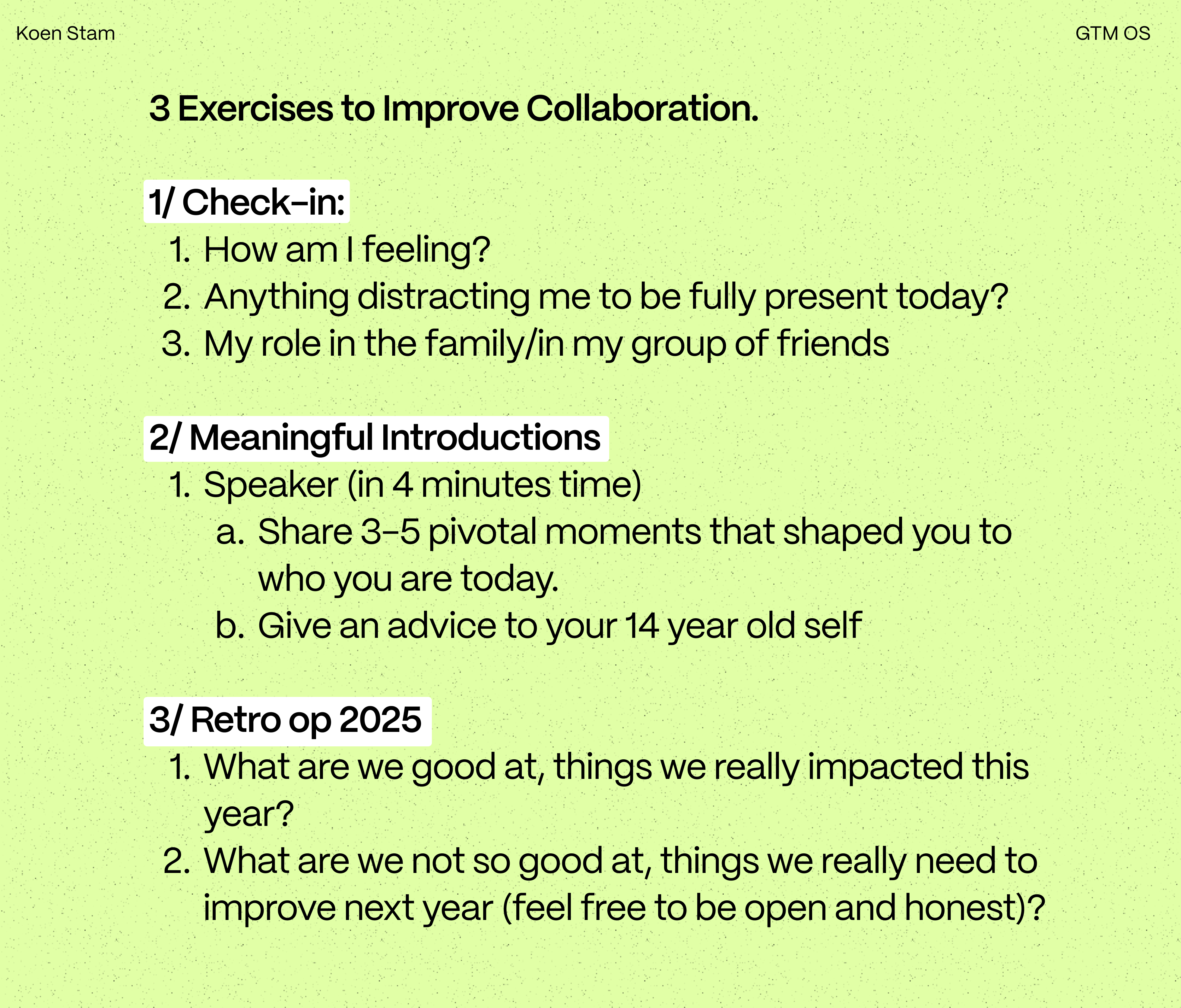
Before you start 2026 planning, run these three short exercises with your leadership team.
They cost nothing but time and create the foundation for execution quality.
1. Check-in for presence
Ground everyone in the room.
Ask: How am I feeling? What might distract me? What role do I naturally play in this team?
2. Meaningful introductions
See the person behind the function.
Share 3 to 5 moments that shaped who you are and one piece of advice you’d give your 14-year-old self.
3. Reflection on 2025
Align context before aligning goals.
Ask: What went well? What challenged you? What is one lesson we carry into 2026?
Why it works
Alignment does not start with process. It starts with empathy that makes process stick. Once the human connection is there, your systems start to perform.
If you only do one thing this week
Run one of these exercises before your next planning session.
You will notice the tone shift from debate to co-creation.Ask yourself and your peers:
Do we understand each other before we plan together?
Is our energy aligned before our targets are?
What assumptions do we hold about each function?
What does shared success look like for 2026?
How do we keep this connection alive through execution?
Tool spotlight: The Daily Prep Agent
Most GTM teams still start their day reactively.
They open their calendar, scroll through meetings, and jump in unprepared.
We built something to change that.
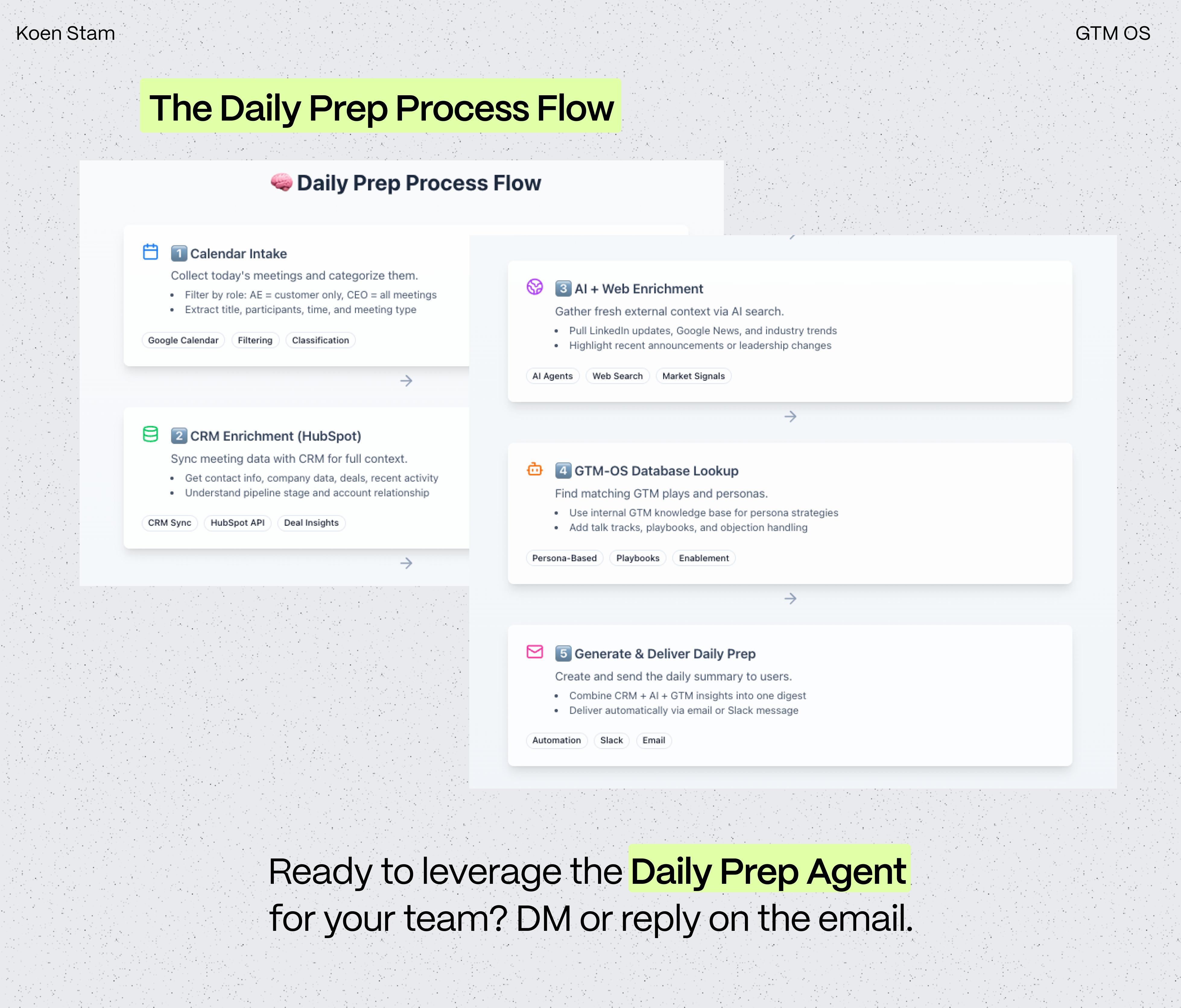
The Daily Prep Agent turns fragmented data into proactive preparation.
It connects your CRM, calendar, and past calls, classifies meeting types, adds live intelligence, and delivers a short, role-specific prep brief minutes before the meeting.
Here’s how it works:
Connects your context: Syncs calendar, CRM, and call recordings to know who you are meeting and what was said last time.
Classifies meetings: Detects type (discovery, demo, renewal, negotiation) and adjusts prep accordingly.
Adds live intelligence: Pulls company and persona data from LinkedIn, Google, and the GTM OS Knowledge Graph of 10,000+ GTM posts, 1,200 podcasts, and 100 playbooks.
Surfaces the right plays: Matches meeting type and role to proven GTM plays.
Delivers automatically: Sends the prep brief to Slack or email before the meeting.
Why it matters
AI-native operators don’t ask AI for help.
They build systems that answer before they ask.
Preparation is the new performance multiplier.
Improving 1 to 5 percent each meeting compounds into months of outperformance by the end of 2026.
To access the Daily Prep Agent, and explore other AI workflows that drive focus and execution, join the GTM OS Community → gtm-os-community.circle.so.
GTM OS Playbook of the Week:
Cross-Functional Collaboration to Drive ARR & NRR in 2026
Audience: SaaS founders, CROs, and GTM leaders ($2–30M ARR)
Goal: Align teams, simplify execution, and compound ARR and NRR through collaboration.
Time to apply: 30–60 minutes per play to start; ongoing cadence keeps it alive.
1. Shared ICP Ownership Across Functions
Purpose (Why it matters)
If Sales, Marketing, and Customer Success don’t share one definition of an ideal customer, execution fragments. A shared ICP drives efficiency, higher win rates, and retention.
Quick Setup (Do this week)
Meet Sales, CS, and Marketing for a 2-hour ICP workshop.
List your top 20 retained and expanded customers.
Identify 5 shared traits (industry, size, pain, use-case, trigger).
Write one clear statement: “We win when [segment] with [pain] use [solution] to [result].”
Publish it in Notion or Google Docs and make it visible to all GTM teams.
Review quarterly based on churn and expansion data.
Impact Metrics (What Good Looks Like)
• Win rate +20%
• Churn –30%
• CAC payback < 12 months
Common Pitfalls & Fixes
• ICP too broad → Narrow to top retention segment
• Defined by firmographics only → Add behavior and use case
• Ignored by Sales → Link ICP adherence to quota credit
Cadence
Review every quarter (1 hour)
Expert Sources
2. Unified Revenue Visibility and Decision Rhythm
Purpose
Without a single view of performance, every team tells a different story. Shared metrics create alignment and speed.
Quick Setup (Do this week)
Pick 5 metrics: Pipeline, Win Rate, CAC, NRR, Velocity.
Track them in one shared spreadsheet or Notion page.
Assign an owner to each metric.
Update weekly before the GTM sync.
Make all revenue decisions from this shared view.
Impact Metrics (What Good Looks Like)
• Faster decision cycles
• Meeting time reduced by 30%
• Predictable reporting cadence
Common Pitfalls & Fixes
• Too many metrics → Limit to five
• Conflicting data → Choose one system of record
• No follow-up → Assign owners in meetings
Cadence
15-minute weekly sync, 1-hour monthly review
Expert Sources
3. Signal-Based Collaboration and Account Intelligence
Purpose
Most GTM teams waste effort on accounts not ready to buy or expand. Shared signals focus energy on real buying and retention opportunities.
Quick Setup (Do this month)
Agree on 3 core signals: product usage, engagement, and intent.
Add a “Signal” column to your CRM or shared sheet.
Run a 30-minute weekly Signal Sync between Sales, CS, and Marketing.
Follow up within 48 hours on high-readiness accounts.
Track closed-won and retained deals from this list monthly.
Impact Metrics (What Good Looks Like)
• Pipeline-to-revenue conversion +25%
• Deal velocity +20%
• CAC per opportunity –15%
Common Pitfalls & Fixes
• Activity mistaken for readiness → Use behavioral signals
• Static scoring → Refresh definitions quarterly
• Siloed tools → Centralize data in one view
Cadence
Weekly Signal Sync (30 minutes)
Expert Sources

