The 90-second version
I came back from 6 days off having built more clarity on next year than most of my desk-bound weeks give me, and the reason is boring: I protected 3 numbers.
Lesson 1: the input comes before the pipeline. Treat your own capacity like you’d treat a Q4 selling-day count, because both run out at the same pace.
Lesson 2: trust decides which channel works, not the other way round. The same move saved a coaching relationship and revived 3 warm leads this week.
Lesson 3: an AI agent amplifies whatever is underneath it, including the mess. Map the job first.
The European read: we still treat the annual break as the thing that waits. It is the only week all year most of us get the quiet to actually think, which is exactly why it is the first thing the calendar eats.
Read time: ~8 min

3 lessons from a week off, before the plan locks
With about 10 selling weeks left before the year closes, and next year’s plan already due, the operators who start executing now (in October) are the ones who hit the number they’re about to set.
From my week: I spent part of a week off thinking through a coaching concept I’ve been building for over a year, not for spare time, but because the break was the first quiet stretch I’d had in months.
My take: I used to think planning started when finance sent the template, in late November. It doesn’t. The plan rushed together in week 2 of December is the plan that stalls your first quarter, and I’ve watched that exact lag cost 3 different teams their January.
Do first: Block 90 minutes this week, alone if that’s what you have, and write the one number you’re building toward next year and the 3 things that have to be true for it.
The rule: The plan that starts in October ships in January. The plan that starts in December ships in March.
Sources: 5 steps to build next year’s plan early enough to hit it

Hi, it is Koen Stam and welcome to GTMcraft OS: The European GTM Operator. This newsletter is built from 100,000+ GTM signals collected from 100+ operators and founders, combined with 13+ years of my own lessons and failures from the trenches. I write at the intersection of go-to-market practice and AI-powered systems for founders and GTM operators scaling their next 2M, 5M or 10M ARR.
Lesson 1: Protect the input before you protect the pipeline
I track 3 numbers now when I take time off: sleep, steps, HRV. Not because I’m chasing a wellness trend, I’m not, but because I wanted to know what 6 days actually does to the thing that makes every other decision this quarter possible, which is a clear head. The first night was the worst of the week, a 4-hour-32 stretch thanks to an early flight. By night 2 I was back over 9 hours, and the 7-day HRV average ended up the highest it has ever been. I came back with the clearest thinking I’ve had on how we cross this Q4, and it happened on a balcony, not at my desk.
My take: For years I took exactly 1 holiday a year, in the summer, and told myself that was enough. It wasn’t a decision, it was a default, and the calendar filling up with events, communities and a new coaching concept made it easier to keep deferring. What changed is not that I found more time. I protected 3 numbers instead of zero, and the strategic thinking showed up as a side effect, not the goal.
The European read: The 1-holiday-a-year habit is not a personal quirk, it is close to the regional default for operators who carry a number. We treat the break as the thing that can wait because everything else on the calendar insists it cannot. The irony is that the clearest thinking on the quarter almost never happens inside the quarter’s own meetings.
Do first: Pick the 1 input you can measure for free this week, sleep is the easiest, and write down just 1 number a day. No app, no dashboard, a note is enough.
Do this week: Before your next day off, book the 3 numbers you’ll track during it. Measuring is what makes it count as recovery, not just absence.
Do this month: Put your next real break on the calendar now, for a date you aren’t already negotiating away. Founder-operator fallback: no PTO policy, no problem, pick 1 day with zero calls and treat it as the experiment.
The rule: The input comes before the pipeline. You cannot out-plan a depleted operator.
You know it worked when: the first strategic idea of the week arrives somewhere other than your desk.
The play: 5 steps to turn your outbound Q4 plan into a capacity plan — built for your selling days, but run the same math on your own. Count your actual available hours before you set what you’ll build next, review it weekly the way the play reviews outbound capacity every Friday.

Lesson 2: You earn the informal channel, you don’t default into it
I’ve worked with a coach for close to 2 years, first on content, then on packaging 14 years in the trenches into something others could use. For most of that time we ran on a fixed biweekly call plus async updates in Notion. In the last few days/week we moved to WhatsApp, voice notes, texts, a call when something needed it, and the pace changed. Response time dropped, nothing got lost in a messy inbox, and it stayed useful because the trust was already built.
I saw the same pattern this week on the other side of the table. A handful of warm leads for a new coaching cohort had gone quiet after a LinkedIn message and a follow-up email, both reliably messy channels. The moment I followed up on WhatsApp instead, replies came back within the hour. Same person, same offer, different channel, and it only worked because the relationship had already earned it.
My take: It is tempting to read this as “move everything to WhatsApp,” and that is exactly the wrong read. The lesson is the sequence, not the tool. Trust first, informal channel second. Skip the first step and the same message on the same channel reads as presumptuous instead of convenient.
The European read: European buyers are more allergic to over-familiarity than the “just text me” culture that travels well from the US. The move is not to default to informal, it is to notice the exact moment credibility has been earned and switch only then.
Do first: Pick 1 relationship that has gone quiet on a formal channel, where you know the trust already exists, and send one direct, informal message instead of a third polished follow-up.
Do this week: Map which active conversations have earned an informal channel and which haven’t. Don’t collapse the list into one bucket.
Do this month: Make the trust-to-channel handoff a named step, not a hack: formal outreach earns the right to go informal, never the start. Founder-operator fallback: a 15-minute list in a notebook, not a CRM field.
The rule: You earn the informal channel. You cannot default into it.
You know it worked when: a contact who went quiet on email or LinkedIn responds within hours on the channel you switched to.
The play: 5 steps to run async selling that shortens the cycle

Lesson 3: Map the job before you buy the agent
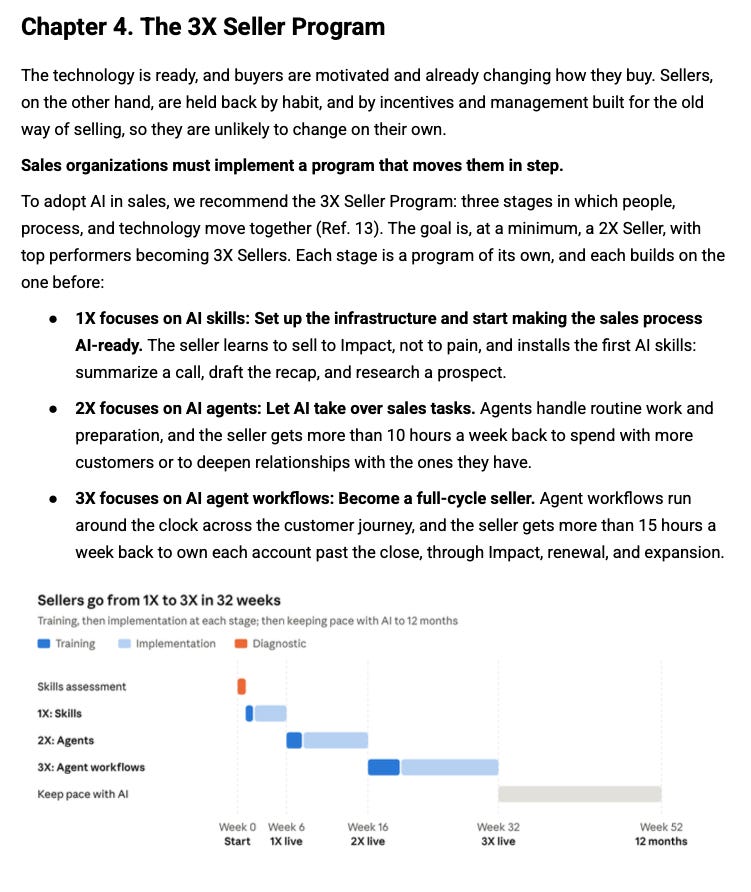
I spent part of the break listening to Jacco van der Kooij lay out a framework for AI and sellers: 1X modernizes the process, 2X offloads work to agents, 3X becomes a genuinely full-cycle operator. The order is the whole point. Skip to 2X before 1X is done and you’ve automated a broken process, faster.
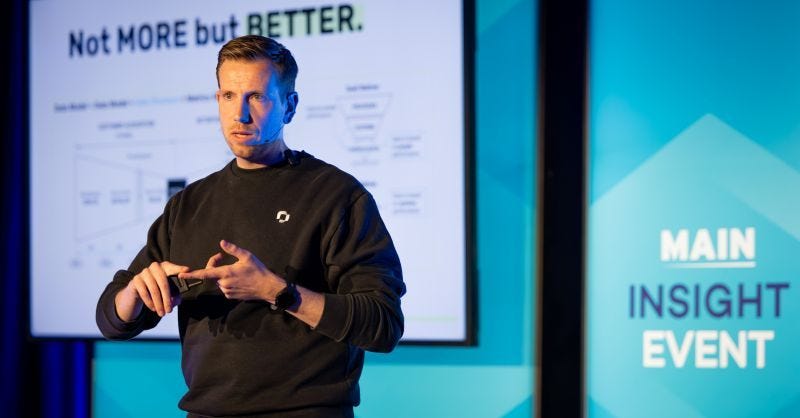
I watched the same sequence at Personio, where I lead our international GTM org. Our CRO, Philip, presented on this exact question at Shift AI Europe in Barcelona this same week: don’t add AI to GTM, rebuild GTM around it. The number that stuck wasn’t the adoption rate, though 91% monthly active usage is real and public. It was the reframe: from “who’s using AI” to “what are we building once, for everyone,” only possible once the jobs, not the tools, are mapped. The agent hub across our AE and BDR teams exists because that mapping happened first.
My take: AI readiness gets sold as a tooling decision. It isn’t. It’s a process decision wearing a tooling costume. The teams that get this backwards spend real money proving it, one rep-built model at a time.
The European read: European teams often buy the caution around AI as a compliance story. It is rarely the real blocker. The real blocker is the same one engineering had before anyone touched a model: undefined process, now amplified instead of fixed.
Do first: Before you evaluate a single new AI tool this week, write down the process it would run on, in plain steps, the way you’d hand it to a new hire.
Do this week: Pick the least-documented workflow in your GTM motion and fix that first, before any agent touches it. Founder-operator fallback: no written process anywhere is the finding, not a side note.
Do this month: Build or buy once it’s mapped, never before. 2 people building the same AI workflow in parallel, because nobody mapped it first, is the tell.
The rule: Map the job before you buy the agent.
You know it worked when: adoption of a new AI tool outpaces the rollout announcement, because the team already knew exactly where it fit.
The play: 5 steps to fix the base before you point an agent at it

Save this if you're heading into the last stretch of the year with a full calendar and an empty tank. Send it to 1 founder or operator who's about to skip their own break to "get ahead."
This week’s play to steal

Fixes: late-autumn planning that eats H1 before the first program fires, plus a plan sized by hiring first instead of the capacity you already have.
Best for: any operator who owns a number for next year and hasn’t started the plan yet, especially one still defaulting to more leads plus more hires.
The 5 steps:
Start a full sales cycle before January, back-dated from your real activation lag.
Set the ambition and name 3 to 4 levers, including where AI-freed hours move before you size hires.
Cap the ambition against 6-plus years of your own trend lines, not a wish.
Cost every initiative with an impact and a date, cut the small and slow ones.
Co-build with finance, pressure-test with 3 hard questions in the room, re-forecast monthly.
Template: score your plan 1 point per signal, 5 means ready to present.
Start is a full cycle before January, not the finance calendar.
Ambition is capped by your own trend, not a wish.
Every initiative has a cost, an impact, a date.
The realistic-to-aggressive gap is named, not hidden.
The plan is room-tested, not just announced.
Paste this into your AI:
You’re my annual planning analyst. Ask for my ramp time, program build time, average sales cycle, next year’s ambition, and 6-plus years of growth pace. Compute my activation lag and planning start date, draft a top-down model with 3 to 4 levers (including where AI-freed hours change the hiring math), build realistic and aggressive scenarios against my trend, cost each initiative, and give me 3 questions to pressure-test the plan with my team before I present it.
Why this matters now
About 10 selling weeks remain before the year closes, and the plan for next year is already due whether you’ve started it or not. Every operator reading this is weighing the same 3 trade-offs this week: protect your own capacity or burn through it, earn the trust that makes a relationship easy or keep forcing a formal channel, map the process or hand a broken one to an agent. None of these are new problems. What’s new is how little runway is left to get them right before the number you’re about to set becomes the number you’re stuck defending.
3 questions for the room
What’s the one input you’ve let slip this quarter that you’d never let slip in January?
Which relationship in your pipeline right now would answer faster on a channel you haven’t tried yet, because the trust is already there?
Which process in your GTM motion would an AI agent make worse right now, not better, because the job underneath was never mapped?
Join The Revenue Room
8 people, 1 quarter. European B2B SaaS founders between 1M and 10M ARR and GTM leaders who own the number. I tell you what I would do in your seat, you run it. No course, no content library, nothing to fall behind on.
A hotline. A private group nobody outside it sees. Post the problem that is on your desk, any working day, and you have my answer within 48 hours, plus whatever the other 7 have run into before. You never solve a complex one alone again.
A 90-minute call every 2 weeks, case-led. You post your case 48 hours ahead, 3 cases get the floor, and I tell you what I would do, stop doing and measure by Friday. Next call you come back with what happened and we keep solving problems together.
1 private 60-minute session with me, placed where it moves your number most.
I have scaled B2B SaaS to 10M ARR 3 times now and I run a GTM org pushing toward 40M ARR, in Europe. You get what I am running this quarter, not what I remember from 2019.
Master your human GTM skills AI can’t replace inside GTMcraft,
Koen
Your (human) GTM Coach
—
PS. Co-written by Wispr + 3 GTMcraft Skills + Claude Opus 5.5; edited & approved by Koen