


The 90-second version
Your first enterprise deal is sized to the logo. And the pilot often starts free, without a signer, and gets extended in March.
The worked example: one enterprise land I was part of started with 210 seats in one team. It was paid and had a sponsor. It grew into a 3.5M contract over its full term.
One play, 5 steps: gate the pilot, write it as a contract, charge for it, run it in public, close on the readout.
The European read: your first big land outside your home market is won the same way. Let the buyer see it working at a customer back home.
No named production signer or no booked decision date: no pilot.
Read time: ~9 min

The problem: your first enterprise deal is sized to the logo
From my week: we ran a lot of pilots with banks and insurers, and we were not always strict enough on the criteria. Then there is always the risk that the customer pulls the plug after 6 months. On 10 November I told a room of about 15 founders and CEOs at a VC’s office in Amsterdam: I’ve never closed an enterprise deal myself. As a sales leader, you need the credibility of your sales team. They want to see that you can help them in their complex deals. So I stay vulnerable, open and learning. It is like football: great players are not always great coaches, and the other way round.
What surprised me most in that room: only a few hands went up for a key list of target accounts. Most were shooting at too many accounts. Founders and operators typically don’t really see how to play in the mid-market and enterprise segment consistently. These deals are more complex and not standalone deals.
So it goes like this. A bank says yes to a pilot. The team celebrates. Nobody asks who signs the production contract. The pilot starts in January, runs past 90 days, and ends in “let’s revisit next quarter”.
A free pilot with no signer is a free trial. I would not count it.
Why it happens
Jason says the buyer does want new vendors, but only in a way that is not risky (SaaStr, updated October 2026, first published 2024). His advice: “Call and email the exact buyer, and aim high.”
The pilot gets agreed with whoever said yes first. The exact buyer, the one who signs production, never joins.
Reggie from Sierra describes the opposite on GTMnow (podcast, 11 November). Sierra plays far above your size, so copy the shape at your size: a paid proof of concept on a small set of use cases, in production.
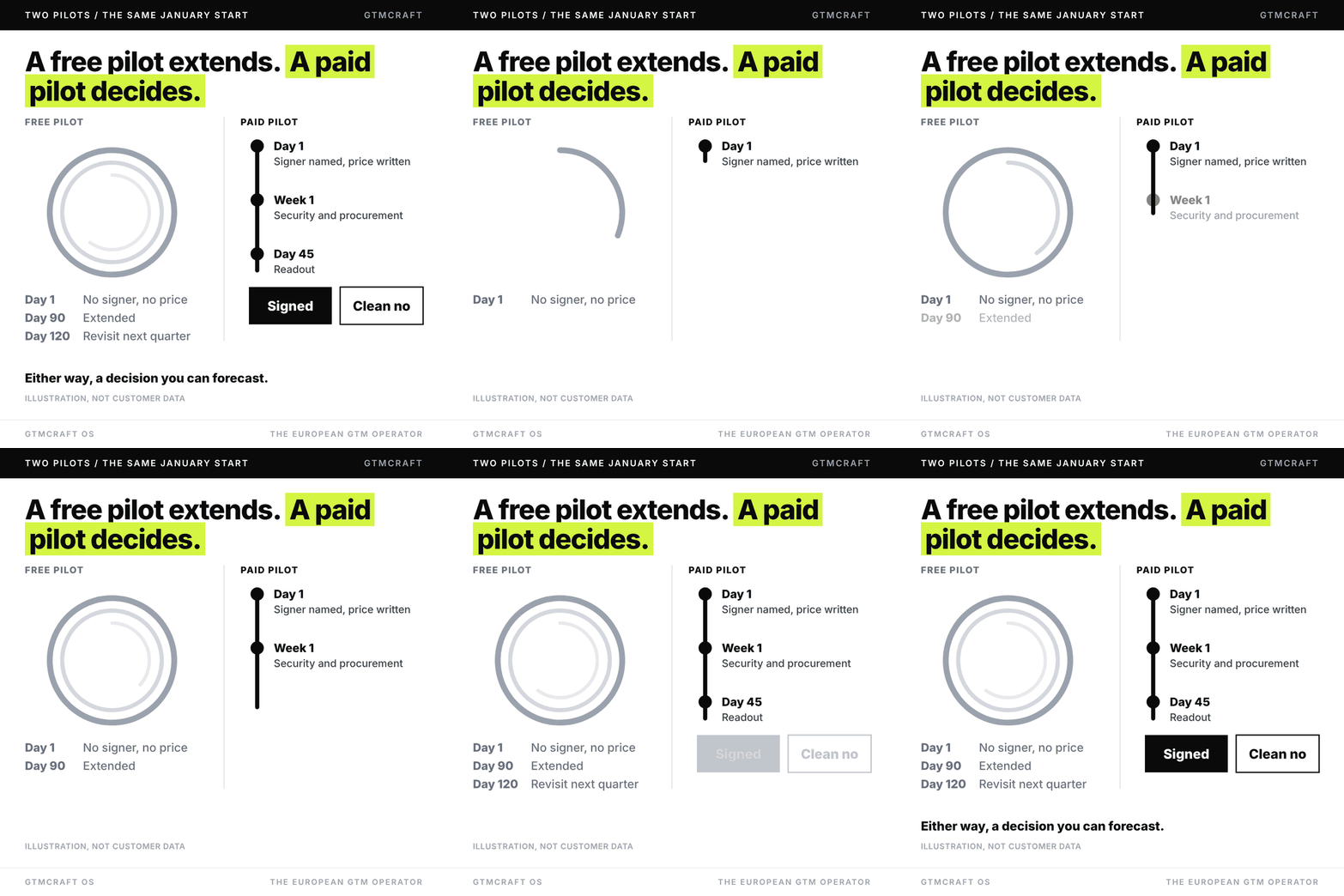
My take: bigger logo is not a bigger deal. At a scale-up I helped grow, selling video software into banks and insurers, we grew a tier 1 bank in the Netherlands from 10 seats to over 5,000. We only made that possible through a strategic partnership: our solution was embedded inside our partner’s platform. That is what let us sign a central contract. Especially in enterprise, you can’t sell without partners.
The biggest deal I was part of, a 3.5M contract over its full term, started with 210 seats in one team. That first land was small in scope. It was not small in seriousness. It was paid, it had a sponsor, and the path to the bigger contract was part of the conversation from day 1. Land small in scope, never small in commitment. After every first land we wrote a results memo and sent it wider than the buyer. The memo did the selling into the next team.
Where I would be stricter today: we got good at 12-month contracts with a 6-month opt-out, only if we did not meet the criteria. You need to be a little bit more strict on those criteria. That is why the pilot is a contract.
And dare to say no to revenue. A bank in New Zealand offered EUR 200k committed for the first year. We said no: we could not deliver the service quality that far out of our time zone. If it does not fit your ICP, you cannot make that customer successful. Saying no is the gate too.
Hi, it is Koen Stam and welcome to GTMcraft OS: The European GTM Operator. This newsletter is built from 100,000+ GTM signals collected from 100+ operators and founders, combined with 13+ years of my own lessons and failures from the trenches. I write at the intersection of go-to-market practice and AI-powered systems for founders and GTM operators scaling their next 2M, 5M or 10M ARR.
The play: run an enterprise pilot that ends in a signed contract
Fixes: pilots that run for months and end in “let’s revisit next quarter”.
Best for: founder teams and sales leaders landing their first 5 to 10 deals above 50k ACV, where one buyer asks for a pilot “to start in January”. It bites hardest in a second country, where you have no references yet.
Time: 30 minutes this week for the first move. Then 45 to 60 days per pilot.
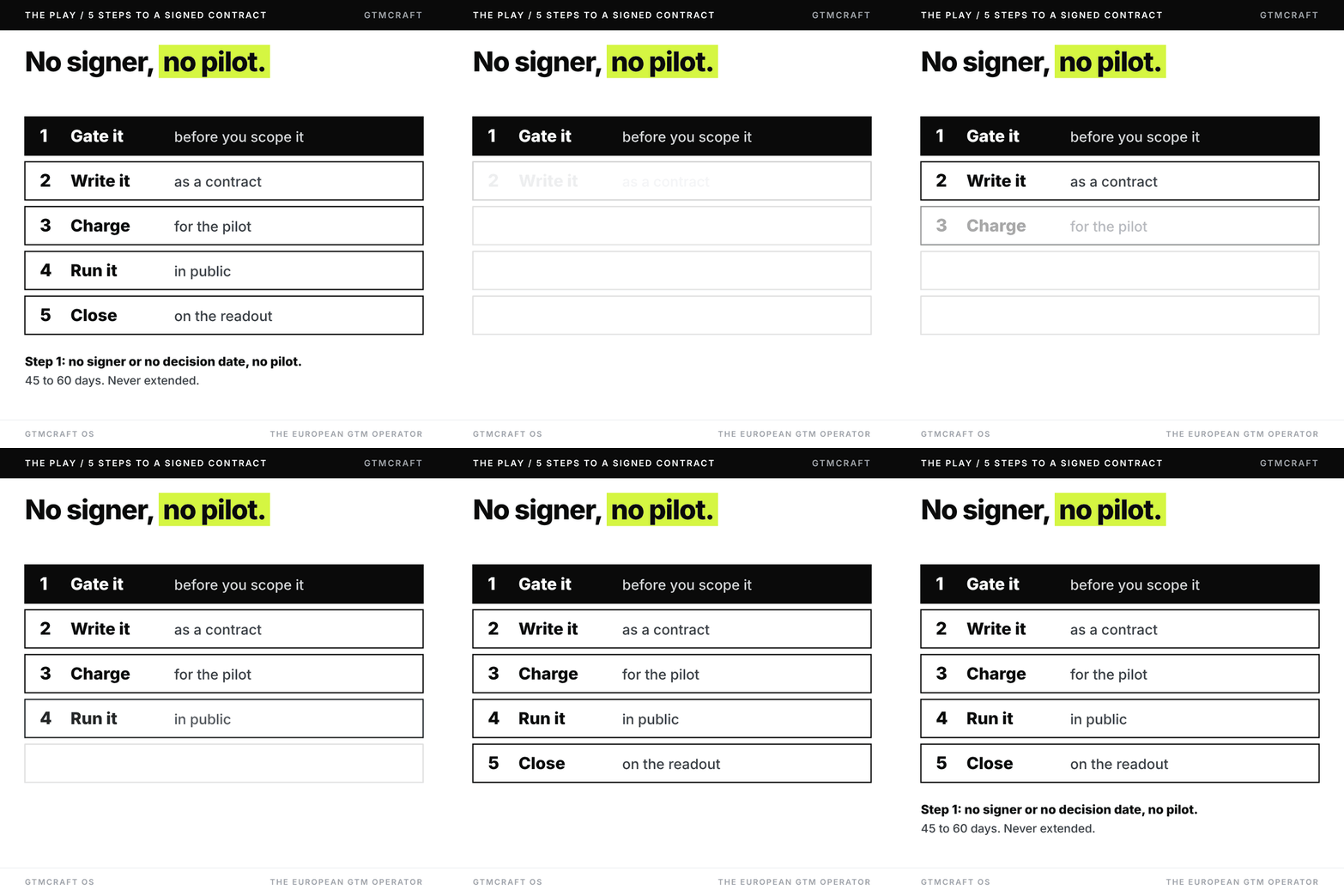
Step 1: gate the pilot before you scope it
Most dead pilots were dead before day 1: no signer, no budget, no decision date. Kyle adds what the pilot itself has to prove (LinkedIn, 26 October). Tie what makes you different to the buyer’s own success criteria inside the proof of concept.
Do it: the rule is no named production signer or no booked decision date: no pilot. Before you write a scope, ask 5 questions.
The problem in 1 sentence.
Who signs production.
Is there budget this fiscal year.
What happens on success, and by when.
Who sponsors at kickoff.
Score each green, amber or red. 2 reds: back to discovery, not a pilot. If a partner already sits in the account, ask them who signs production.
Founder version: 1 call of 20 minutes, scored on paper. No named production signer or no booked decision date: no pilot.
Head of sales version: every seller brings their pilot requests to your Monday deal review with the 5 scores filled in. You approve no pilot with 2 reds.
Done when: every pilot request has a named production signer and a booked decision date before anyone writes a scope.
Step 2: write the pilot as a contract
A pilot without written success criteria cannot be won. It can only be extended.
Do it: 1 use case, 1 team, 45 to 60 days, never over 90. 3 criteria, each with today’s baseline and a target, never “positive feedback”. Then a conversion clause: production scope, annual price, start date. Claude can draft the agreement from your discovery notes, and then list every criterion the buyer could pass and still say no.
Founder version: fill in the 1-page agreement below with the buyer on the call, and send it the same day.
Done when: the signed agreement holds the production price and the start date.
Step 3: charge for the pilot
A buyer who will not pay for a pilot will not pay for production.
Do it: agree the expected annual value first. Price the pilot as a share of it for the pilot months, minus 20 to 50 percent, and never below what it costs you to deliver. Credit the fee to year 1 if they sign within 30 days of the final readout.
Founder version: annual value divided by 12, times the pilot months, minus 30 percent. Worked example: a EUR 60k deal and a 2-month pilot is 60k / 12 x 2 = EUR 10k, minus 30 percent is EUR 7k.
Done when: every pilot is paid, and the year 1 price is written in the agreement.
Step 4: run the pilot in public
A sponsor who sees results every week sells internally for you.
Do it: at kickoff, book every session, the decision meeting included. Start security, the data agreement and procurement in week 1, not week 7. At the midpoint, ask: “If the results look like this, what stops you signing?” Every Friday, send the sponsor a 5-line readout. Progress on each criterion against the baseline, 1 user quote, 1 risk, the next step.
Founder version: after each check-in, paste the call transcript into Claude, ask for the 5 lines, check them and send them yourself.
Done when: security and procurement close before the final readout.
Step 5: close on the readout, not after it
Extending a pilot that missed its criteria is a no that nobody said out loud.
Do it: send a results memo before the decision meeting. What you set out to prove, the 3 criteria against the baseline, what users said. Then what production looks like, with the agreed price and start date. In the meeting, walk the criteria and put the order form on the table. Missed the criteria? Agree a clean exit and a date to revisit. Never extend.
Founder version: 5 paragraphs in the same shared doc as the agreement. Send it wider than the buyer, to the next team you want.
Done when: every pilot ends in a signature or a written no within 2 weeks of the final readout.
The template
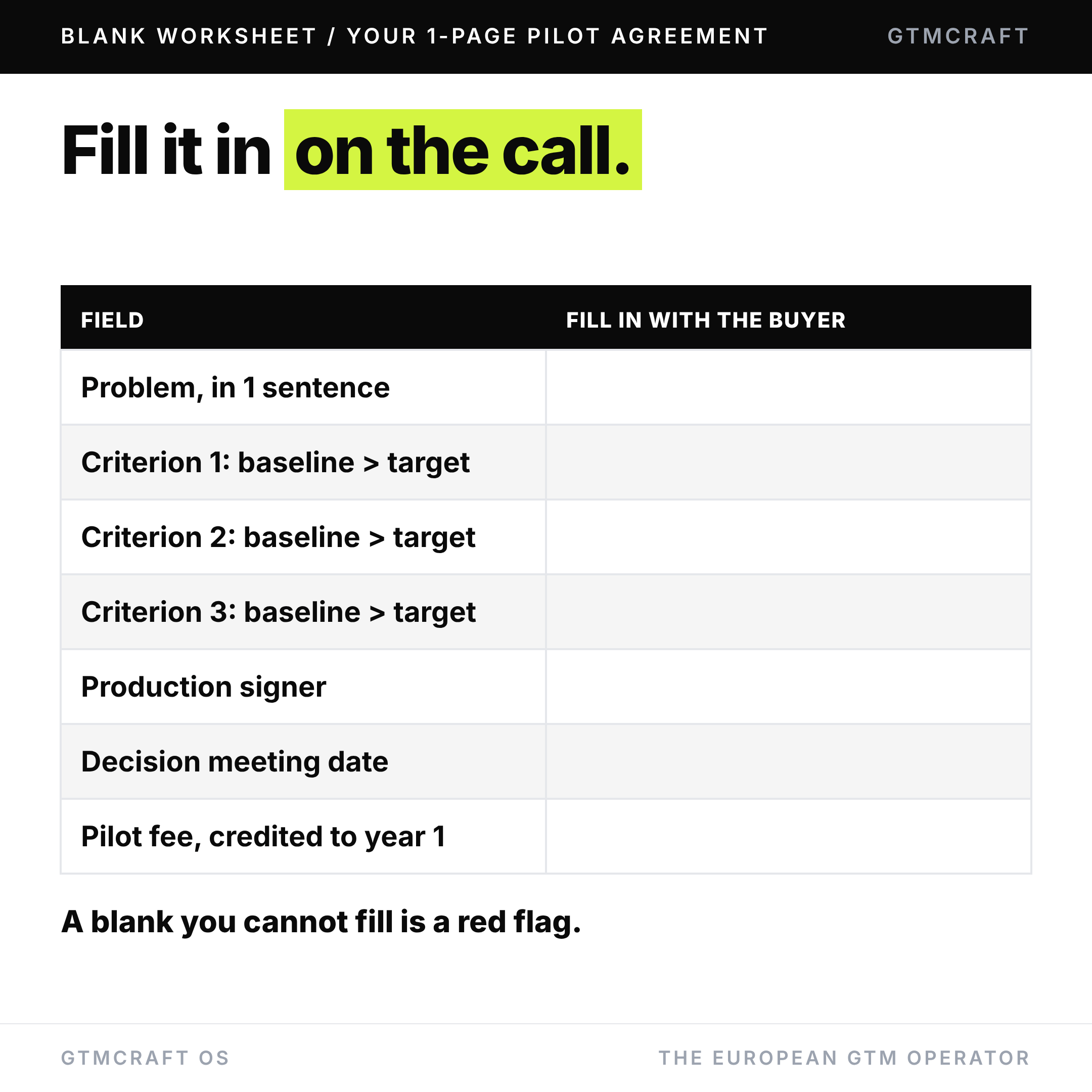
The 1-page pilot agreement. The problem in 1 sentence, the scope, 3 criteria with baseline and target, and the timeline with the decision meeting. The owners on both sides and the production signer. The fee and its year 1 credit, the production terms, and what happens if the criteria are missed.
Paste this into your AI:
Here are my discovery notes for this account: [paste]. My expected annual contract value is [EUR], the pilot length is [days] and my delivery hours are [hours]. Score the account green, amber or red on 5 questions. The problem in 1 sentence, a named production signer, budget this fiscal year, the decision and date on success, a sponsor at kickoff. Quote the buyer’s words as evidence. If there is no named production signer or no booked decision date, or there are 2 reds, tell me to go back to discovery. Otherwise draft a 1-page pilot agreement: 1 use case, 1 team, 3 criteria with baseline and target, 45 to 60 days. Add owners on both sides, the production signer and a conversion clause with scope, annual price and start date. Then give 3 fee options. Do not invent names, numbers or dates. Mark anything missing as missing.
With the GTMcraft Operator Brain, your AI already has the play, the skill and the sources: no paste.
The European read: your first big land outside your home market is won the same way: small, visible, proven at home. You have no references in that country yet. At the scale-up, our big land at a UK bank started with a benchmark of banks against their peers, per region: the Netherlands, Belgium, the UK. Then webinars and roundtables on how to move up the maturity curve. Then our safari trip: UK prospects by bus to our biggest Dutch customers, their peers in another country, to see onboarding and rollout. A real example of ABM.
The rule: no named production signer or no booked decision date: no pilot.
You know it worked when: at least half of your completed pilots convert to a signed production contract within 2 weeks of the readout, and none was extended. Founder read: for your next pilot request, you can name the person who signs production and the date they decide.
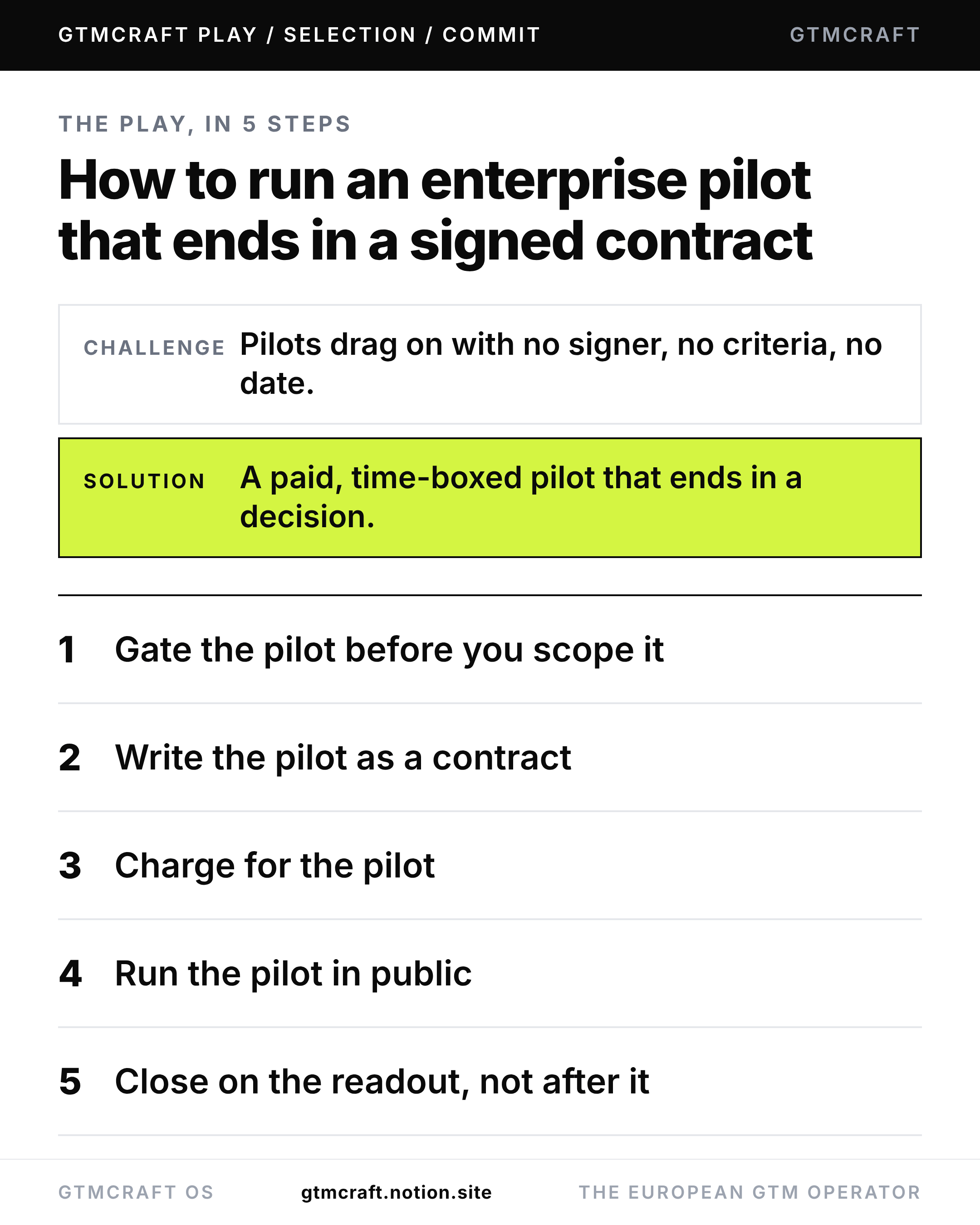
Where this play sits on your bowtie
The pilot is won in Selection and closed in Commit. What feeds it, what runs next to it, and what it grows into. 3 plays, all free:
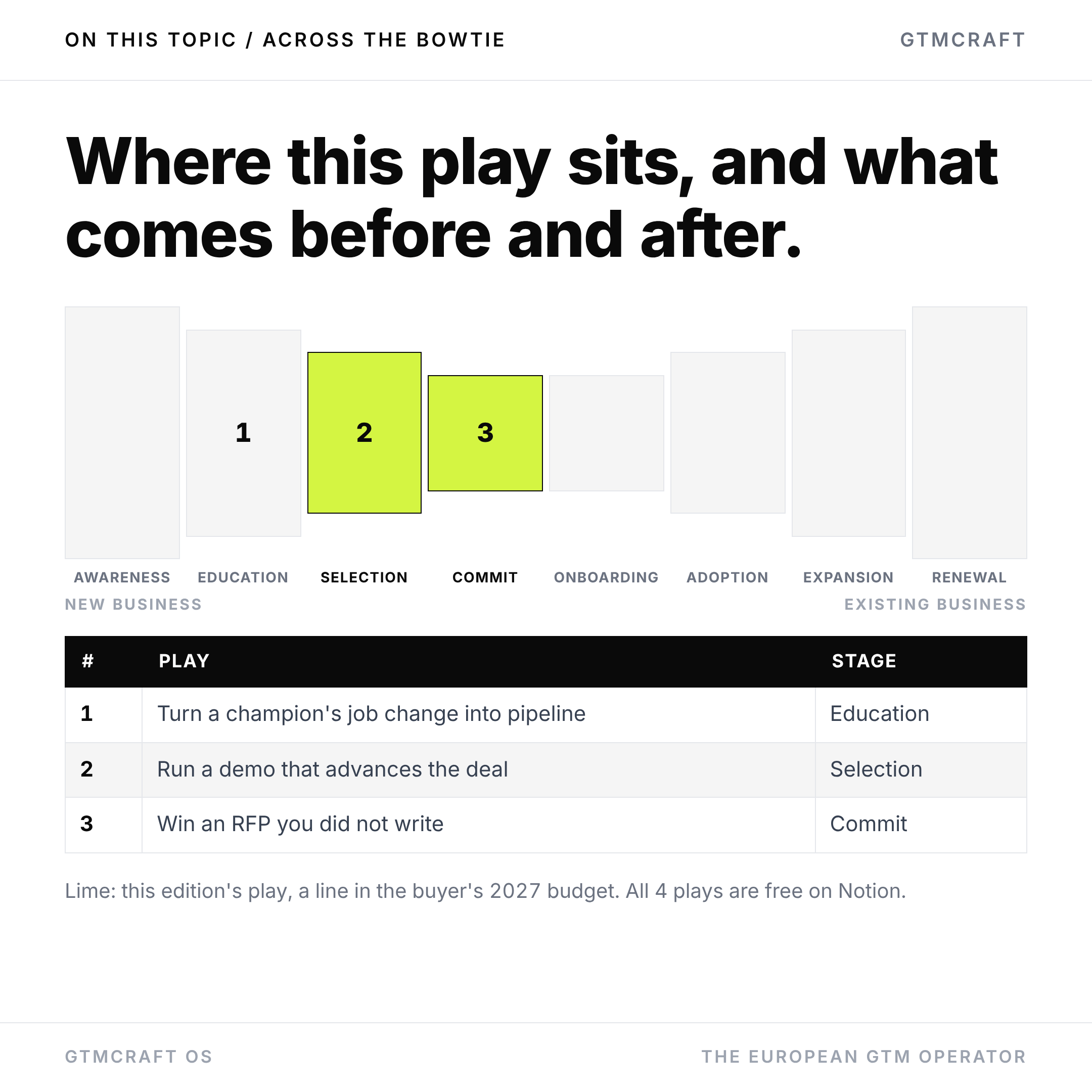
1. Before, Education: How to raise win rate by ranking accounts on signal, not size, in 5 steps. Bigger logo is not a bigger deal: pick the account by signal before you offer the pilot.
2. Alongside, Commit: How to get your enterprise deal through procurement on time and on price, in 5 steps. Step 4 starts procurement in week 1. This play runs it.
3. After, Expansion: How to expand NDR by pricing for value, not seats, in 5 steps. From 1 team to the whole group, priced on the value the results memo proved.
All 250+ GTMcraft plays across New and Existing Business are free:
Save this for the next time a buyer asks for a pilot to start in January.
Send it to 1 founder who is about to agree one.
Key sources
The 5 sources that shaped this play. The full list of 15 lives in the play.
Newsletter. SaaStr (Jason Lemkin), “How can you land big customers if you’re a new startup no one has heard of?” (updated October 2026, first published 2024). Find the exact buyer and make the change feel safe.
Podcast. GTMnow, “How Sierra doubled its ARR in 5 months”, with Reggie Marable (11 November 2026). A paid proof of concept on a few use cases, in production.
Podcast. GTMnow, “Agents now search more than humans”, with Marcus Holm of Exa (27 October 2026). Land and expand works when the executives are in the deal from the start.
LinkedIn. Kyle Asay on proofs of concept (26 October 2026). Tie your difference to the buyer’s success criteria.
LinkedIn. Koen Stam, the Odyssey Plan post (12 August 2026). The 3.5M contract at the scale-up, and the paid first land it started from.
Why this matters now
From today, Wednesday 18 November, to Friday 11 December is 18 working days. Get the 1-page agreement signed by then. A 45-day pilot that kicks off on Monday 11 January reaches its final readout on Thursday 25 February. Book the decision meeting for that week, today, before anyone leaves for the holidays. Send the 5 gate questions on your live pilot request this week.
One question for the room
For the pilot you start in January, can you write down who signs the production contract, and the date they decide?
Go deeper with GTMcraft Operator Brain
Scale on plays and skills, not prompts. This play and 250+ more are free and live in GTMcraft OS on Notion.
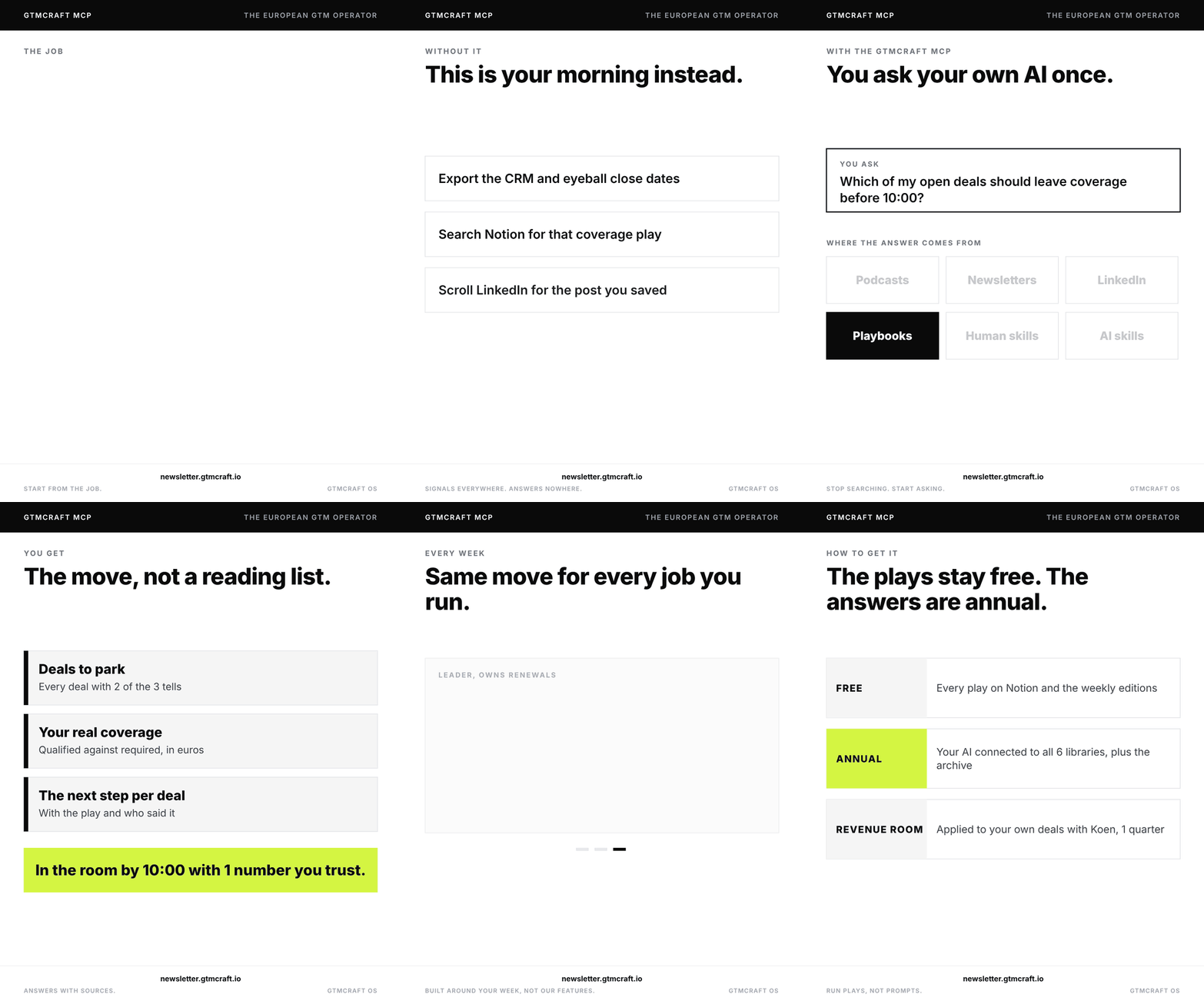
The GTMcraft Operator Brain is the connection, and you can buy it on its own: EUR 297 a year. Every play, every lesson and every source behind them, inside your own AI and next to your own deals. 6 libraries: podcasts, newsletters, LinkedIn posts refreshed daily, playbooks, human skills and AI skills. The aim is simple: 5 to 10 percent better execution on the number you own. Connect it once and ask it which Q4 deals have power, and which need that meeting by 13 November.
The first 50 keys went out this weekend.
Get your GTMcraft Operator Brain key, EUR 297 a year, or reply Operator Brain to this email.
The Revenue Room
8 people, 1 quarter. European B2B SaaS founders and GTM leaders who own the number. I tell you what I would do in your seat, you run it. A hotline with an answer within 48 hours, a case-led call every 2 weeks, and 1 private session with me.
The Q4 room started on 23 October. The Q1 2027 room opens in January. Reply JANUARY to this email to hear first, and bring your 2 coverage numbers to the first call.
Master your human GTM skills AI can’t replace inside GTMcraft,
Koen
Your (human) GTM Coach
—
PS. Co-written by Wispr Flow + my GTMcraft Newsletter Skill + Claude Opus 5.5; edited & approved by Koen
Turning down EUR 200k committed from a bank in New Zealand is the part I'd want more founders to read. Time zone fit almost never makes it into pilot criteria. Most teams would say yes and figure out the support later.