The 90-second version
2 weeks of silence on a late-stage deal is a signal, not a pause. The rule: a touch every 5 working days, and no call ends without a next step.
When a deal looks good, be the most neurotic seller in the room. Ask every late-stage deal where it can still go wrong.
An internal finalist turned his 15 minutes of feedback into a working session. That is the hunger I look for.
The European read: your buyer’s calendar is not yours. Holidays and notice periods differ by country.
The thread: control comes from the next step you set yourself, before anyone asks for it.
Read time: ~8 min

Hi, it is Koen Stam and welcome to GTMcraft OS: The European GTM Operator. This newsletter is built from 100,000+ GTM signals collected from 100+ operators and founders, combined with 13+ years of my own lessons and failures from the trenches. I write at the intersection of go-to-market practice and AI-powered systems for founders and GTM operators scaling their next 2M, 5M or 10M ARR.
7 working weeks, 5 days between touches, 3 questions per deal, 1 feedback slot
From Monday 2 November to Friday 18 December there are 35 working days. Touch a deal every 5 working days and it gets 7 touches before the slowdown. Let it sit 2 weeks between touches and it gets 4.
I wrote it on LinkedIn on Sunday: “October was not the start I wanted. We were not in control, and too many deals slipped.” Last week kept coming back to control: in a sales team I coach, in a hiring round, and from today in my own pipeline.
Lesson 1: 2 weeks of silence is a signal, not a pause
On Friday I ran the weekly sales meeting of a scale-up team I coach. End of October, 7 to 8 weeks left. For any contract that has to be signed this year, new or existing business, 2 weeks of silence is dangerous.
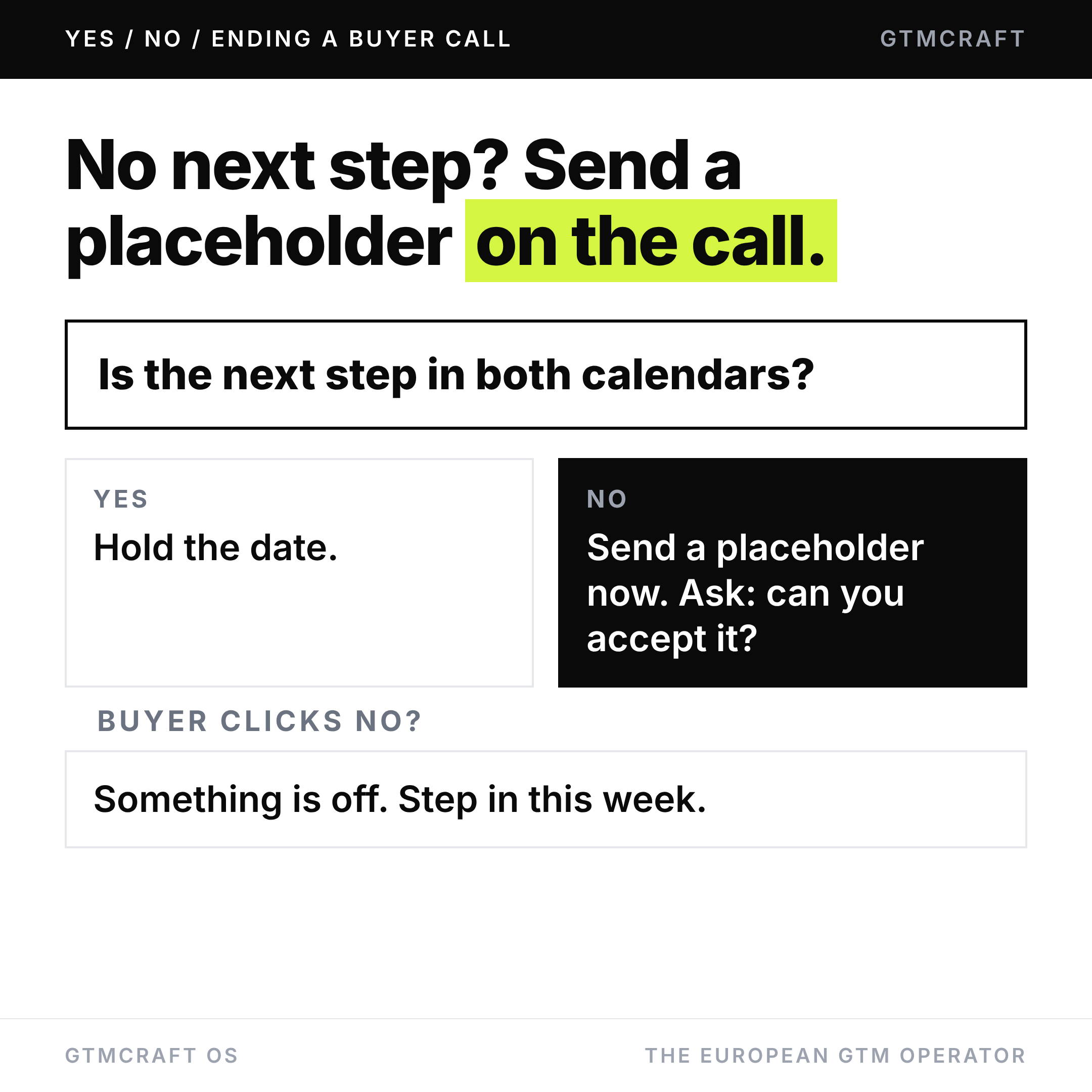
The rule: at most 5 working days between one contact moment and the next. Never leave a call without a next step. Full calendars? Send a placeholder while still on the call. “Can you accept it now?” If the buyer has to click no, something is off, and you get a moment to step in. It does not always work. It keeps you in control.
One buyer’s manager was on holiday. Do not call on her first day back. Plan the touch 1 or 2 working days after, and go async in between: a short video, an email, a profile view. It does not have to be a meeting, just a touch that can get a reaction, so you know the deal is alive. One rep sent a short use-case nudge before a deal went quiet. The person who holds the budget replied that it would certainly be fine.
One deal went closed-lost that week. It hurts. It is also a good signal: now we focus on the deals with momentum.
My take: I care about one word in the last 7 weeks: momentum. Is it in the deal or not? Did we make progress, and can we move it one stage in the CRM? If a deal has had no recorded activity since September and still sits in Q4, I ask one question: is this still realistic? If not, move it out. What is left is the pure pipeline we still work toward the end of the quarter. That goes for all of us, me included.
The European read: 11 November is a public holiday in several European markets, and December holidays differ by country. Check the next touch against the buyer’s calendar.
Do first: next to every deal you expect to close this year, write the date of the last 2-way contact. Older than 5 working days? It gets a touch today. Founder fallback: your 10 biggest deals, 20 minutes, even alone.
Do this week: end every buyer call with a placeholder in both calendars, sent while you are still on the call. Founder fallback: start with your next 3 buyer calls.
Do this month: check every close date parked on a month end or the week before Christmas. Set the realistic date and work back from it. Founder fallback: one pass over your 10 biggest deals.
The rule: no more than 5 working days between 2 touches on a deal you expect to close this year.
You know it worked when: no deal in your Q4 forecast shows more than 5 working days since the last 2-way contact. Founder read: each of your 10 biggest deals has a dated next step in both calendars.
The play: How to cut the dead deals your forecast still counts — in 5 steps. It moves the deals that died in place to a re-engage lane, so they stop padding the number.

Lesson 2: when a deal looks good, be the most neurotic seller in the room
I opened that Friday meeting with an AI review the team reads before it starts. As I wrote on Saturday, I built it with their founder-CEO from their CRM. One link is a deal review: past close dates, missing next steps, questions per person. The other covers late stages.
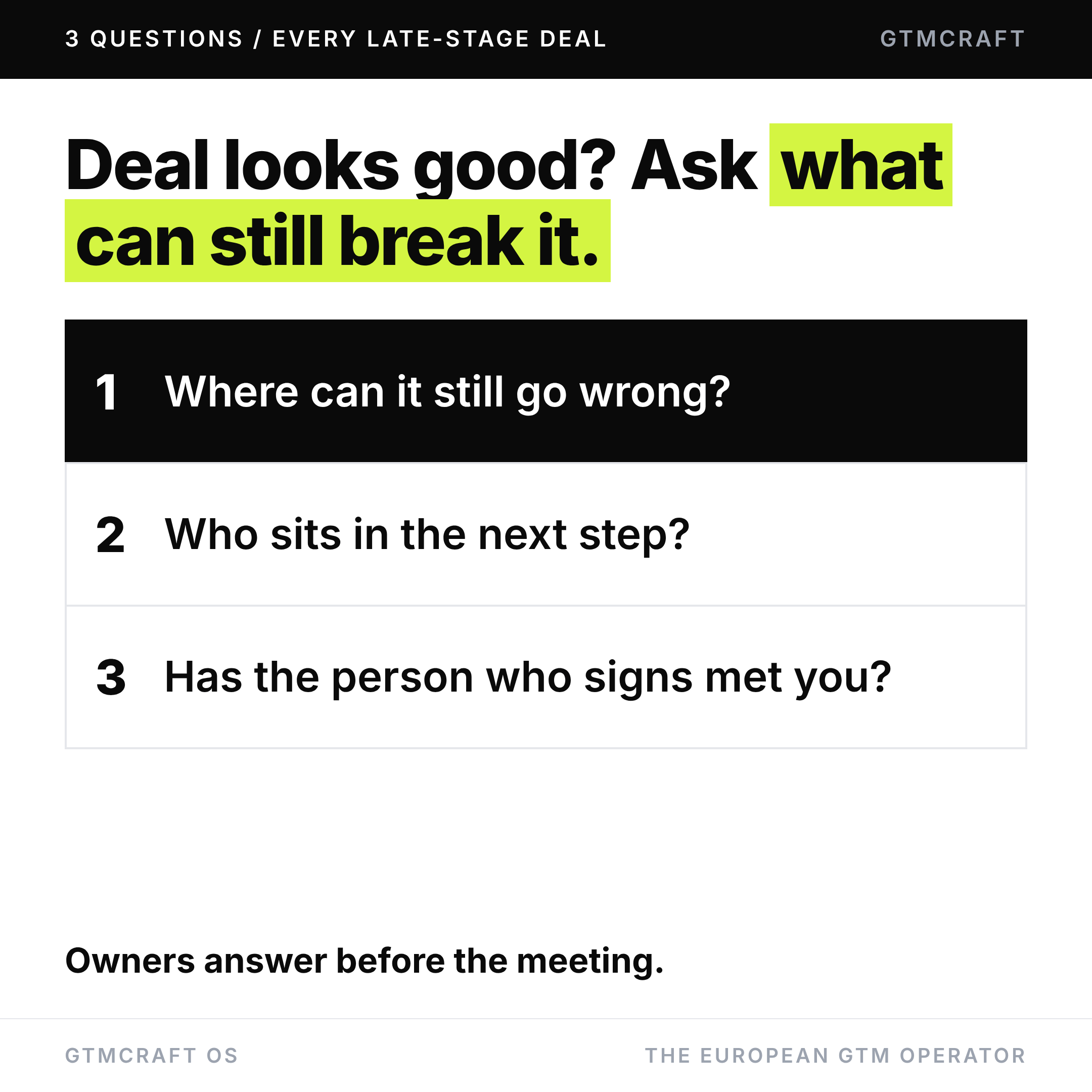
During the meeting I sharpened that second one: for every deal in negotiation and closing, 3 questions about where it can still go wrong. At the end of the funnel, when it looks very good, you want to be the most neurotic seller. If we think about what can go wrong and tackle it, we minimise every risk. Some you can ignore. Each is a push: how tight is this deal really?
Then a harder test on myself. On Sunday I wrote: “I have been too easy in the review of my own pipeline. More than once.” Matt Green gave me the filter on 18 October: coverage with power. A second forecast number that only counts deals where a director or above sat in a meeting with you. Not on cc. Every deal without it gets 2 weeks: that meeting by 15 November, or it leaves the Q4 forecast.
My take: my rule since August is that if I cannot name the next step and its date, it is not pipeline. The late-stage questions and Matt’s filter add who sits in that next step, and what can still break it. Most of them are homework: each owner goes through them early in the week, fixes what was forgotten, and brings only what is still open to the room. The review flags. The owner answers.
The European read: in owner-led European companies the managing director or the owner signs. Swap director for the person who signs.
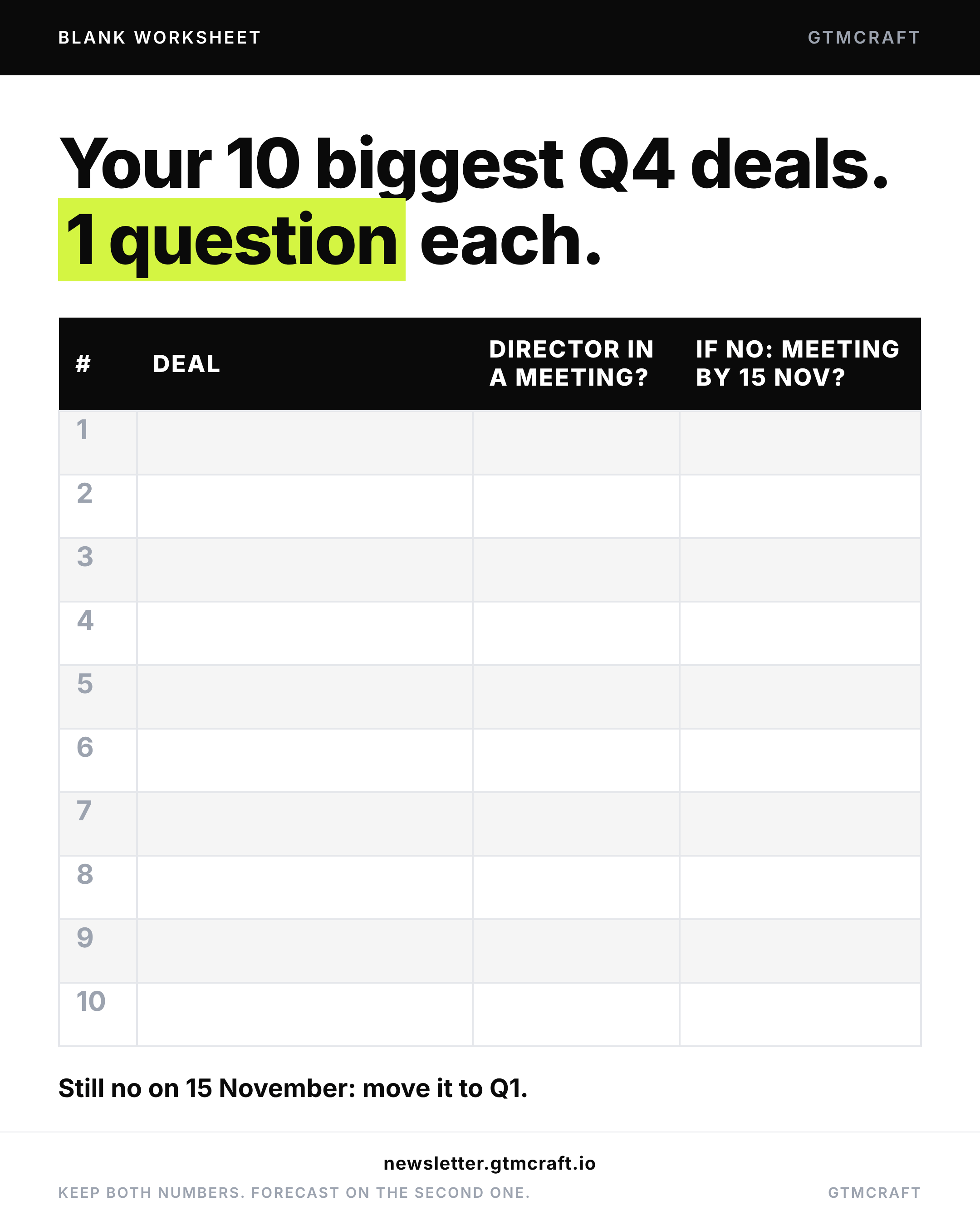
Do first: list your 10 biggest Q4 deals and mark each one where a director, or the person who signs, sat in a meeting with you. Add up those euros. That is your coverage with power.
Do this week: before your next sales meeting, have your AI read every deal in negotiation or closing and ask 3 questions per deal, starting with where it can still go wrong. Each owner answers in writing before the meeting. Founder fallback: no sales meeting? Paste your CRM export into your AI on Friday and answer them yourself.
Do this month: every deal still without that meeting on Friday 13 November moves to Q1. Forecast on the second number. Founder fallback: both numbers in one line of your investor update.
The rule: a late-stage deal with no meeting with the person who signs, or no answer to where it can still go wrong, stays out of the forecast.
You know it worked when: your forecast carries 2 numbers, total coverage and coverage with power, and every late-stage deal has its 3 answers written. Founder read: you know which of your 10 biggest deals has met the person who signs.
The play: How to run a weekly sales meeting that decides, not reports — in 5 steps. An AI pre-read goes out first, so the room reviews 4 to 6 key deals and decides. Want your own AI to run it on your CRM every Friday? That is the job of the GTMcraft MCP, below.

Lesson 3: the finalist who used his feedback slot as a working session
Last week I sat in a finalist round for a front-line sales leader seat. One finalist was internal. On the day, he asked me directly: “Cool, we have 15 minutes. I want to go over feedback.”
He turned them into a deep Q&A on the challenge ahead, with pen and paper.
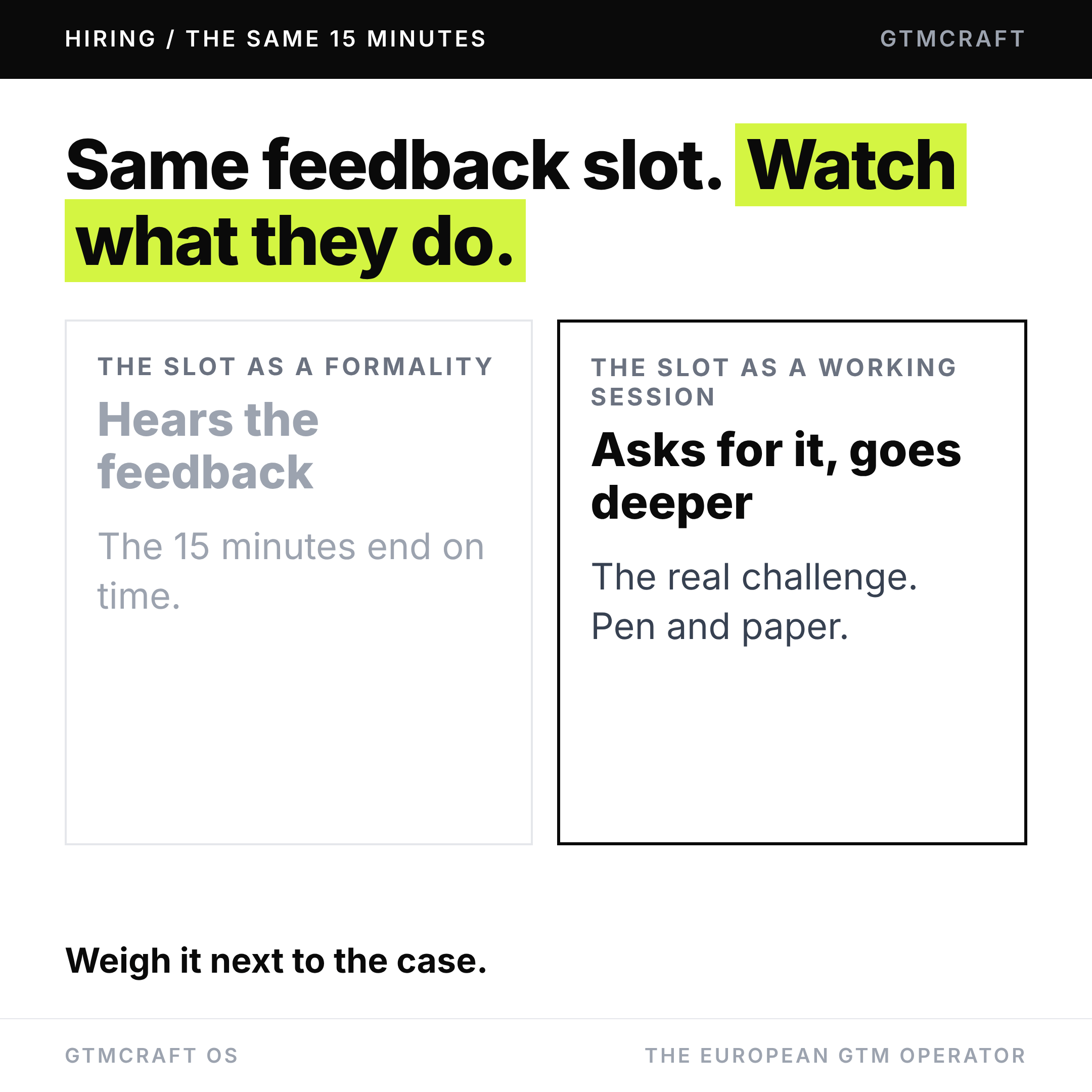
He showed depth on the numbers: how to own a specific number to reach the end-of-year revenue goal. That is rare for an AE. He was decisive on people: he knew he would need replacing, and came with his answer to that risk. And he was clear on how he would lead: one-to-one coaching, sitting next to the team.
My take: internal candidates have more data points and more people to learn from, and usually they do not use them fully. He did. I have been practising, teaching and preaching that an internal candidate should always be favoured, so I have to practise what I preach. There is always a risk, and I look at how fast a person would ramp. But the question I care about most is simple: is this person really willing to get the job, and will they go the extra mile? Pen and paper tell me he is coachable, willing, eager and curious. The same thing I asked of the sales team on Friday: set the next step yourself.
The European read: an external hire in many European markets works a 1 to 3 month notice period. An internal move starts when the decision lands. Open the backfill search the same week.
Do first: list every leadership seat you are filling. Next to each internal name, write one thing that person did unprompted in the last 90 days. A blank is information. Founder fallback: name the 2 people you would back and one thing each did unprompted.
Do this week: give every finalist, internal or external, the same 15 minutes of feedback after the case, and write down what each one does with it. Founder fallback: you are the panel, so keep the notes in your phone.
Do this month: put a day-60 review in the diary for any promotion, with the checks written down. Founder fallback: one page and one date, shared with the person.
The rule: give every finalist the same 15 minutes of feedback, and weigh what they do with it next to the case.
You know it worked when: every finalist had the same 15 minutes and you can say what each one did with them. Founder read: your next hire has a day-60 date in both calendars.
The play: How to know by day 60 whether your leadership hire is working — in 5 steps. It writes the checks before the offer, so the standard protects the person you promote.

Save this. 3 lessons from my week, each with a play you can run today.
Send it to 1 founder who still runs the Q4 forecast from memory.
Why this matters now
15 November falls on a Sunday, so your coverage-with-power deadline is Friday 13 November, 2 working weeks from today. Run the worksheet this morning.
3 questions for the room
Which deal in your Q4 forecast has gone more than 5 working days without a 2-way touch?
Which of your late-stage deals cannot answer where it can still go wrong?
What did your last finalist do with the 15 minutes after the case?
Go deeper with GTMcraft MCP
Scale on plays and skills, not prompts. This play and 250+ more are free and live in GTMcraft OS on Notion.
The GTMcraft MCP is the connection, and you can buy it on its own: EUR 297 a year. Every play, every lesson and every source behind them, inside your own AI and next to your own deals. 6 libraries: podcasts, newsletters, LinkedIn posts refreshed daily, playbooks, human skills and AI skills. The aim is simple: 5 to 10 percent better execution on the number you own. Connect it once and ask it which Q4 deals have power, and which need that meeting by 13 November.
The first 50 keys went out this weekend. Get your GTMcraft MCP key, EUR 297 a year, or reply MCP to this email.

The Revenue Room
8 people, 1 quarter. European B2B SaaS founders and GTM leaders who own the number. I tell you what I would do in your seat, you run it. A hotline with an answer within 48 hours, a case-led call every 2 weeks, and 1 private session with me.
The Q4 room started on 23 October. The Q1 2027 room opens in January. Reply JANUARY to this email to hear first, and bring your 2 coverage numbers to the first call.
Master your human GTM skills AI can’t replace inside GTMcraft,
Koen
Your (human) GTM Coach
—
PS. Co-written by Wispr + 3 GTMcraft Skills + Claude Opus 5.5; edited & approved by Koen