
👋 Hi, it is Koen Stam and welcome to GTM OS: The Future GTM Operator, my weekly newsletter for founders and revenue leaders scaling B2B SaaS from 0 to 10M+ ARR.
Every edition is built from 100,000+ GTM signals collected from operators and founders, combined with 10+ years of my own lessons and failures from the trenches.
Read the Monday and Wednesday editions ↓
Part I: The AI-SDR playbook

👋 Hi, it is Koen Stam and welcome to GTM OS: The Future GTM Operator, my weekly newsletter for founders and revenue leaders scaling B2B SaaS from 0 to 10M+ ARR.
Part II: The AI-SDR system: define, select, measure, segment

👋 Hi, it is Koen Stam and welcome to GTM OS: The Future GTM Operator, my weekly newsletter for founders and revenue leaders scaling B2B SaaS from 0 to 10M+ ARR.
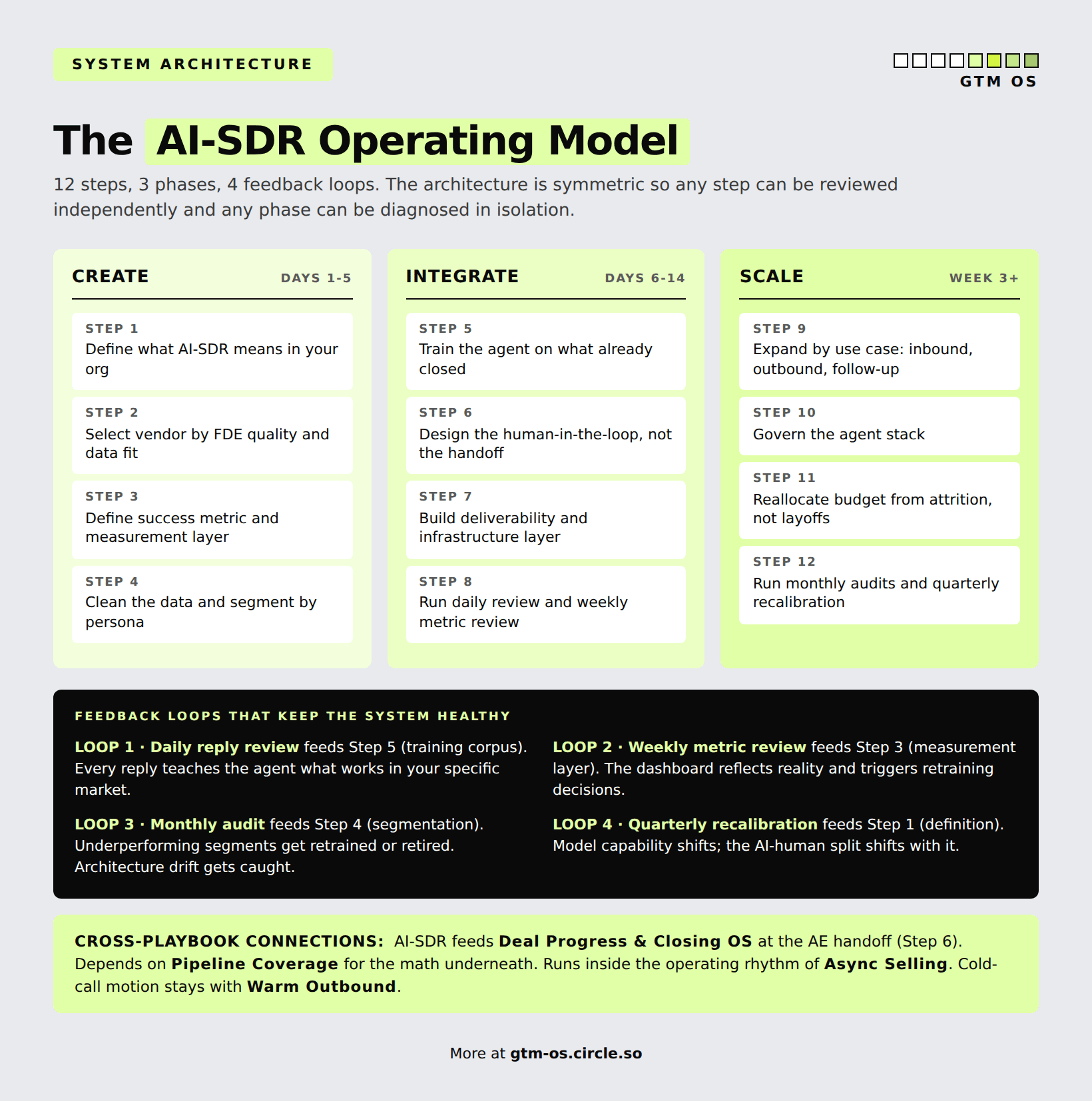
You have the foundation. The definition is signed, the vendor is selected, the dashboard is live, the data is clean. Today you turn on the agent, book the first meetings, and learn what the daily review teaches you about your own pipeline. Steps 5 through 12 are the execution and the governance. This is where the 10% separate from the 90%.
Monday framed the challenge. Wednesday covered the four foundation steps. If you completed Phase 1 this week, you are ready for what follows: the INTEGRATE and SCALE phases, the 12-question self-assessment, and the AI-SDR governance pack with docx templates for the operating cadences that keep the agent stack healthy at scale.
Diagnostic before you proceed
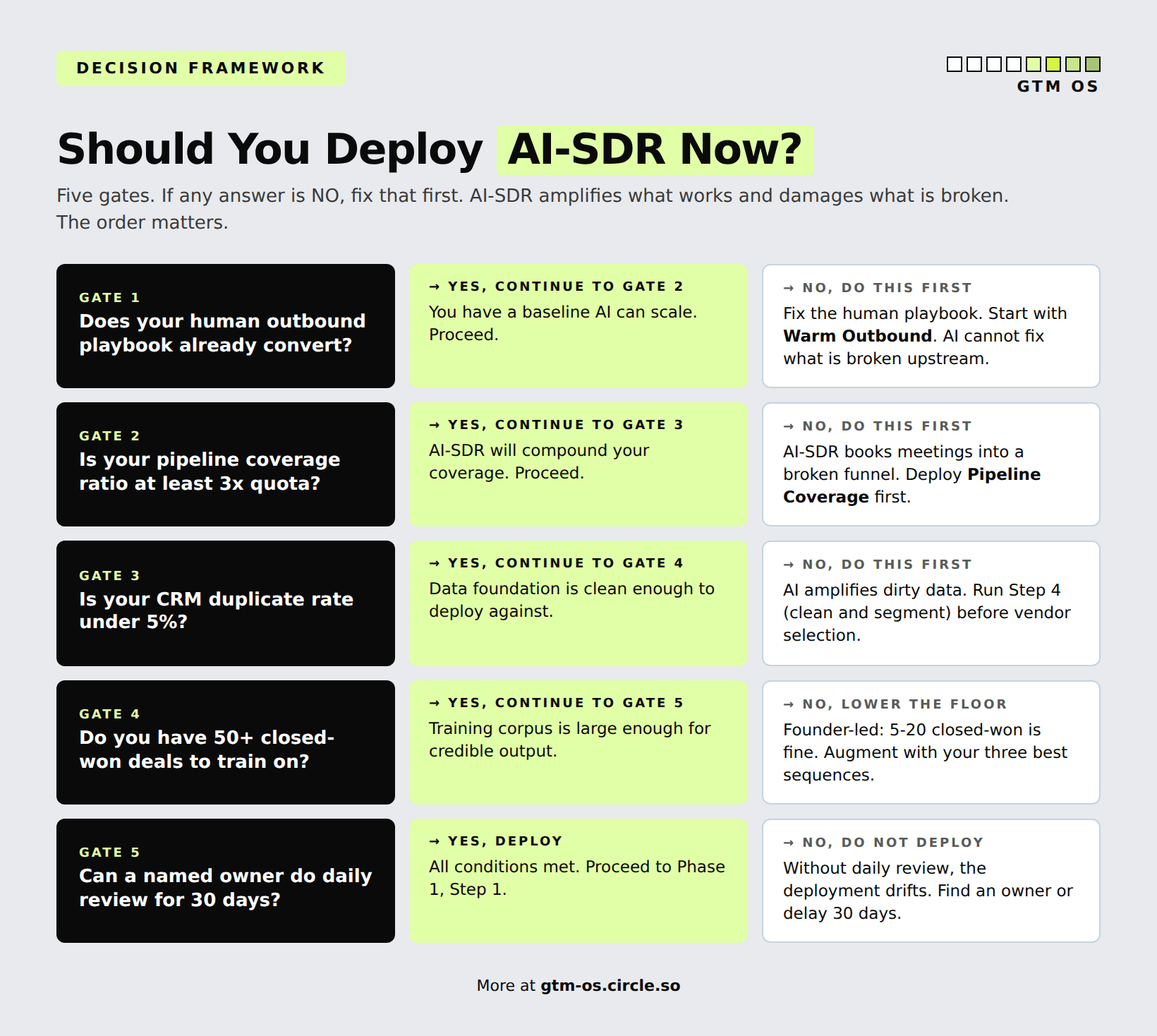
Before you read Phase 2, run the eight diagnostic questions below. If you answer no to any of them, the answer is not “skip ahead to fix it.” The answer is “go back to the Wednesday edition and complete that step before deploying.”
Do you have a one-page signed definition of what AI-SDR means in your org, with explicit AI-handled and human-handled workstreams? If no, start at Step 1.
Have you cut your vendor shortlist to two and called the FDE for each one before signing? If no, start at Step 2.
Is your primary success metric defined in one sentence with a documented human baseline from the last two quarters? If no, start at Step 3.
Is your CRM duplicate rate under 5% with automated deduplication running? If no, start at Step 4.
Are your persona-geo segments documented with title patterns, company criteria, and pain points? If no, start at Step 4.
Do you have 50 to 100 closed-won email threads accessible for the training corpus? If no, your Step 5 will produce generic output.
Have you protected your primary corporate domain by configuring 2 to 3 secondary sending domains? If no, your Step 7 will damage deliverability.
Is there a named owner with a calendar block for daily review of agent replies in the first 30 days? If no, your Step 8 will not happen.
Phase 1 gate
Do not proceed to Phase 2 unless all four Phase 1 steps are complete and the diagnostic above returned eight yeses. The single most common cause of AI-SDR failure is proceeding to deployment before the foundation is set. If any answer above is no, return to the Wednesday edition and complete that step before reading further.
Phase 2: INTEGRATE
Phase 2 is where the agent goes live. The first meetings get booked, the first replies come in, and the first mistakes surface. Operators who treated Phase 1 as busywork find out here that it was not. The agent is only as good as the data, the segmentation, and the definition underneath it. Your job in Phase 2 is not to build the agent; the vendor does that. Your job is to train it against what has already closed, design the human-in-the-loop rigorously, protect deliverability, and read every reply for the first 30 days.
Step 5. Train the agent on what already closed deals
The agent is not creating new messaging from scratch. It is replicating the messaging that already converts in your business. If you train it on generic best-practice copy, it produces generic output. If you train it on your actual closed-won conversations, it produces output that sounds like your best SDR on their best day.
Your closed-won email threads, demo recordings, and call transcripts contain the exact language your buyers respond to. This is training gold, and most orgs have it sitting unused in Gong, Chorus, or email archives that nobody has indexed. Local product-market fit determines training scope: your Netherlands training set is different from your Spain training set because the conversations that closed deals in each market used different language.
How to execute ↓
Pull your last 50 to 100 closed-won deals. Extract the full email threads, call recordings, and demo conversations that moved them from first touch to signed.
Segment the corpus by persona-geo using the segmentation matrix from Step 4. Each sub-agent gets its own corpus.
Identify the three to five highest-performing email sequences and meeting booking flows per segment. These become the agent’s primary template library. The agent does not invent. It remixes these templates against each prospect’s context.
Run a training review session with the top performers from each market. Dutch SDRs review Dutch training data, Spanish SDRs review Spanish training data. They will spot phrasing the agent got wrong or nuances a model cannot infer.
Set the quarterly retraining cadence. Every 90 days, refresh the corpus with the most recent closed-won deals. The first retraining is scheduled for Day 90, not “someday.”
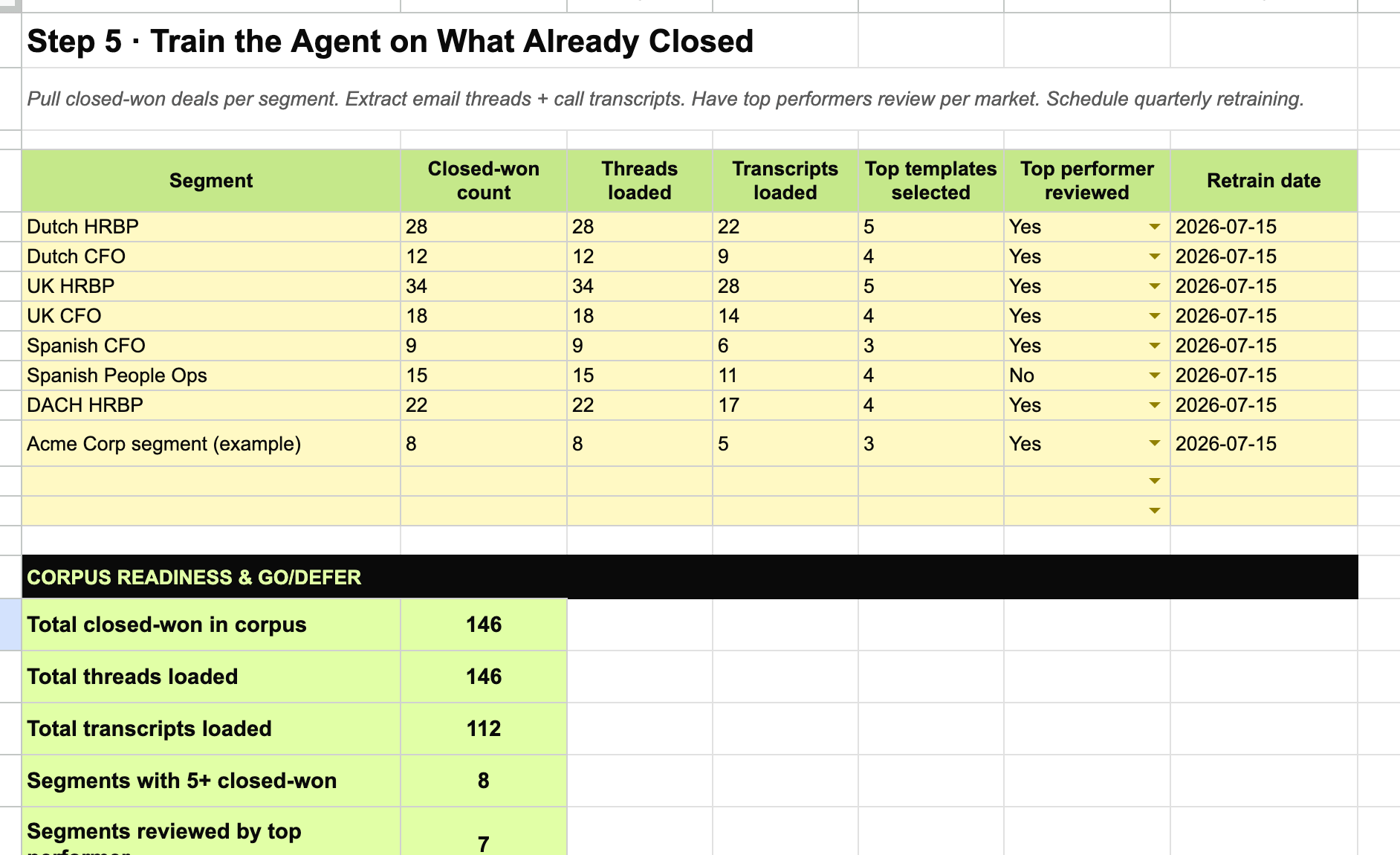
Founder-led note: your closed-won corpus may be small (5 to 20 deals). That is fine. Train the agent on what you have, plus your three best outbound sequences you wrote yourself. Retrain monthly because the corpus grows fast.
Step 6. Design the human-in-the-loop, not the handoff
The category shift in 2026 is that humans approve and agents execute. The human sits inside the loop, reviewing agent output before it goes to the prospect, not after the prospect has replied. The handoff from agent to human AE is the highest-value moment in the entire workflow. A bad handoff destroys trust in the first AE meeting, and the prospect attributes the bad experience to your brand, not to the agent.
How to execute ↓
Design the approval gates for outbound explicitly. Initial outreach template-approved (agent sends without per-message review), reply-to-reply responses reviewed by a human for the first 30 days, meeting-booking confirmations reviewed always. Loosen the gates as trust builds.
Design the inbound handoff flow for your chat agent. What triggers escalation from agent to human, what context the agent passes to the human, and what the prospect sees during the handoff. The prospect should never feel the handoff as a bump.
Define the AE handoff trigger precisely. Default rule: agent stops when a qualified meeting is booked on the AE calendar with a completed qualification form. The AE opens the meeting with full context the agent collected.
Write the handoff briefing template the agent fills out for every AE meeting. Minimum fields: prospect context, stated problem, budget indicator, timeline, objections raised. The AE reads this in the two minutes before the meeting, not during.
Build the escalation path for edge cases. When the agent cannot answer a question, when the prospect asks for something non-standard, or when sentiment drops, the agent pauses and routes to a human. Name the human who catches these escalations during business hours.
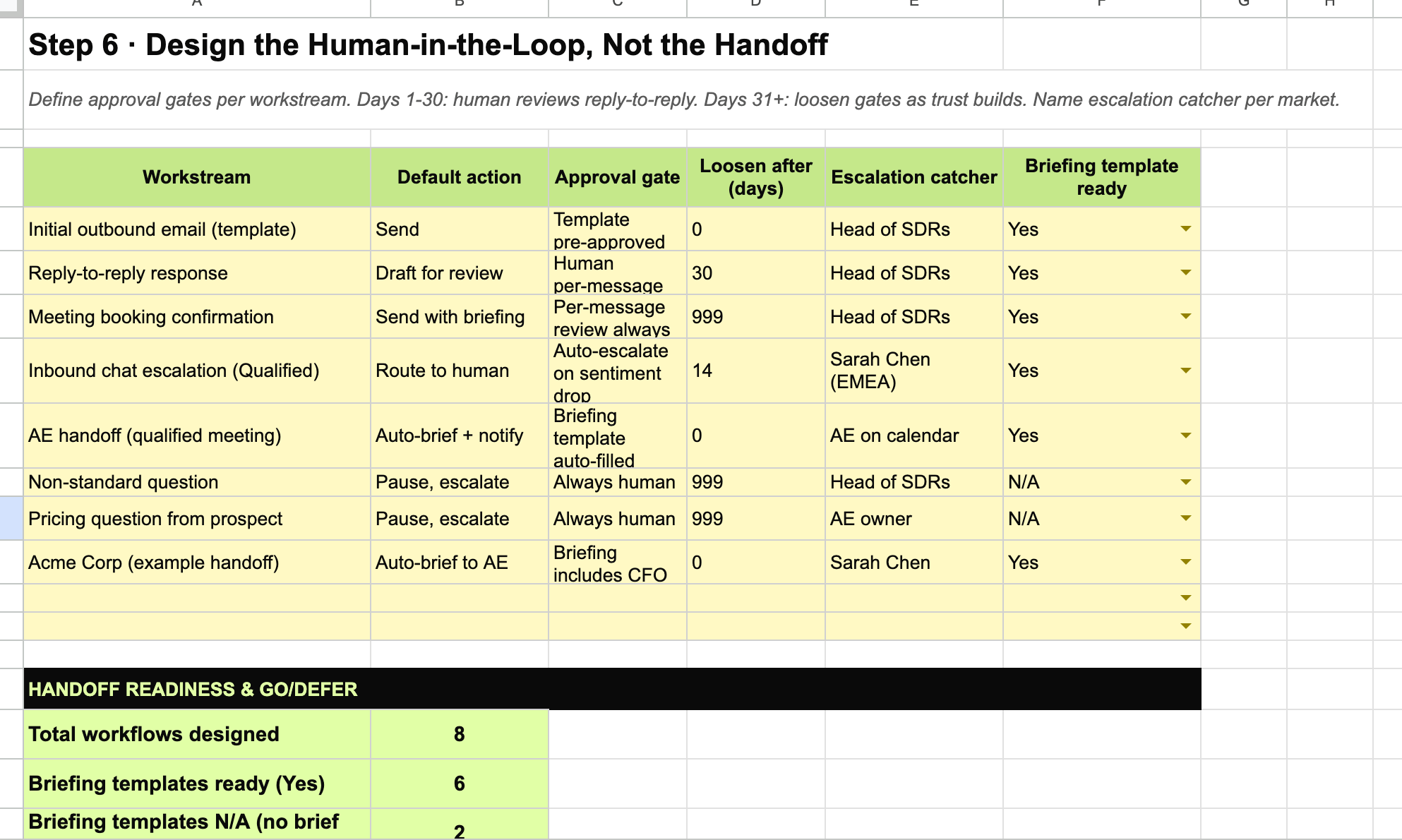
Founder-led note: you are the human in the loop. Review every outbound message for the first 30 days. It is painful and it is necessary. Loosen the review as the agent proves itself.
Step 7. Build the deliverability and infrastructure layer
AI-SDR volume destroys email deliverability if the infrastructure is wrong. Sending 3,000 emails a month from a single domain without warm-up triggers spam filters, and your entire domain reputation suffers, including your customer support and billing emails. Jaspar Carmichael-Jack at Artisan and the deliverability community are aligned on one rule: 2 to 3 weeks of warm-up before production volume is non-negotiable. Operators who skip it lose six months recovering.
How to execute ↓
Buy and configure 2 to 3 secondary sending domains that are brand-adjacent. Never send AI-SDR volume from your primary corporate domain. The corporate domain is reserved for billing, support, and AE-to-customer communication. We separated these from day one at Personio for this reason.
Warm up each secondary domain for 2 to 3 weeks before production volume. Use the vendor’s built-in warm-up tool or a specialist (Warmup Inbox, Lemwarm). Production volume starts at around 20 emails per day per mailbox and ramps to 50 to 80 per day over 14 days.
Configure SPF, DKIM, and DMARC correctly for every sending domain. Verify with MXToolbox. Misconfigured authentication is the single most common cause of deliverability collapse and it is entirely preventable.
Set up inbox placement monitoring (GlockApps, Mailreach, or vendor-native) and review weekly. If inbox placement drops below 85%, pause sending from that mailbox and investigate before it compounds.
Build the bounce-and-complaint suppression list and wire it into the agent’s sending logic. Suppressions are permanent and shared across all agents to prevent cross-contamination.
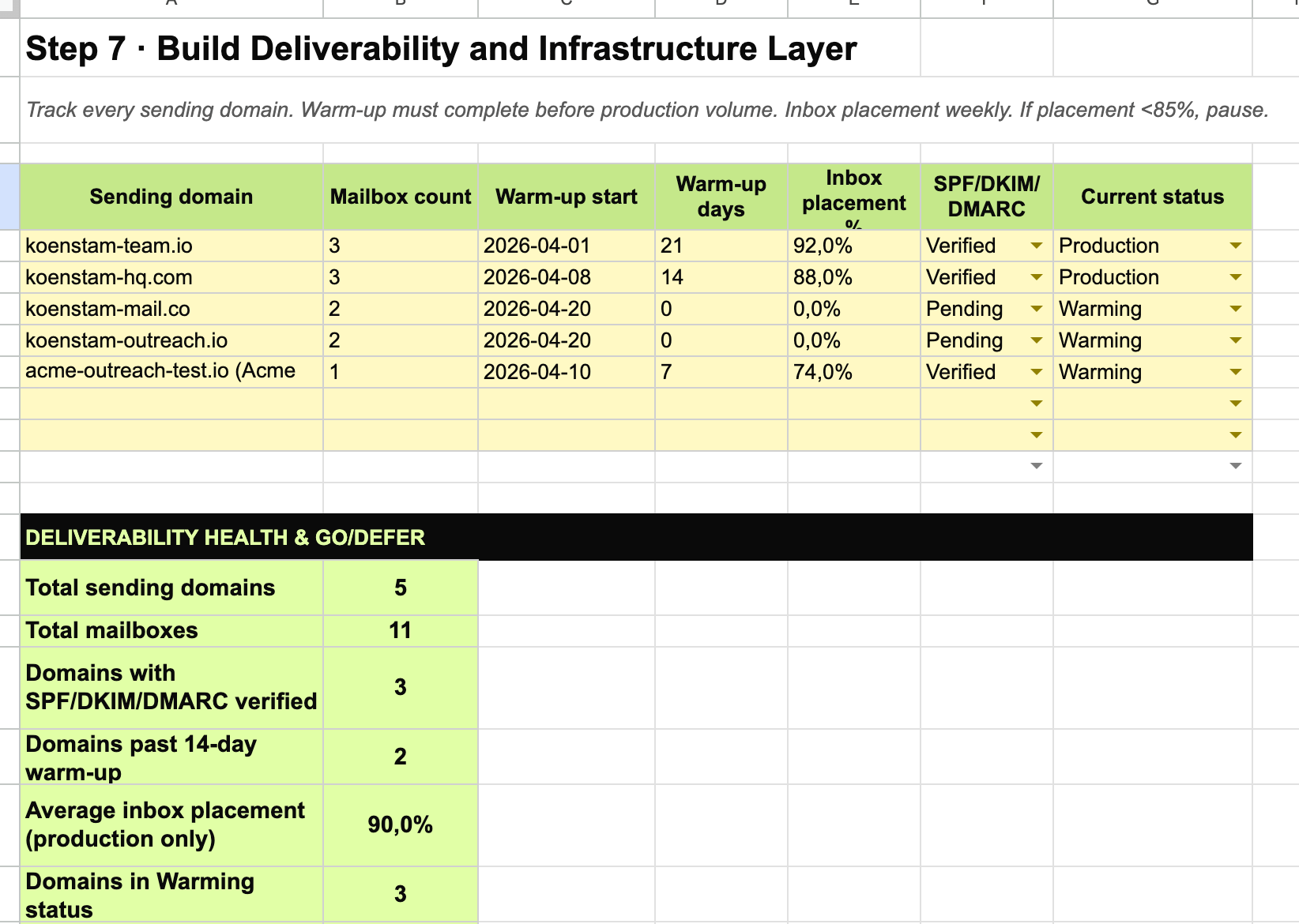
Founder-led note: 1 to 2 secondary domains, 2-week warm-up, monitoring via vendor-native tools. You run the weekly inbox placement review personally.
Step 8. Run the daily review loop and weekly metric review
AI-SDR performance ebbs directly with human attention. Agents that are reviewed daily in the first 30 days outperform agents that are reviewed weekly by a wide margin. Lerutte’s data from SaaStr puts the management baseline at 15 to 20 hours per week for 5 sub-agents in a serious deployment. The first 30 days are the highest-learning-rate window of the entire deployment. Miss it and you lose 90% of the tuning insight that would have compounded for the rest of the year.
How to execute ↓
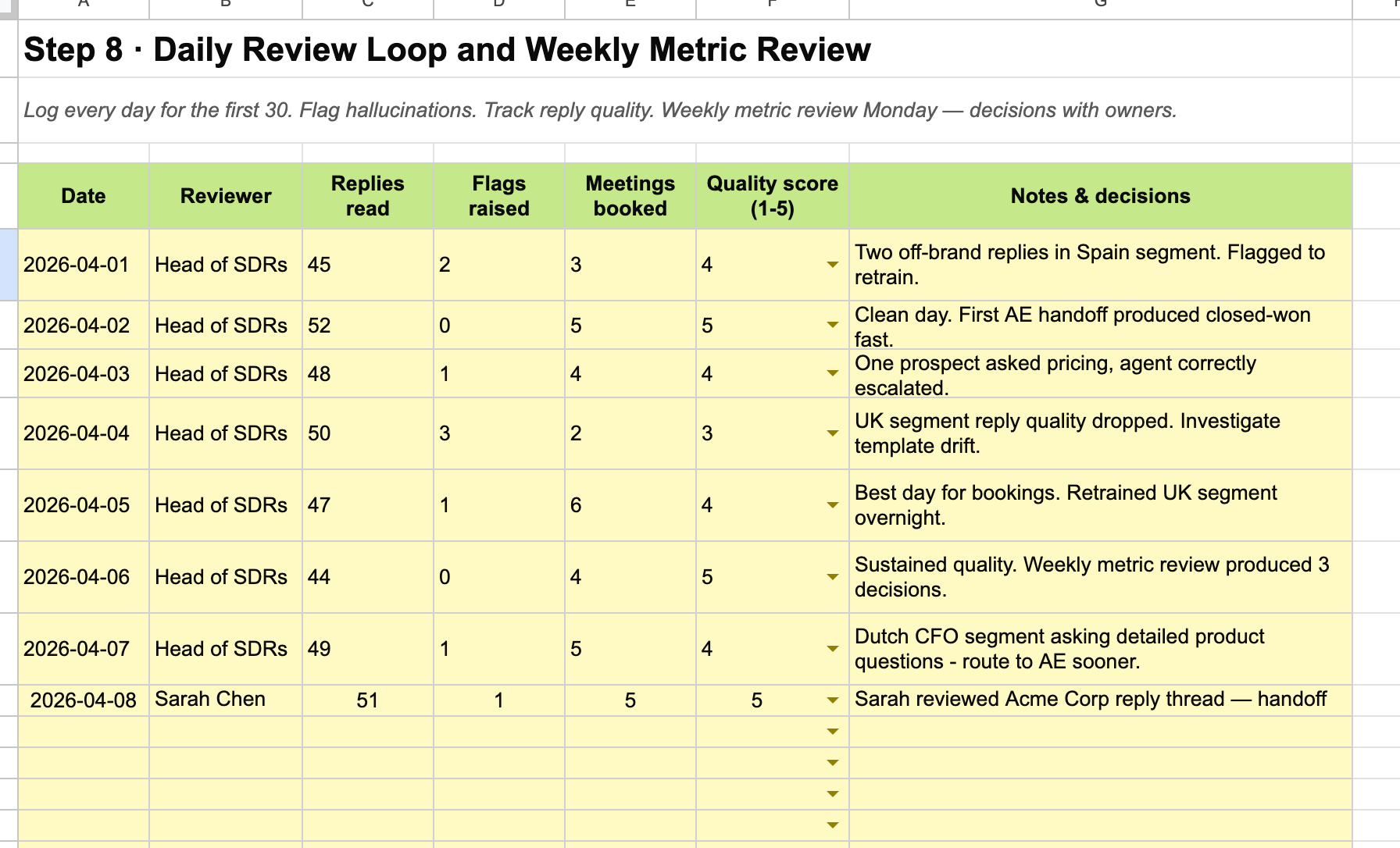
Set the daily review block on the calendar before the agent deploys. 30 to 60 minutes per day, same time every day, owned by one named person. Not “someone will check it.”
Build the daily review checklist. Read all replies from the last 24 hours, flag hallucinations or off-brand messaging, check escalation queue items, verify meeting booking quality. Log findings in a running doc.
Set the weekly metric review meeting with the CRO, head of SDRs, and RevOps. 30 minutes, every Monday. Agenda: primary metric trend, secondary metric trends, deliverability red flags, retraining decisions, owners.
Write the decision rules for retrain, pause, or expand. Retrain if reply rate drops 20% week over week in a segment. Pause the agent if inbox placement drops below 85% or if escalation rate exceeds 5%. Expand to a new segment only when the current segment has hit its 90-day success metric.
Document every retraining decision and its outcome. This becomes the org’s AI-SDR operating knowledge.
Phase 2 gate
Do not proceed to Phase 3 unless your first agent has hit its 90-day success metric. Expansion before the baseline works produces compounding complexity on a broken foundation. If the 90-day metric is not hit, diagnose in Phase 2 (retrain, reconfigure, or pause) before adding more agents.
Phase 3: SCALE
Phase 3 is where AI-SDR stops being a project and becomes an operating system. You are no longer deploying one agent. You are running a stack across use cases, markets, and lifecycle stages. The risks shift from “will it work” to “will it stay healthy at scale.”
