


The 90-second version
A founder team I coach adds 30 new accounts to outbound every week. 3 to 6 contacts each, about 150 connection requests a week. The leads do not come.
The worked example: 150 requests a week is 30 a day, before a single follow-up. Above 30 a day, says Matt Green, something has to shrink.
One play, 5 steps: cut to 15 to 30 named accounts, map 6 people in each, research once, founders connect next to the seller, judge it in months.
The European read: the founders’ name opens doors at home. In the next country, your customers’ networks are the warm path.
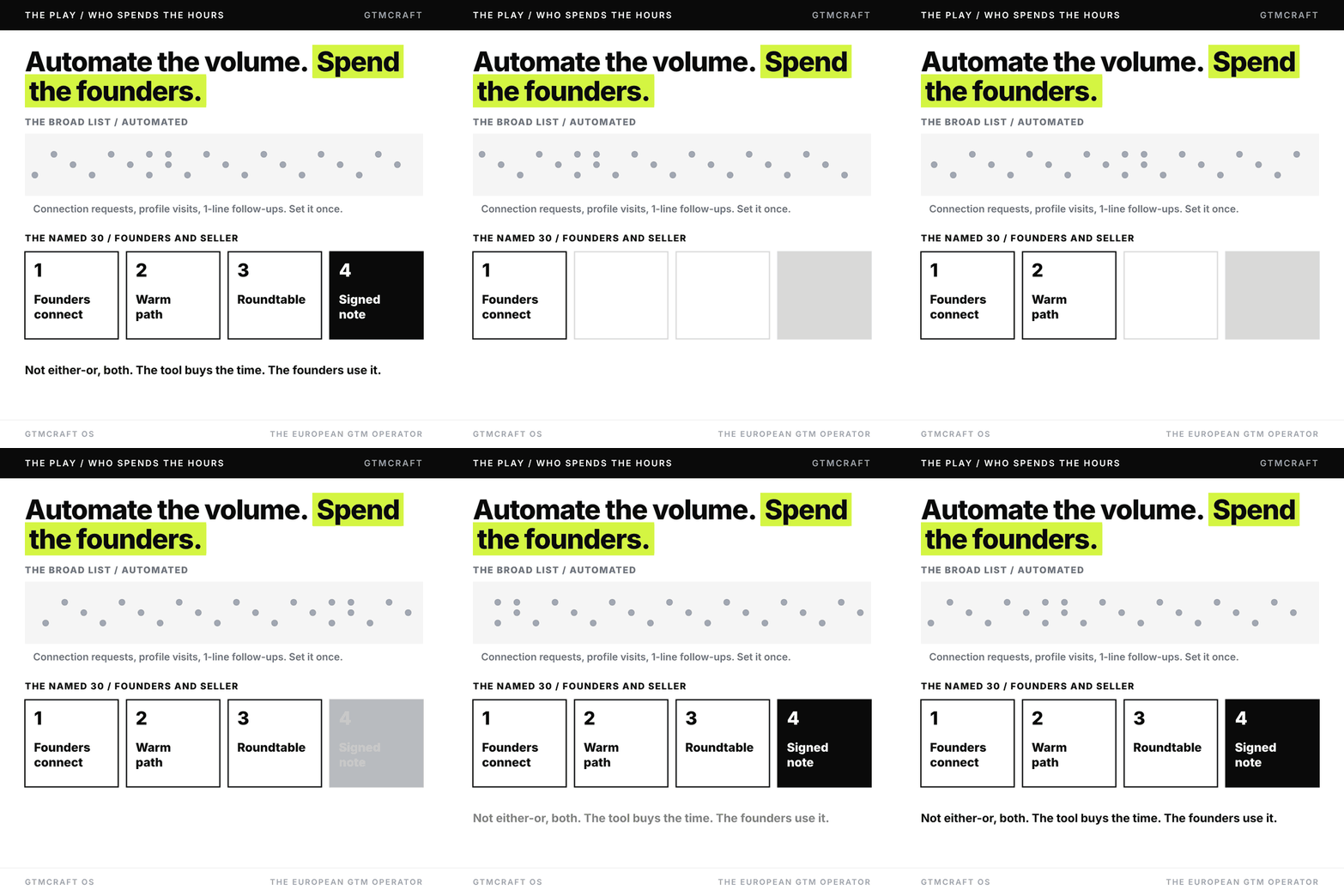
Volume stays, automated. The founders’ hours go to the accounts you would be proud to win.
Read time: ~9 min

The problem: your outbound treats every account the same
From my week: last Friday I ran the second session of the Revenue Room. Instead of me talking the whole time, 2 founder teams each brought one challenge. One team, 2 founders and their first sales hire, adds 30 new accounts to outbound every week. 3 to 6 contacts per account, about 150 connection requests a week, mostly by hand. The leads stay far below target.
They are not lazy. In their own words, they used to shoot wide and hope. They want to go much more targeted. Today every account still gets the same 5 requests, from the same person, in the same week. The account you would be proud to win gets exactly what the account you would never close gets.
And the founders, the 2 people with the strongest name in their market, sit outside it.
Why it happens
Matt Green gave the arithmetic (LinkedIn, 25 October): “accounts per rep X contacts per account X touches a month, divided by working days. More than 30 a day means something has to shrink.” His spoiler: “it almost always should be the list.”
The worked example: 30 new accounts times 5 contacts is 150 requests a week. Over 5 working days that is 30 a day, before one follow-up. From week 2 the new accounts stack on top of last week’s. The program instead: 30 accounts, 6 people each, 2 touches a month is 360 touches, about 18 a day. Across 3 people, 6 a day each.
The second cost is coverage. Andrei Zinkevich, sharing Factors.ai data (LinkedIn, 22 October): most teams reach only 1 or 2 decision-makers, "trying to compete for attention with 100 other vendors." In that data, win rates were 17 percent higher when the buying committee of 6 or more was reached before the deal existed. Vendor data, so a correlation.
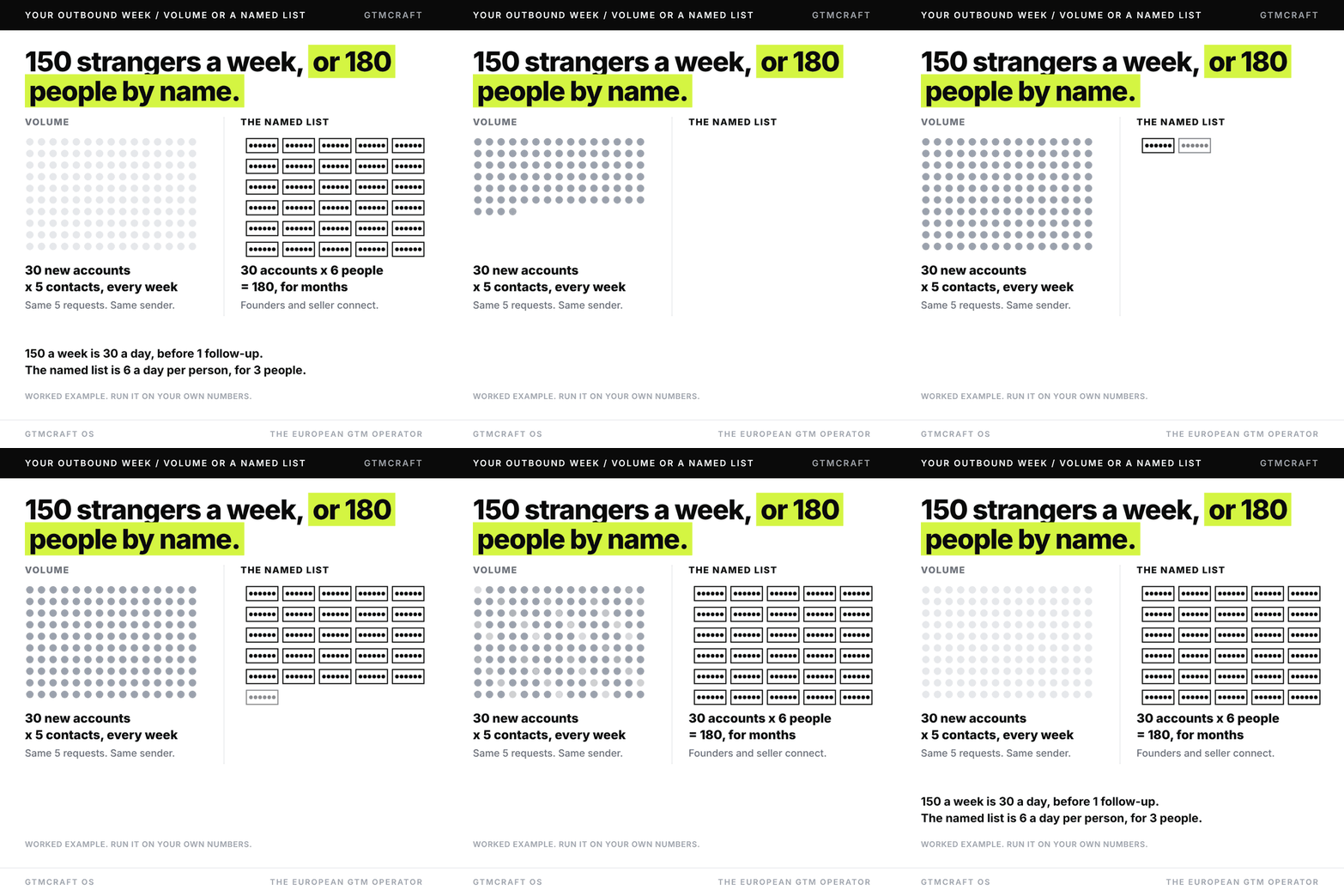
My take: we think so digitally and so much in volume. The question I asked the room was simple: how many accounts do you actually need to convert to hit your commercial goals? Then pick them. Maybe 15 or 20 companies where you say: based on our ICP and our current customers, these are the customers we really want, we would be proud of them. There you invest a bit more, because you know the return is higher. That is where you go high-touch.
And the founders do it too. I say it to my own team as well: always give me the list of accounts you are working. If I also send a connection request, sometimes you do not even need a message. To the 2 founders, with a good name in their market, I said: I would have no reason not to accept.
The connection layer itself I would automate regardless. The tools are all a bit the same, vanilla ice cream. I work with Expandi myself, a GTMcraft partner. It is about execution: the time the tool saves goes to the accounts that matter. High-touch costs more, in money and in hours. That is exactly why the selection has to be sharp.
Hi, it is Koen Stam and welcome to GTMcraft OS: The European GTM Operator. This newsletter is built from 100,000+ GTM signals collected from 100+ operators and founders, combined with 13+ years of my own lessons and failures from the trenches. I write at the intersection of go-to-market practice and AI-powered systems for founders and GTM operators scaling their next 2M, 5M or 10M ARR.
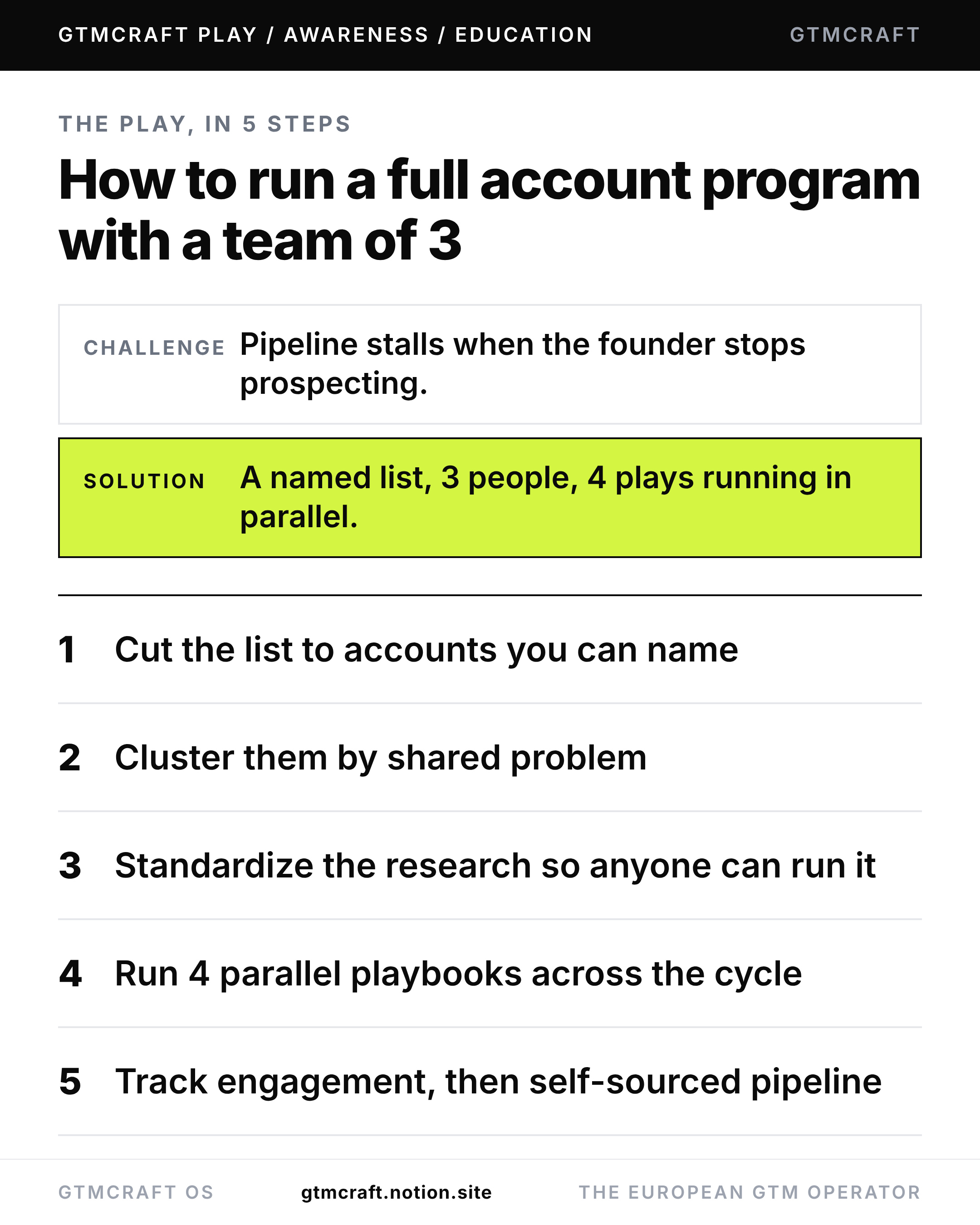
The play: run a full account program with a team of 3
Fixes: outbound that sends the same volume to every account, while the founders stay out of it.
Best for: founder teams with 1 to 3 sellers, selling to mid-size and large organisations, where one win is worth a month of work. It bites hardest in a second country.
Time: 2 hours to cut the list this week. Then 30 minutes a day per person, for months.
Step 1: cut the list to the accounts you can name
The play's case used 46 accounts. In the room I said 15 to 30. The number matters less than the test: can each of you name why this account, and which current customer it looks like? Jason Bay (LinkedIn, 29 October): "Fewer accounts, higher quality activity."
Do it: each person lists 10 companies they would be proud to win, with good ICP fit and a look-alike in your customer base. Merge the lists at the end of the week into 15 to 30. Not either-or, both: the broad outreach keeps running, automated. The named list gets the human hours.
Founder version: you and your seller, 1 hour, 1 shared sheet in HubSpot or a spreadsheet. 15 accounts is enough to start.
Head of sales version: every seller hands you their named list on Monday. You and your CEO connect on the top 10 of each.
Done when: the list has 15 to 30 accounts, and every account has 1 sentence on why and 1 look-alike customer.
2: map the 6 people who carry the problem
In big organisations the first specialist you reach may not even own the topic. So we map the buying committee before the deal exists: 6 key personas per account. 30 accounts times 6 is 180 people. You work those 180 by name until February.
Do it: per account, write 6 roles by name: who feels the problem, who owns the budget, who signs, who uses it, who influences, who can block. Cluster the accounts by shared problem, so 1 message serves a cluster.
Founder version: 4 roles for your top 10 accounts, 30 minutes with LinkedIn open.
Done when: each account has at least 4 named people, and each person has an owner on your side.
Step 3: run the research once, so anyone can use it
Nate Nasralla (LinkedIn, 1 October): "Write with your customer's words." The cheapest source of those words is your own calls. Record first demos, and above all customer calls. Push the transcripts into a Claude project, or let Gong collect them, and pull out the 3 problems your market talks about most. Just start. Record button on.
Do it: 1 page per account: why now, the problem in their words, the 6 people, the warm path. The team brings the first draft, with AI. In the room I fine-tune and sharpen it. In your team, the founder does.
Founder version: your last 10 customer call recordings into 1 Claude project, 1 question: which 3 problems come back most, in their words?
Done when: every named account has a page with all 4 fields filled, and the 3 problems from your calls are written in your customers’ words.
Step 4: run 4 plays in parallel, with the founders in them
This is where the founders come in. 4 plays run side by side on the same named list:
The connection layer, automated. The seller, both founders, or you as head of sales connect, and you decide per person who connects. Not all 3 of you on everyone, or we start spamming again. Set it up once in your outreach tool, then leave it. Once a week it visits the profiles from the founders’ accounts. Almost childish. But a view that gets a view back is the best LinkedIn conversion there is. On 30 Minutes to President’s Club (podcast, 27 October) the advice was close: pair each leader with their counterpart at the buyer.
The warm path. Ask your customers and partners who knows someone in these accounts. Load your customers’ key contacts and your event lists into the tool too. They have a bigger network, and they are your ICP. A competitor can see your connections? I am never afraid of that. Dare to be proud of what you do.
A roundtable. A small room, 10 to 20 people, at a customer’s or partner’s office. GTMonday (newsletter, 27 October): “Registration and follow-up can be automated. The room can’t.”
Something physical. We are heading into Christmas, and I say it to my own teams too: a gold envelope, a real handwritten note, signed by both founders. It sounds odd. Again: it is high-touch versus volume, and we test which reaches better. Zinkevich (Full-Funnel B2B, 6 November) shows the trap: a team that skipped the warm-up “bought a gifting platform” and booked “0 meetings.” The note comes after the connections, never instead of them.
My own habit: no note, and under 50 mutual connections I do not accept. I am an outlier. The team found requests without a note were accepted less. Test both.
Do it: per account, write which of the 4 plays runs this month and who owns it.
Founder version: plays 1 and 4 only. 20 founder connection requests a week, 15 handwritten notes before Christmas. A 1-minute Loom to the person who feels the problem works too.
Done when: every account has at least 2 plays live and at least 1 founder touch.
Step 5: judge it in months, then prune
Andrei again (newsletter, 6 November): "almost all ABM playbooks I've seen are just 2-3 weeks conversion-oriented campaigns." It is fine if they are not in your funnel in December. In February you want positive reactions and first conversations. Matt Green's pruning rule: an account with no reply after 90 days rotates out, the next one on the list rotates in.
Do it: track 2 numbers per month: accounts with a reaction from 2 or more people, and the share of new pipeline from the named list.
Founder version: 1 line per account in your sheet, updated every Friday: reaction yes or no, from whom.
Done when: your sheet shows both numbers each month, and from day 90 every account with no reply has been swapped for the next on the list.
The template
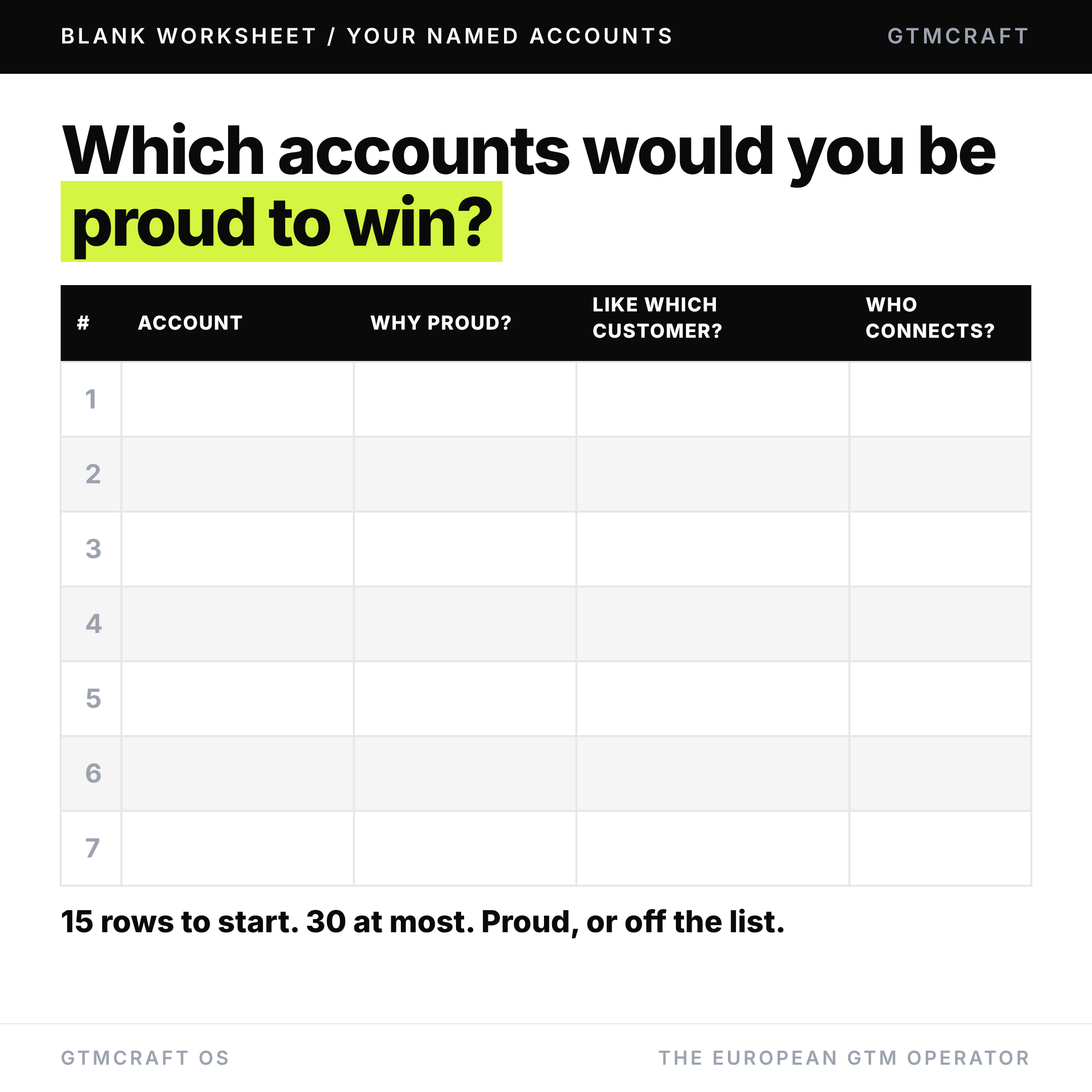
The 30-account sheet, one row per account.
Paste this into your AI:
Here is my customer list and my CRM export: [paste]. Here are transcripts of my last customer calls: [paste]. Rank 15 to 30 target accounts that look like my best customers. For each, give 1 sentence on why now, the look-alike customer, 6 roles to reach and who on my team should connect with each (founder or seller), any warm path through a customer or partner, and a first one-line note in the buyer’s language using the words my customers use. Do not invent names, contacts, numbers or relationships. Mark anything missing as missing.
With the GTMcraft Operator Brain, your AI already has the play, the skill and the sources: no paste.
The European read: the founders’ name opens doors in the home market. In the next country, it often does not. There your customers’ and partners’ networks are the warm path, the roundtable runs in that country’s city, and the founders’ note is written in the buyer’s language.
The rule: automate the volume. Spend the founders on the accounts you would be proud to win.
You know it worked when: at your first read, 4 in 10 named accounts show a reaction from 2 or more people. And the named list sources a growing share of your new pipeline. Founder read: you can name the 15 accounts, and who in each one knows your name.
Where this play sits on your bowtie
A named list is won in Awareness and Education, long before a deal exists. 3 plays that connect to this one, all free:
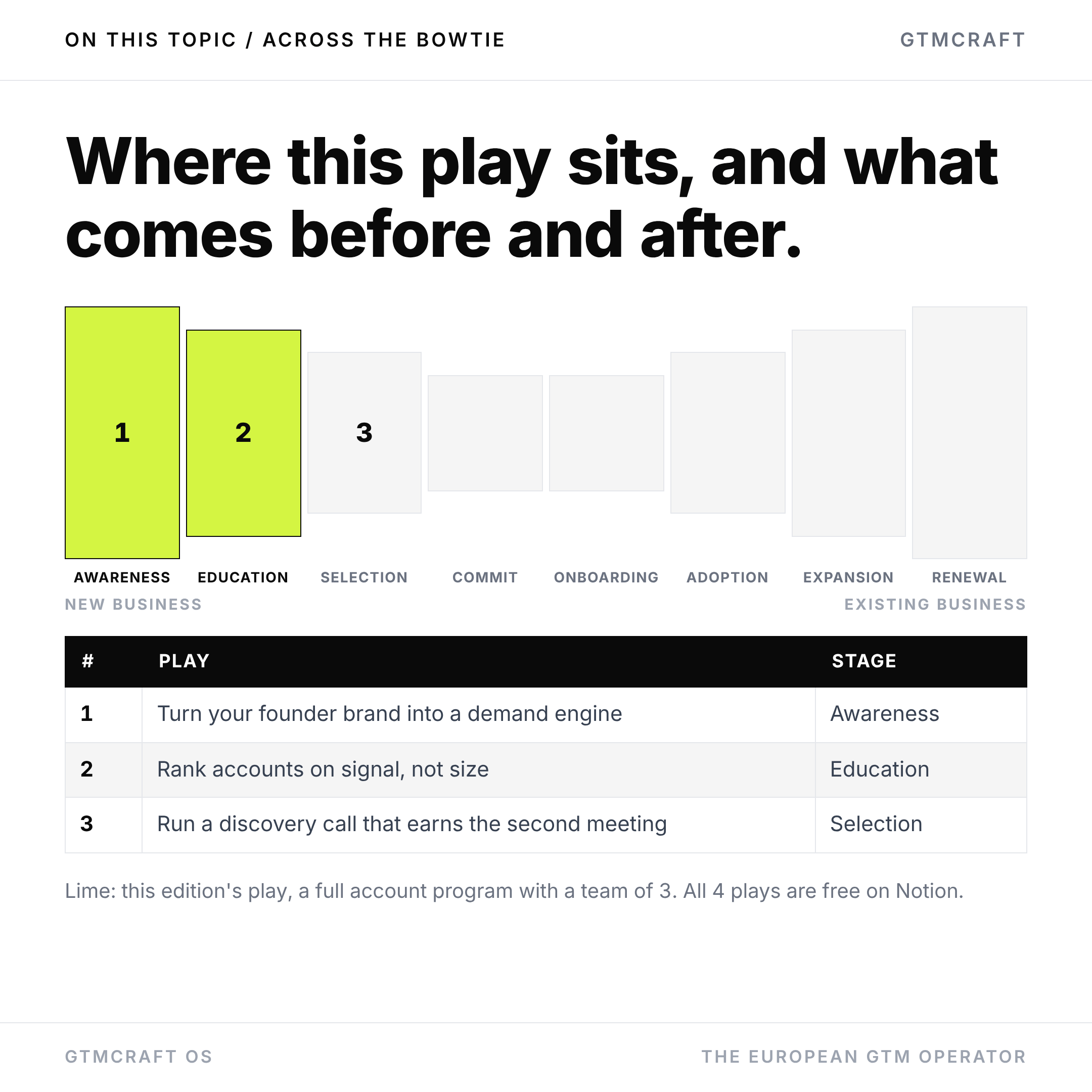
1. Before, Awareness: How to turn your founder brand into a demand engine, in 5 steps. Founders who post are founders whose requests get accepted.
2. Alongside, Education: How to raise win rate by ranking accounts on signal, not size, in 5 steps. Re-rank the named list when a buying signal shows up.
3. After, Selection: How to run a discovery call that earns the second meeting, in 5 steps. The first conversation from the list has to earn the next one.
All 250+ plays across the bowtie are free in GTMcraft Plays on Notion.
Save this for your next pipeline review. Send it to 1 founder whose seller still prospects alone.
Key sources
The 5 sources that shaped this play. The full list lives in the play.
LinkedIn. Matt Green, the target account arithmetic (25 October 2026). The list has to shrink.
Newsletter. Full-Funnel B2B (Andrei Zinkevich), “How to create ABM playbooks that actually work” (6 November 2026). Months, not weeks.
LinkedIn. Andrei Zinkevich, Factors.ai data on the buying committee (22 October 2026). 6 people, not 1 or 2.
Podcast. 30 Minutes to President’s Club, “LinkedIn Social Selling Masterclass” (27 October 2026). Leaders connect with leaders.
Newsletter. GTMonday, “OpenAI is paying $400K for a head of events. Your 2027 budget should notice.” (27 October 2026). Small rooms, at a customer’s office.
Why this matters now
Cut the list by Monday 16 November. Map the people by Friday 20 November. Founders start connecting on Monday 23 November. Put the handwritten notes in the post by Friday 11 December, 10 days before Christmas week starts on Monday 21 December. Read the results on Monday 1 February 2027, about 12 weeks from now: reactions, not closed deals. Start the list today.
One question for the room
Of the 15 accounts you would be proud to win in 2027, in how many is 1 of the 6 people already a 1st-degree connection of a founder?
Go deeper with GTMcraft Operator Brain
Scale on plays and skills, not prompts. This play and 250+ more are free and live in GTMcraft OS on Notion.
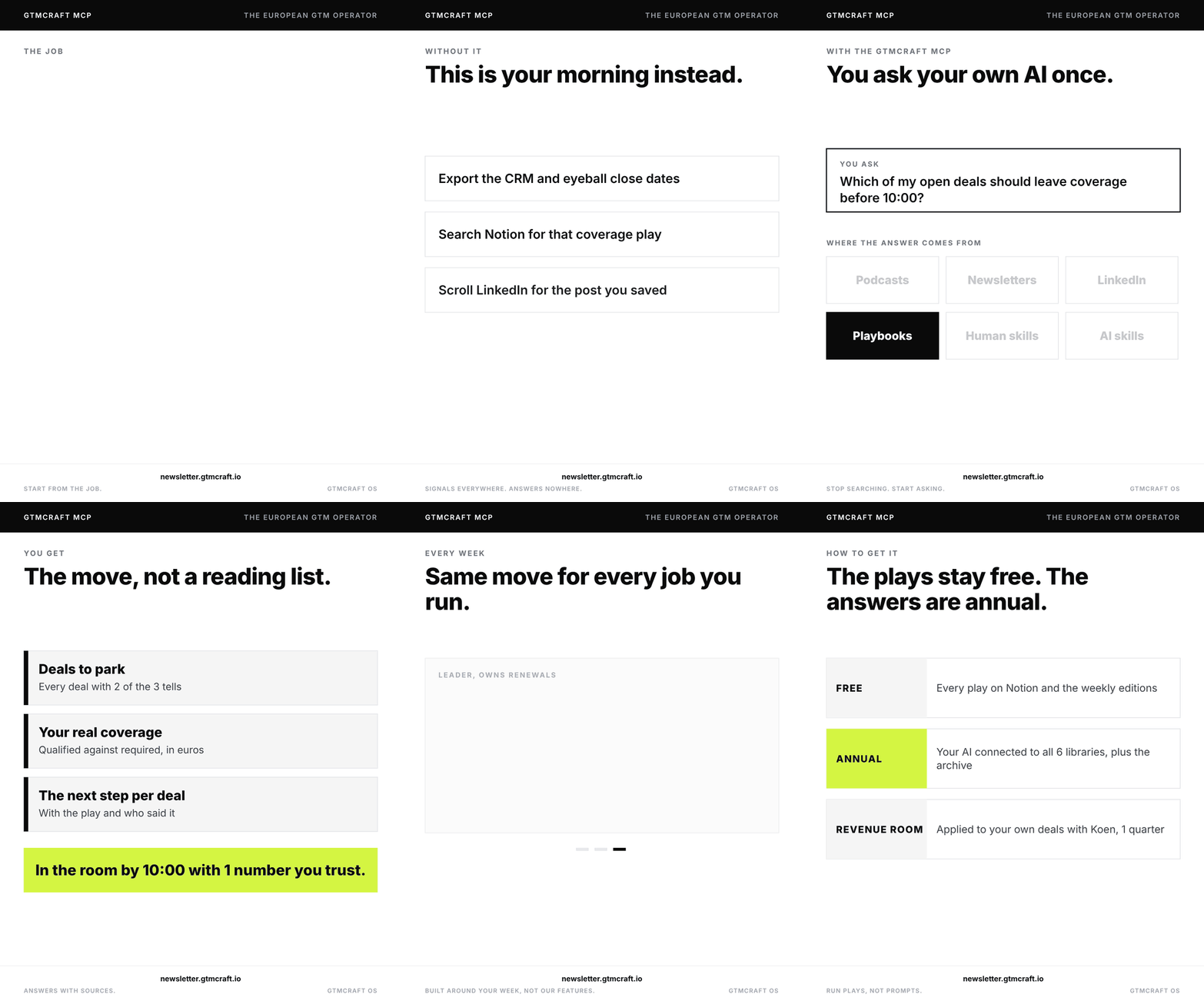
The GTMcraft Operator Brain is the connection, and you can buy it on its own: EUR 297 a year. Every play, every lesson and every source behind them, inside your own AI and next to your own deals. 6 libraries: podcasts, newsletters, LinkedIn posts refreshed daily, playbooks, human skills and AI skills. The aim is simple: 5 to 10 percent better execution on the number you own. Connect it once and ask it which Q4 deals have power, and which need that meeting by 13 November.
The first 50 keys went out this weekend.
Get your GTMcraft Operator Brain key, EUR 297 a year, or reply Operator Brain to this email.
The Revenue Room
8 people, 1 quarter. European B2B SaaS founders and GTM leaders who own the number. I tell you what I would do in your seat, you run it. A hotline with an answer within 48 hours, a case-led call every 2 weeks, and 1 private session with me.
The Q4 room started on 23 October. The Q1 2027 room opens in January. Reply JANUARY to this email to hear first, and bring your 2 coverage numbers to the first call.
The tools I name are tools I use or recommend. Expandi is a GTMcraft partner.
Master your human GTM skills AI can’t replace inside GTMcraft,
Koen
Your (human) GTM Coach
—
PS. Co-written by Wispr Flow + my GTMcraft Newsletter Skill + Claude Opus 5.5; edited & approved by Koen
The 6 roles per account match our enterprise deals almost exactly.
At Conversion we sold analytics plus GA360 to companies like LPP and Vattenfall. 6 to 8 months per deal, 3 to 6 people on the buying side and the CFO often one of them, because the GA360 ticket alone was around $100k.
So step 5 is the part I'd show every founder who wants pipeline from this by Christmas 😄