

👋 Hi, it is Koen Stam and welcome to GTM OS: The Future GTM Operator, my weekly newsletter for founders and revenue leaders scaling B2B SaaS from 0 to 10M+ ARR.
Every edition is built from 100,000+ GTM signals collected from operators and founders, combined with 10+ years of my own lessons and failures from the trenches.


On Monday I shared the playbook behind Personio’s 47% win rate and 67% higher deal values with digital sales rooms. On Wednesday I published the CREATE phase: four steps to define your async rules, launch buyer workspaces, deploy video selling, and build mutual action plans.
Today is the execution guide. Eight steps across two phases. Phase 2 (INTEGRATE) operationalizes async selling through automation, data integration, multi-threading, and coaching. Phase 3 (SCALE) embeds it as organizational infrastructure through AI intelligence, champion enablement, hiring, and governance.
You do not need to read all eight steps. Start at the one that matches your biggest gap.
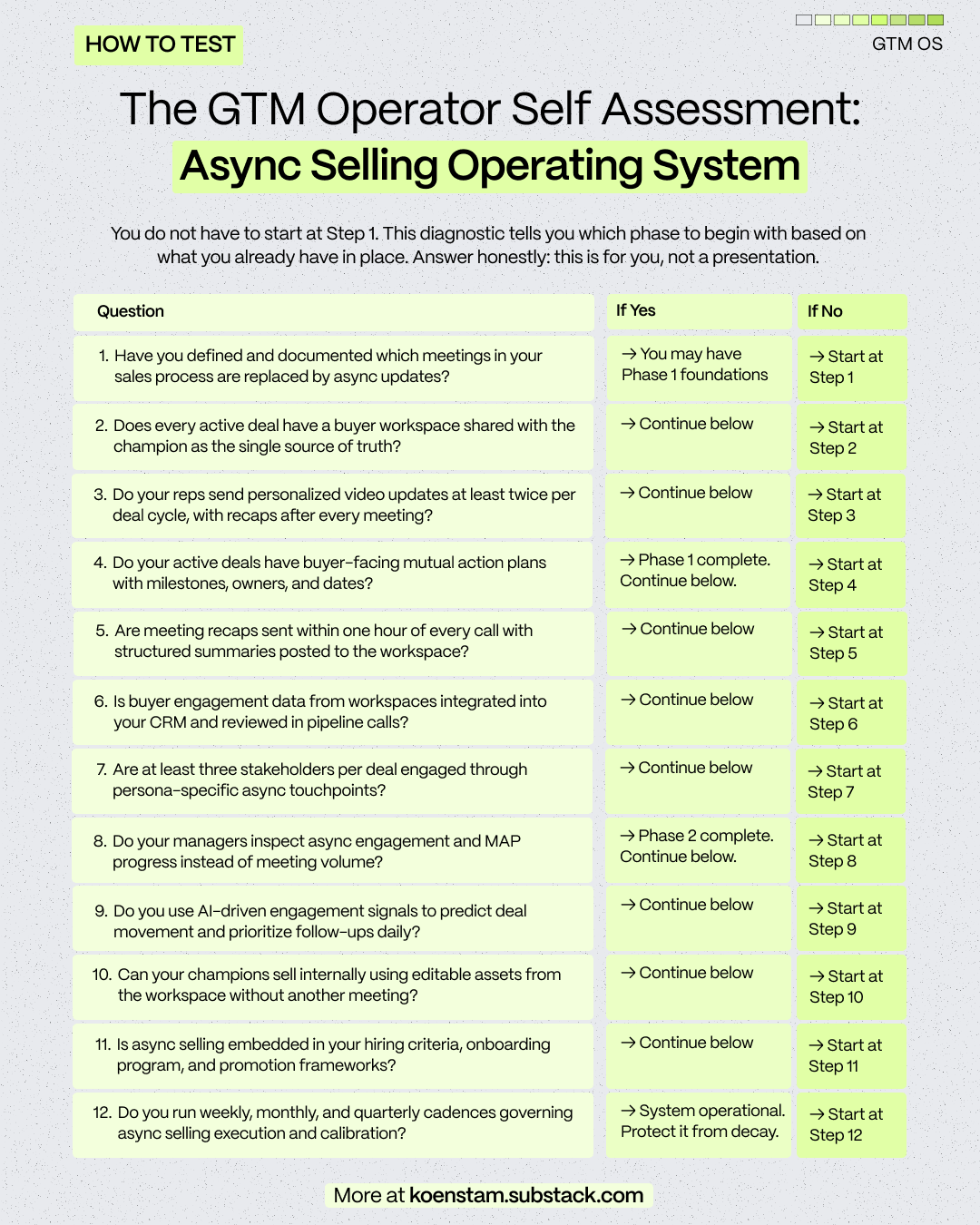
Answer these honestly. This tells you where to begin.
Are meeting recaps sent within one hour of every call, with structured summaries posted to the buyer workspace? If no, start at Step 5.
Is buyer engagement data from workspaces integrated into your CRM and reviewed in pipeline calls before rep narrative? If no, start at Step 6.
Are at least three stakeholders per deal above average ACV engaged through persona-specific async touchpoints? If no, start at Step 7.
Do your managers inspect async engagement signals and MAP progress instead of meeting volume? If no, start at Step 8.
Phase 2: INTEGRATE
Phase 1 is complete when every active deal has a buyer workspace with a personal welcome video, a mutual action plan with buyer-owned milestones, and your team has documented rules for which meetings are now async. If any of these are missing, finish Phase 1 first.
Step 5. Automate the follow-up loop
Follow-ups create velocity. Delays kill it. Trumpet data shows 83 percent of buyers expect near-instant responses. When your rep finishes a meeting at 4 PM and sends the recap the next morning, the buyer has already moved to the competitor who responded within the hour.
How to execute ↓:
Set a team-wide standard: every meeting produces a structured recap within one hour. Connect your call recording tool to your follow-up workflow. AI generates a draft summary. The rep reviews, adds personal context, and sends via the workspace. Configure idle deal alerts at 48 hours. Set MAP milestone reminders. Track average follow-up time as a team metric.
The standard: AI drafts, rep reviews and personalizes, then sends. Never send a fully automated follow-up without human review.
If you are founder-led: write your own recaps within one hour. Use a timer. The discipline of speed matters more than the tool.

Step 6. Integrate engagement data into CRM and pipeline reviews
Engagement data from buyer workspaces is the leading indicator your pipeline reviews are missing. CRM stage updates tell you where the rep thinks the deal is. Workspace engagement tells you where the buyer actually is.
How to execute ↓:
Connect your workspace platform to your CRM. Map engagement events to deal records. Build a deal engagement dashboard with traffic light scoring: green (active this week), yellow (no engagement in three to five days), red (no engagement in seven or more days). Add engagement data to your pipeline review template. Replace “What happened on the last call?” with: What moved in the workspace since the last review? Which stakeholders engaged? What is the MAP completion rate?
If you are founder-led: check workspace analytics manually before every deal review. Note who viewed what and when.

Step 7. Multi-thread every deal with persona-specific async touchpoints
Single-threaded deals are fragile deals. When your entire relationship runs through one champion, you are one job change away from losing the deal. Async communication makes multi-threading practical. You cannot book five separate meetings with five stakeholders. You can send five personalized videos addressing each person’s specific concerns. Each message takes five minutes to record. Five meetings would take five hours.
How to execute ↓:
Define minimum multi-threading standards per deal size: at least three stakeholders for deals above average ACV, at least five for enterprise. After every group meeting, send personalized one-on-one follow-ups to each attendee. Use video for executive engagement: 60-second personalized messages to the economic buyer who will not join a live call. Map the buying committee early. Mirror the committee with your selling team: CSM-to-project-lead, SE-to-IT-lead, exec-to-exec.
If you are founder-led: focus on engaging the champion plus the economic buyer. Send one additional personalized video per deal to someone besides your primary contact.

Step 8. Coach managers to inspect momentum, not meetings
Async selling fails when managers keep inspecting the wrong signals. If the deal review still starts with “When is the next meeting?”, reps will optimize for that metric and ignore async execution.
How to execute ↓:
Retire old coaching signals: meeting volume, call count, calendar utilization. Replace with workspace engagement, MAP milestones completed, stakeholders engaged, async response speed. Define the manager operating rule: if nothing moved asynchronously, the deal is stalled. Create a coaching prompt framework: What did the buyer review since we last spoke? Who is actively engaging and who is silent? What did the champion share internally? Build promotion signals around async execution. Run monthly coaching calibration.
If you are founder-led: review your own deals against engagement data weekly. Ask yourself: did anything move async this week? If not, why am I confident in this deal?

Phase 3: SCALE
Phase 2 is complete when follow-up recaps are sent within one hour for every meeting, engagement data is integrated into your CRM and pipeline reviews, every deal above average ACV has at least three stakeholders engaged asynchronously, and your managers inspect momentum instead of meetings.
