

👋 Hi, it is Koen Stam and welcome to GTM OS: The Future GTM Operator, my weekly newsletter for founders and revenue leaders scaling B2B SaaS from 0 to 10M+ ARR.
Every edition is built from 100,000+ GTM signals collected from operators and founders, combined with 10+ years of my own lessons and failures from the trenches.

The full system
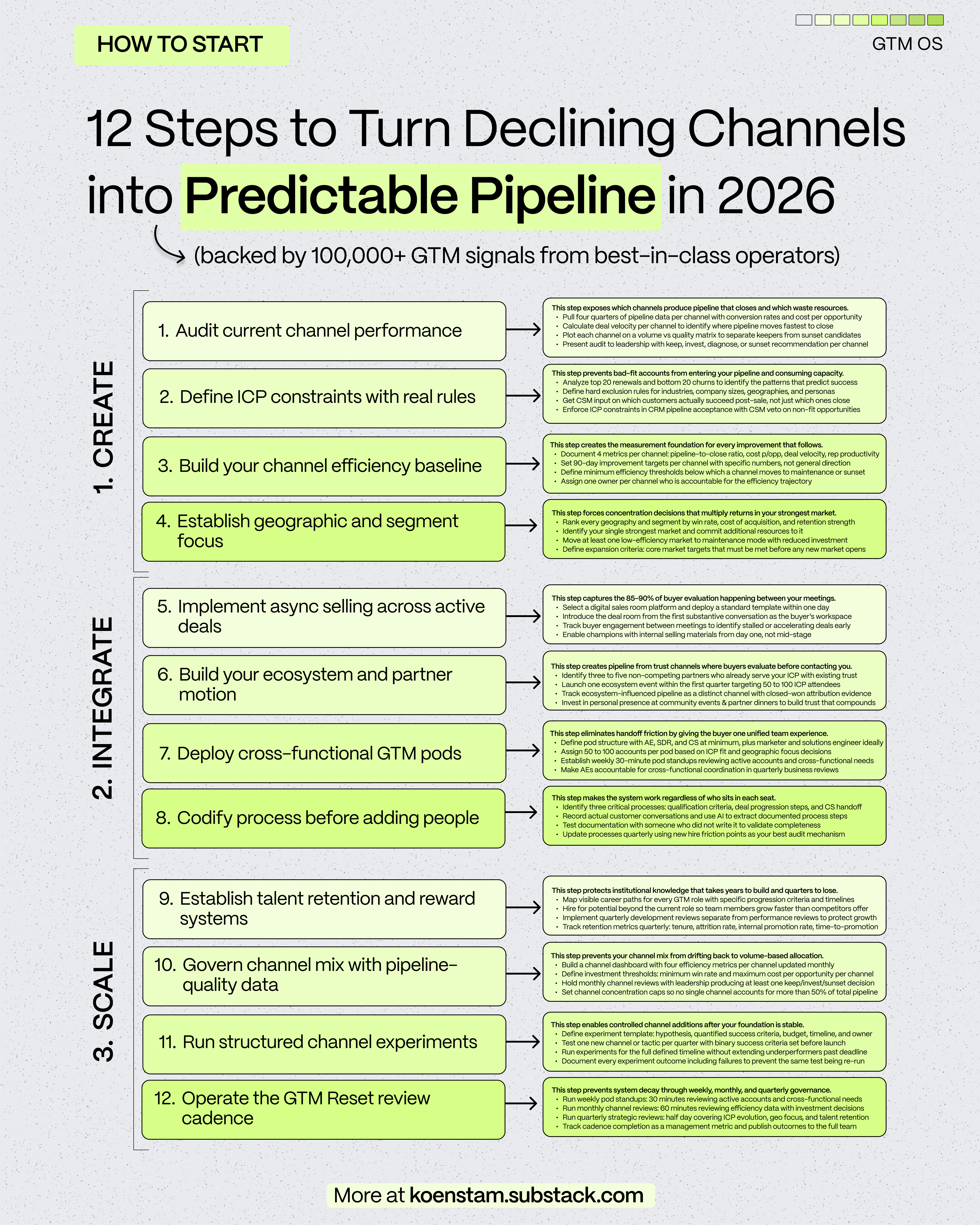
This week we have been building the GTM Channel Reset.
On Monday I shared the playbook behind Personio Benelux’s growth from 2M to 10M+ in under three years, and the Channel Audit Workbook to make Step 1 actionable. On Wednesday I published the CREATE phase: four steps to audit your channels, enforce your ICP, build efficiency baselines, and make geographic focus decisions.
Today is the execution guide. Eight steps across two phases.
Phase 2 (INTEGRATE) deploys five tactical pillars that improve conversion quality.
Phase 3 (SCALE) builds the governance system that prevents decay.
If you missed Monday or Wednesday ↓:


Before you start: run the diagnostic
Answer these honestly. This tells you where to begin.
Do your active deals use digital sales rooms with async recaps and engagement tracking? If no, start at Step 5.
Do you track ecosystem pipeline as a distinct channel with at least three active partner relationships? If no, start at Step 6.
Do your GTM functions operate as cross-functional pods with shared accounts and weekly standups? If no, start at Step 7.
Are your three most critical processes documented, recorded, and independently executable by new hires? If no, start at Step 8.
Do you hold monthly channel governance reviews that produce at least one keep/invest/sunset decision based on efficiency data? If no, start at Step 10.
You do not need to read all eight steps. Start at the one that matches your biggest gap.
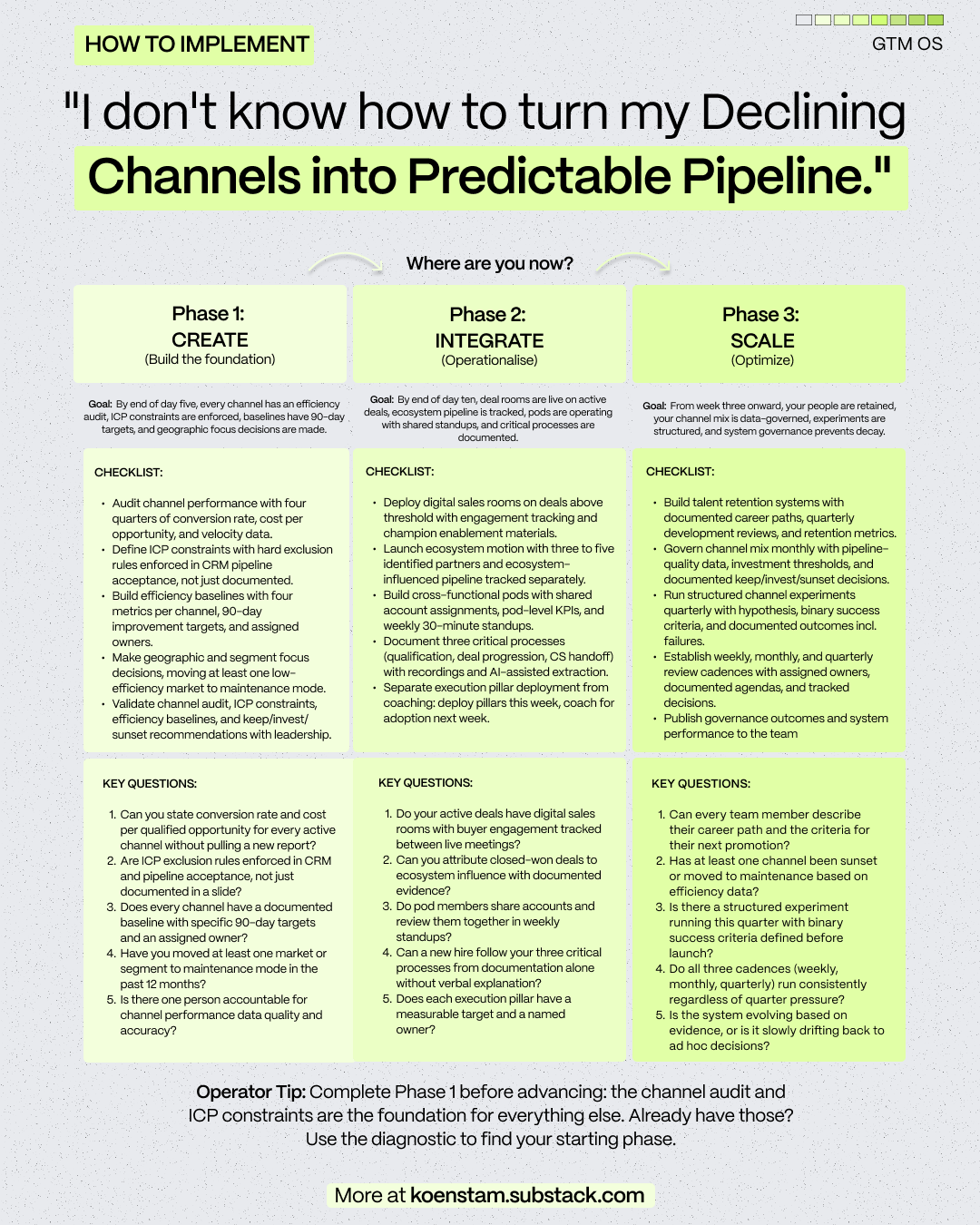
Phase 2: INTEGRATE
You take the focus decisions from Phase 1 and deploy the pillars that improve conversion quality across your GTM motion.
Step 5. Implement async selling across active deals
85 to 90 percent of the buying decision happens without a live call. If your sales process is a sequence of meetings, you are ignoring the vast majority of the buying journey.
Buying committees are larger. The buyer you speak with must sell your solution internally to people you will never meet. They need materials, evidence, and structured information to do that effectively. Without enablement, your champion walks into an internal meeting, says “I think we should go with this vendor,” and gets asked ten questions they cannot answer. The deal stalls.
Digital sales rooms create a shared workspace where all stakeholders collaborate asynchronously. In 2026, deal room platforms auto-capture who opened which document, how long they spent, and which stakeholders are active. This gives you buying committee intelligence that was invisible three years ago.
How to execute ↓:
Select a deal room platform. trumpet, Aligned, GetAccept, DealHub, Recapped.io, and Allego are options (I’m ambassador and user of trumpet, get your free trial here). The platform matters less than the habit. Pick one that integrates with your CRM.
Create a standard template: project plan, mutual action plan, business case, product overview, security docs, team introduction, and a section for buyer-specific content.
Introduce the room from the first substantive conversation. Position it as the buyer’s workspace, not your internal documentation.
Brief every AE on async protocol: written recaps within two hours of every meeting, short video recaps for complex updates, shared documents with tracked engagement.
Use deal room engagement as a leading indicator in reviews. Replace “How was the last call?” with “Show me the room engagement since the last call.” One question. Completely different signal.
Train your champions early. Give them internal selling materials from the first conversation: ROI summaries, competitive differentiation, internal presentation templates. Do not wait until mid-stage.
What the numbers look like: 40%+ win rate increase, 65%+ ACV increase, 875 previously unknown stakeholders uncovered in the buying journey. These are real numbers from teams I have deployed this with.
If you are founder-led: use a shared document per deal. Include discovery summary, mutual action plan, key documents, and async communication. Share it with the buyer. Track whether they open it.
