

👋 Hi, it is Koen Stam and welcome to GTM OS: The Future GTM Operator, my weekly newsletter for founders and revenue leaders scaling B2B SaaS from 0 to 10M+ ARR.
Every edition is built from 100,000+ GTM signals collected from operators and founders, combined with 10+ years of my own lessons and failures from the trenches.

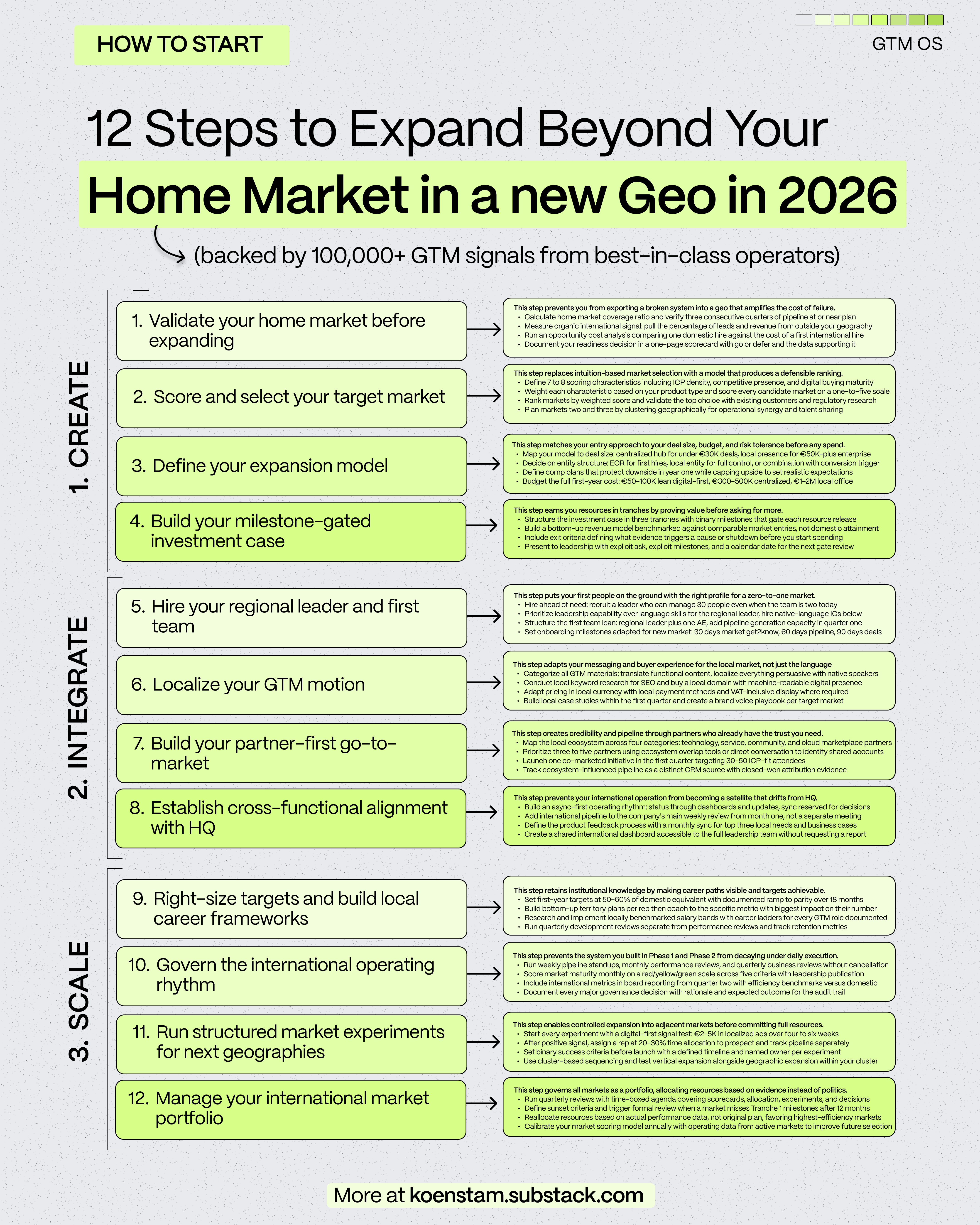
The full system
This week we have been building the International Scaling Operating System.
On Monday I shared the playbook behind Personio Benelux’s growth from 2M to 10M+ in under three years, how Gong’s expansion taught the S-curve reality, and the International Scaling Workbook to make the CREATE phase actionable. On Wednesday I published the CREATE phase: four steps to validate readiness, score markets, choose your expansion model, and build the investment case.
Today is the execution guide. Eight steps across two phases.
Phase 2 (INTEGRATE) puts your first team on the ground and connects the operation back to HQ.
Phase 3 (SCALE) builds the governance system that prevents decay and the experimentation framework for adjacent markets.
If you missed Monday or Wednesday ↓:


Before you start: run the diagnostic
Answer these honestly. This tells you where to begin.
Have you hired a regional leader and first team with onboarding milestones adapted for new market entry? If no, start at Step 5.
Are your GTM materials localized (not just translated) with local SEO, pricing, and payment methods live? If no, start at Step 6.
Do you have at least three active partner relationships producing introductions with ecosystem pipeline tracked as a distinct CRM source? If no, start at Step 7.
Is your international operation integrated into the weekly pipeline review with a shared dashboard and operating rhythm with HQ? If no, start at Step 8.
Do you run weekly, monthly, and quarterly governance cadences with market maturity scoring that never get cancelled? If no, start at Step 10.
You do not need to read all eight steps. Start at the one that matches your biggest gap.
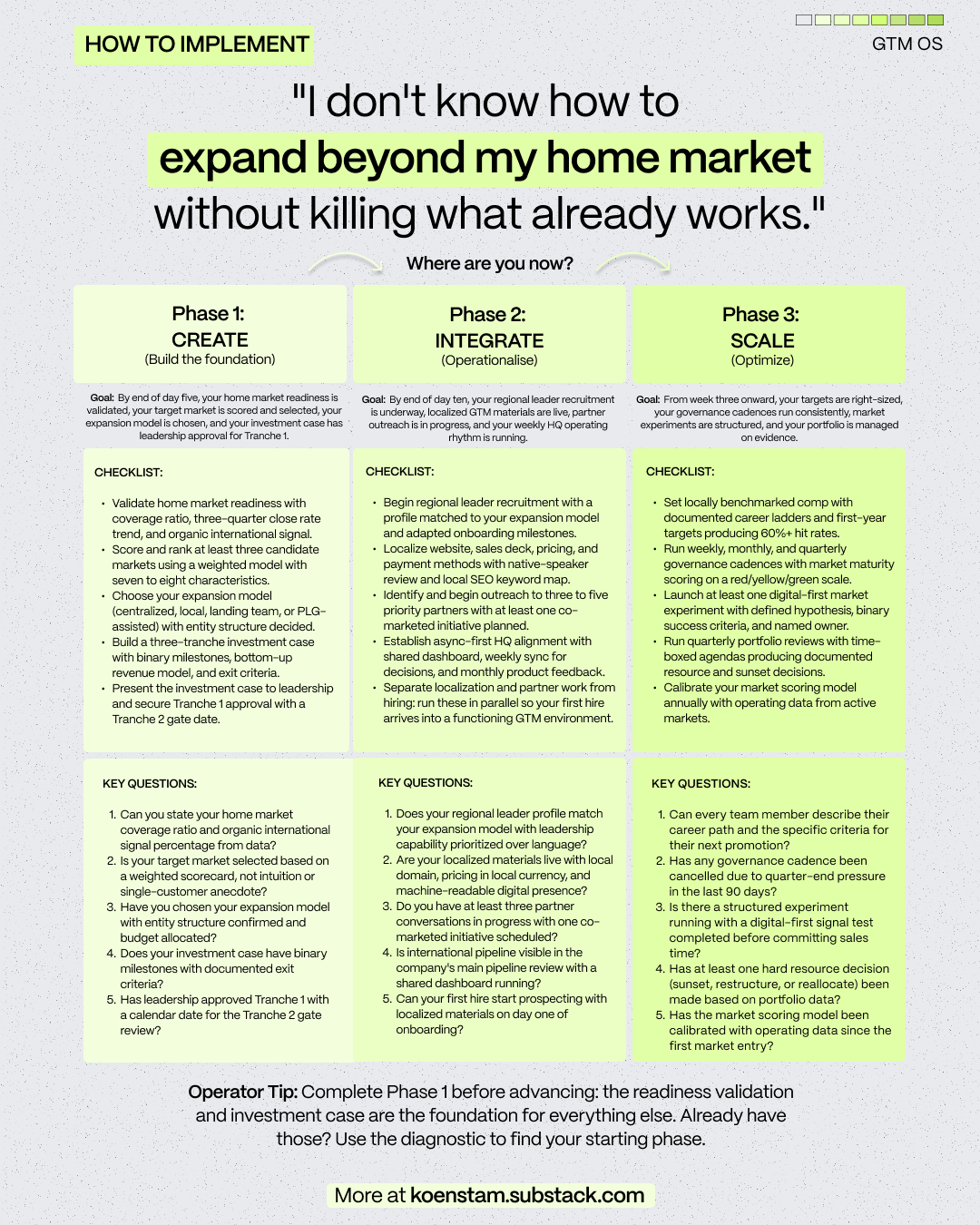
Phase 2: INTEGRATE
You take the foundation from Phase 1 and put people on the ground, localize for local buyers, build credibility through partners, and connect everything back to HQ. These four steps run in parallel.
Step 5. Hire your regional leader and first team
Your first hire sets the culture for every hire that follows. Rick Kelley’s principle at Meta: hire ahead of where you think the team is going. If you need someone who can manage 30 in two years, hire that leader now when the team is two. The cost of layering someone over your first hire 18 months later destroys trust, creates turnover, and resets the market.
How to execute ↓
Define the regional leader profile based on your expansion model. Centralized: a player-coach who can prospect, close, and build process. Local office: a mini-CEO who can hire and manage cross-functionally. Landing team: pair a top-performing transplant from home market with a senior local hire.
Prioritize leadership capability over language capability. Rick initially over-indexed on language and rolled back. Your leader needs strategic judgment and resilience. Hire native-language AEs and SDRs below them.
Structure the first team for zero-to-one: regional leader plus one AE. In 2026, one operator running an AI-SDR workflow covers prospecting volume that required two to three SDRs three years ago. Add one marketing resource (fractional is acceptable). Do not hire customer success before you have customers to serve.
Set onboarding milestones: Day 30 market familiarization (competitive landscape, buyer behavior mapped). Day 60 pipeline generation (first qualified opportunities from local prospecting). Day 90 deal progression (first deals at proposal stage or beyond).
If you are founder-led: hire one senior AE through EOR who can prospect and close independently. You remain de facto country manager, flying in monthly.
Step 6. Localize your GTM motion
When I expanded Personio into Belgium from the Netherlands, the first move was pragmatic: dedicate sufficient team from my existing growth marketer, translate the basics, start advertising to see if it sticks. Translation and localization are different disciplines. The operator rule: if it is functional, translate. If it is persuasive, localize.
Cultural messaging differences change conversion rates by 50% or more. A US-style headline triggers skepticism in Germany. The Swiss market responds to straight-to-the-point efficiency messaging. Southern European markets respond to storytelling.
How to execute ↓
Audit existing GTM materials: functional (translate) versus persuasive (localize). Product docs and knowledge base need accurate translation. Homepage, landing pages, sales decks, case studies, and email sequences need full localization with native-speaker review.
Conduct local keyword research. Do not translate English keywords. “ERP software for mid-market” becomes “ERP-Software fur Mittelstand” in German, a conceptually different term.
Adapt pricing for local payment: SEPA in DACH, iDEAL in the Netherlands, Bancontact in Belgium. Display VAT-inclusive pricing where required.
Make your digital presence machine-readable. In 2026, buyer-side AI tools pre-filter vendors using structured data. Published pricing, visible certifications (SOC 2, ISO 27001), and complete review profiles per market are required.
Build local case studies within the first quarter. Even a brief logo and quote from your first local customer carries more weight than a detailed case study from another continent.
If you are founder-led: start with localized landing page, one local case study, and translated sales deck. Use a freelance native speaker. Total cost: 2-5K euros.
