

1,000+ subscribers strong: Building GTM OS Together
We just passed 1,000 subscribers in under six months. It’s a milestone I’m truly grateful for. Whether you’re reading this on Substack, interacting on LinkedIn, or testing one of the GTM OS Assistants, thank you for being part of the journey.
This newsletter will now ship once a week — on a Monday.
Every issue will focus on:
A personal update on the GTM OS journey
1 deep-dive GTM playbook with 7 actionable strategies to implement this week
3 top GTM podcast episodes from last week — each packed with takeaways
10 standout GTM LinkedIn posts from last week, with direct implementation steps
The goal is to keep this actionable, relevant, and grounded in what’s working right now. Your feedback helps sharpen both the product and the newsletter — keep it coming.
Amplifying Growth, One Percent at a Time
This week, I want to pull back the curtain for everyone who’s subscribed to the Substack or tested any of the GTM OS Revenue Assistants. Here’s the why behind what we’re building — and how it’s designed to help you make smarter GTM moves, faster.
As GTM leaders, we often face moments of uncertainty: What’s our next big move? AI won’t replace us — but it can amplify us. If we each improve just 1% to 5% every day, and if that compounds across our teams, we’re talking serious ARR impact.
That belief is what led me to start this three years ago — building GTM OS on top of trusted patterns from top GTM leaders, informed by thousands of data points. Today, AI is at the center. But to be effective, it has to be led from the inside. We as leaders have to model, facilitate, and guide its use. Because if we just hand our teams generic GPTs without showing what “good prompting” looks like, the outputs — and eventually our brand and leads — will suffer.
Right now, I’m working with a small cohort of GTM leaders in partnership with a VC/PE firm and their portfolio companies. On the other hand, as I shared last week (see post), August is open for broader testing. I’ve released the Onboarding Assistant, Revenue Assistant, and Playbook Assistant for anyone to try. Paid subscribers and those on the waitlist will receive an updated newsletter this week with full access to all current GPTs — free for the entire month of August. Everything leads up to the formal launch in September.
On the left-hand side of the system sits the GTM OS database — 50,000+ hours of GTM podcasts and 10,000+ top LinkedIn posts, across marketing, sales, RevOps, CS, finance — all connected to a growing swarm of GPTs. These GPTs will soon evolve into full agents that can plug directly into your company’s data systems — starting with your CRM (like HubSpot), email client, and calendar. Much more to come, but those are the first buckets of integration.
Soon, this entire ecosystem will live behind a single GTM OS platform. From there, you’ll one-click into the assistant you need, track your progress, save your favorites, and collaborate inside a new community space. Think: shared learning, wins, playbooks, and live cohort sessions — all driving one mission: amplify AI to grow ARR and win rate, together.
And we’re just getting started. The next big milestone? Co-creating GPTs with other GTM leaders who are pushing AI forward. If that’s you — if you’ve built a GPT that’s helping your team execute faster — I’d love to collaborate.
We don’t need 50% leaps. Just 1% improvements every day. That’s how we win 2025 and beyond.
Podcast of the Week turned into a Practice Playbook
AI-Powered Outbound & SDR Success — What SaaStr Is Doing Right
Overview:
Jason Lemkin and Amelia Lerutte share real-world learnings from deploying AI for outbound sales at SaaStr. Key takeaways cover true performance impact, data training, human roles, and how to scale intelligently.
1. Train AI SDRs Like New Hires
Why this matters:
AI won’t magically perform out of the box. Like a new SDR, it needs intensive onboarding to match your tone, ICP, and campaign logic.
How to execute it well:
Step 1: Block 90 mins AM and 60 mins PM to manually tune outputs
Step 2: Feed in historical emails, persona messaging, event recaps
Step 3: Align with marketing on key segments and message quality
Step 4: Set a 14-day QA sprint reviewing 50–100 AI emails daily
Step 5: Assign a lead owner (VP Sales or AE) to oversee training
Step 6: Use Slack alerts or dashboards to spot issues in real-time
Step 7: Lock in your best-performing flows and freeze weak ones
2. Start with Warm Outbound + Brand Halo
Why this matters:
AI performs best with leads who’ve heard of you or engaged before. Warm audiences reduce reply risk and elevate conversion quality.
How to execute it well:
Step 1: Target past event attendees, sponsors, or site visitors
Step 2: Segment CRM for "last touched" but not yet converted
Step 3: Pull 6–8 engagement signals (web visits, opens, sessions)
Step 4: Prioritize based on recency and lead scoring
Step 5: Coordinate with marketing for air cover (ads, emails)
Step 6: Include context like “saw you attended X event”
Step 7: Launch small batch sends, test subject lines + CTA
3. Maintain Human-in-the-Loop Responses
Why this matters:
AI might book meetings, but humans close deals. Real-time human replies boost trust and accelerate qualification.
How to execute it well:
Step 1: Route AI responses to Slack with urgency tags
Step 2: Assign AEs to handle hot replies within 5 mins
Step 3: Pre-write response templates for known objections
Step 4: Use AI to draft, but human to review and send
Step 5: Create alert rules for VIP accounts or large opps
Step 6: Monitor sentiment and refine voice/tone weekly
Step 7: Hold “AI inbox standup” 2x/week to review trends
4. Build a ‘Working Theory’ Before Sales Calls
Why this matters:
When AI sets the meeting, you may lack deep context. Enter with a hypothesis and validate, instead of wasting discovery time.
How to execute it well:
Step 1: Use AI to pull CRM, site activity, and firmographic data
Step 2: Draft a working theory (Why now? Why us?)
Step 3: Ask ChatGPT or Claude “Why would X buy Y?”
Step 4: Cross-check signals in Apollo or LinkedIn
Step 5: Prep 3 assumptions to validate live
Step 6: Align your deck to the theory (not a generic pitch)
Step 7: Use Gong or Fathom to capture validation signals
5. Automate Post-Call Collateral with AI
Why this matters:
Following up with tailored materials quickly boosts momentum and signals professionalism. AI turns meetings into custom decks or one-pagers within minutes.
How to execute it well:
Step 1: Record sales calls using Fathom, Gong, or Zoom
Step 2: Extract key asks and outcomes with AI summarizers
Step 3: Input summary into tools like Gamma, GenSpark, or Canva AI
Step 4: Upload relevant assets (pricing, tiers, photos)
Step 5: Generate a deck or one-pager personalized to buyer
Step 6: Review for accuracy and brand tone before sending
Step 7: Send within 2 hours post-meeting to stay top of mind
6. Daily QA = Better AI Every Week
Why this matters:
Even great AI needs constant tuning. Daily quality control prevents brand risk, hallucinations, and compounding errors.
How to execute it well:
Step 1: Sample 30–50 AI emails each day
Step 2: Tag errors (factual, tone, alignment)
Step 3: Train corrections directly into the tool (not just notes)
Step 4: Track improvements in reply rates week over week
Step 5: Rotate reviewers to avoid blind spots
Step 6: Benchmark against your top-performing humans
Step 7: Share learnings with sales & marketing weekly
7. Layer AI as Additive, Not a Replacement
Why this matters:
AI should complement your GTM playbook, not replace it. When combined with marketing, human SDRs, and brand touchpoints, performance multiplies.
How to execute it well:
Step 1: Use AI to amplify, not replace, SDR volume
Step 2: Run parallel marketing (ads, nurture emails) to same audience
Step 3: Assign specific workflows to AI vs. human reps
Step 4: Create a unified buyer journey with integrated touchpoints
Step 5: Align attribution across human + AI outreach
Step 6: Schedule biweekly syncs between RevOps, SDRs, and AI owners
Step 7: Monitor ROI across both AI-only and hybrid plays
Want to implement the advice for your business and GTM teams? As part of GTM OS we have created over 100+ GTM playbooks, pre-configured for you to leverage. You can create your own playbooks instantly, or build from this rich library of playbooks. Either way, you must try out the Playbook Assistant. Try it out here.

3 most interesting Podcast episodes on GTM use-cases (from last week).
TL;DR — AI in GTM Is No Longer Optional
Make AI mandatory, not optional—embed AI use in every GTM role and performance review, like Canva.
Build your support brain daily—write one article per day from real tickets to train your AI agent, like RB2B.
Shift SEO to brand-first—optimize for branded queries and co-mentions, not backlinks, to win AI search.
Design AI systems, don’t wing it—use structured frameworks like AI councils, doc pillars, and topic clusters.
Proactively operationalize AI—architect workflows and enablement layers before adoption lags.
Podcast #1 – Jessica Chiew of Canva on Building AI‑Native GTM Org
Show: The Revenue Leadership Podcast by Topline
Guest: Jessica Chiew, Head of GTM Operations & Strategy at Canva
Notion Link: Learn more
YouTube URL:
3 Key Takeaways:
AI as a cultural mandate, not a plug-in: At Canva, every revenue and ops leader is expected to use AI—embedded even in performance reviews—to drive GTM innovation.
Central framework meets bottom-up execution: Canva operates a central AI council alongside function-level “workflow experts” to ensure alignment while enabling experimentation.
Build vs Buy decisions are strategic bets: Canva selectively builds AI foundations in-house (e.g. CRM enrichment), while using vendors for other workflows—guided by impact and scalability.
5 Implementation Steps:
Nominate or hire a GTM AI Lead to own experimentation and cross-functional coordination.
Launch an AI governance council to align vision and manage vendor selection.
Identify 5 high-impact workflows (e.g. prospecting, messaging, proposal generation) and pilot measure outcomes.
Invest in data quality and enrichment before layering AI on top.
Empower workflow champions in each function to own experimentation, scaling, and enablement.
Podcast #2 – AI Talks with Adam, Pete, and Robb
Episode: AI Talks with Adam, Pete, and Robb
Show: AI Talks
Guest(s): Adam Robinson, Robb from RB2B
Notion Link: Learn more
YouTube URL:
3 Key Takeaways:
Support docs are the foundation of AI success: Start with your most painful, repeated tickets. If you write one article per day based on actual questions, in six months you'll have 150–180 articles—enough to train a high-performing support agent.
Write for both human and AI: Use structured formatting (H1–H3 tags, bold, lists, image descriptions) to help AI parse content like a search engine. Good support docs are like SEO pages.
Knowledge base = 3 pillars: Robust support depends on three components: core documentation, FAQs (to capture edge cases), and change logs (for AI context on product evolution).
5 Implementation Steps:
Audit the top 25 recurring tickets and write 1 article/day to replace future replies.
Use real user phrasing as the question headline; repeat the question in the answer.
Design articles with clear structure: headers, numbered steps, and accessible ALT text.
Create a central change log—each product update should be logged with impact notes.
Set AI tools (like Intercom’s Fin or Deli) to strict mode to expose doc gaps, then iterate daily.
Podcast #3 – SEO in an AI-First World: How to Adapt and Win in 2025
Show: Exit Five
Guest: Andrei Țiț, Head of Product Marketing at Ahrefs
Notion Link: Learn more
YouTube URL: Watch here
3 Key Takeaways:
AI Search = New Demand Channel: 0.5% of Ahrefs' traffic comes from AI search—but that group drives 12% of signups.
Brand Is the Moat: Search engines and AI models increasingly favor brands with strong, consistent visibility and recall.
Forget Backlinks. Think Brand Anchors. Co-mentions (e.g., “Ahrefs CMO Tim Soulo”) are the new currency for LLMs.
5 Steps to Implement:
Audit Your LLM Crawlability – Ensure you’re not blocking AI bots like GPTBot; use LLM.txt files to direct them.
Shift SEO Metrics – Track branded search volume, brand keyword share of voice, and share of traffic value.
Create Topical Authority – Build deep content clusters with TL;DRs and rich context to match LLM retrieval patterns.
Track AI Visibility Gaps – Use tools like Ahrefs Brand Radar to find queries where your competitors are surfaced, but you aren’t.
Prioritize Branded Mentions – Invest in influencer UGC, PR, Wikipedia entries, and Reddit/Kora visibility—LLMs crawl it all.
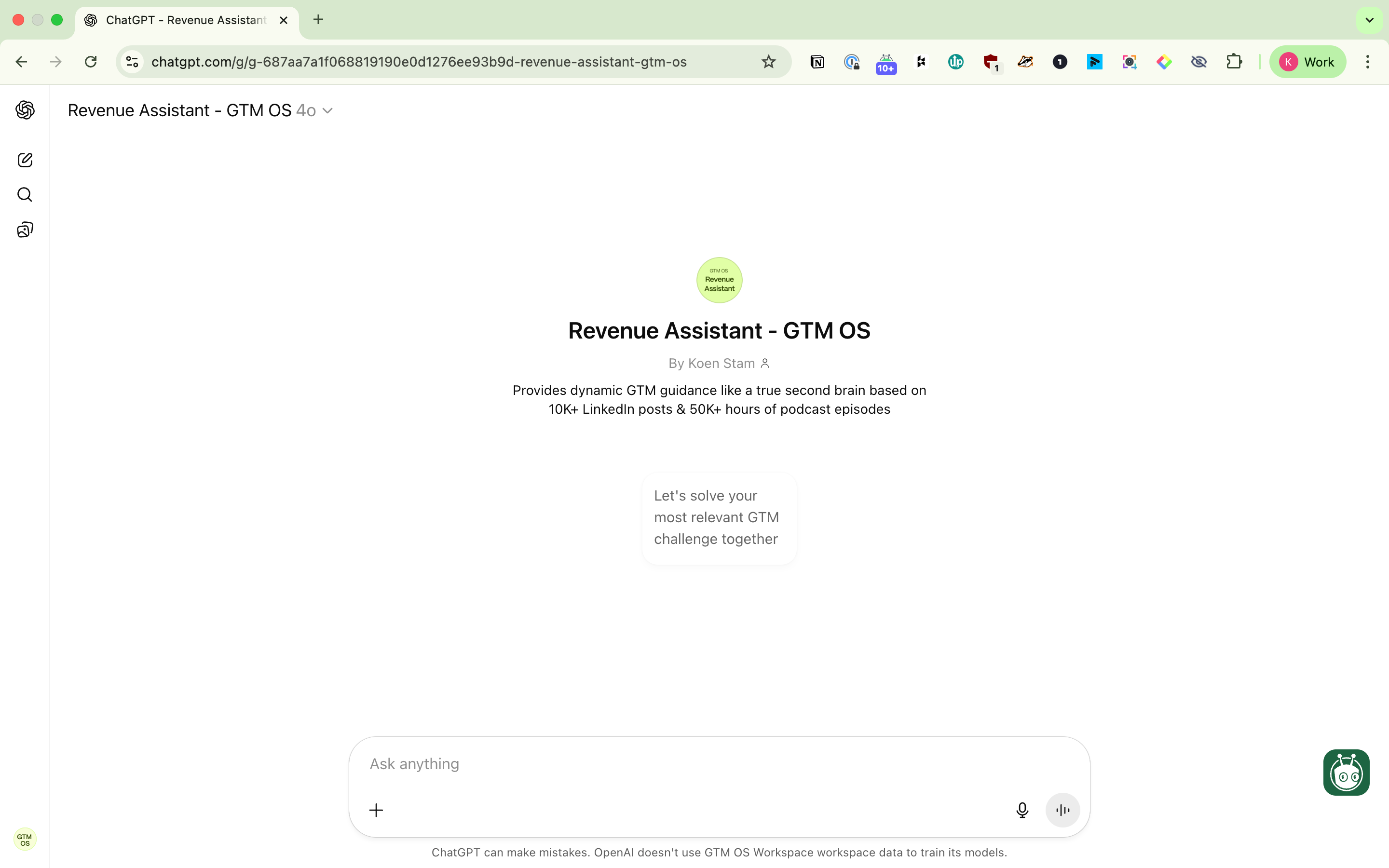
Want to implement the advice for your business and GTM teams? As part of GTM OS we have collected over 50,000 hours of podcast episodes, all broken down into key takeaways, learnings, and actionable strategies. You can instantly get your advice from these GTM experts, by leveraging the Revenue Assistant. Try it out here.
10 most interesting LinkedIn posts on AI use-cases (from last week).
TL;DR — AI in GTM Is No Longer Optional
AI agents are already replacing full roles across prospecting and operations.
The only AI that matters is the kind that drives measurable outcomes.
“AI-native” means rethinking workflows—not adding a chatbot.
Teams adopt AI through experimentation, not enablement decks.
LLM-driven discovery is outperforming traditional search—adapt or fall behind.
1. The trillion dollar opportunity in enterprise software is AI Agents. – Aaron Levie
Notion: Learn more
LinkedIn: Read more
Key takeaway
AI Agents are positioned as the new operating system for enterprise GTM. The biggest value lies in automating cross-functional workflows, not just point tasks.
3 steps to implement
Identify and document costly workflows with manual task repetition.
Prototype a task-specific AI agent that integrates into existing tools.
Track time saved and ROI to justify broader deployment.
2. The top thing separating useful AI agents from hype is: Context. – Nicholas Holland
Notion: Learn more
LinkedIn: Read more
Key takeaway
Context is what makes AI agents useful. So we need to think about onboarding and training them like we train human employees.
3 steps to implement
Define success metrics for every AI tool deployed internally.
Run short-term tests and measure against defined impact goals.
Decommission any AI tool that doesn’t influence real GTM outcomes.
3. AI hackathon instead of another AI best-practices deck. – Matt Green
Notion: Learn more
LinkedIn: Read more
Key takeaway
Turn theoretical AI enablement into hands-on exploration via internal hackathons. This lowers resistance and unlocks frontline innovation.
3 steps to implement
Host a one-day hackathon focused on GTM workflow augmentation.
Let each team redesign one process with AI tooling.
Review outputs, select winners, and integrate top ideas into ops.
4. Agents + LLMs isolated within tools have a fatal flaw. – Lee Bierton
Notion: Learn more
LinkedIn: Read more
Key takeaway
Siloed agents limit visibility and effectiveness across teams. A unified orchestration layer is critical to scale AI meaningfully.
3 steps to implement
Map current AI usage across sales, CS, and marketing stacks.
Build or integrate a shared data layer for AI agents.
Ensure new AI workflows can read and write across departments.
5. AI is overhyped and underutilized. – Eddie Reynolds
Notion: Learn more
LinkedIn: Read more
Key takeaway
Excitement around AI is high, but operational follow-through is lacking. Focus must shift from awareness to embedding into workflows.
3 steps to implement
Audit current GTM functions for AI pilot potential.
Start with narrow-scope pilots tied to known inefficiencies.
Document learnings and operationalize top performers into playbooks.
6. AI tools aren’t ready to replace marketers (yet). – Nicole Leffer
Notion: Learn more
LinkedIn: Read more
Key takeaway
AI enhances marketer productivity but doesn't replace judgment, narrative, or context. Adopt tools to amplify, not automate, human insight.
3 steps to implement
Assign AI tools to augment 1–2 repeatable campaign workflows.
Encourage team to pair daily creative work with AI assistance.
Review campaign lift and AI usage post-mortem.
7. Hot AI summer isn’t slowing down. – Saanya Ojha
Notion: Learn more
LinkedIn: Read more
Key takeaway
AI isn't a trend—it’s becoming foundational to how modern GTM teams operate. Founders and leaders must embrace, not delay, its integration.
3 steps to implement
Run a monthly AI trends briefing across GTM leaders.
Assign an internal AI owner for tools and experiments.
Benchmark peers to spot early mover advantages.
8. More than 50% of our sales team is now AI. – Jason Lemkin
Notion: Learn more
LinkedIn: Read more
Key takeaway
AI isn’t assisting reps—it’s becoming reps. The shift from co-pilot to agent has already happened in some orgs.
3 steps to implement
Automate one full-funnel prospecting function using AI tools.
Benchmark AI performance against junior reps.
Reallocate saved capacity to higher-leverage human selling.
9. AI-native SaaS ≠ Chatbot bolted on. – Scott Leese
Notion: Learn more
LinkedIn: Read more
Key takeaway
True AI-native SaaS means AI is core to the product's value—not just layered on. Founders must redesign the product around outcomes, not features.
3 steps to implement
Redefine product jobs-to-be-done with AI as the engine.
Kill superficial AI features that don't reduce friction.
Position AI as transformation, not augmentation, in GTM messaging.
10. A click from an LLM converts 4.4x better than search. – Yamini Rangan
Notion: Learn more
LinkedIn: Read more
Key takeaway
LLM-native content is not just trendier—it converts better than traditional SEO. The implication: GTM acquisition strategies must evolve fast.
3 steps to implement
Publish AI-optimized answers on LLM-scraped platforms like Quora or Reddit.
Embed structured schema to train AI on your content.
Compare LLM-conversion vs SEO to reallocate budget.
Want to implement the advice for your business and GTM teams? As part of GTM OS we have collected over 10,000+ LinkedIn posts by GTM experts, all broken down into key takeaways, learnings, and actionable strategies. You can instantly create your own playbooks or checklist from the advice of these GTM experts, by leveraging the Playbook or Checklist Assistant. Try the latter out here.

That’s it for this week. New (longer) format, but with the TL;DR you hopefully get some teaser insights to decide which part of the newsletter is most relevant for you. Keep sharing feedback so we can make it more tailored, specific and relevant to you Founders and Revenue leaders in B2B SaaS.
As a reminder, in September GTM OS will go finally live. If you want to be part, become either a paid subscriber to get already access to the platform from this week OR join the waitlist here.


