

TL;DR
Async selling is no longer optional. Buyers move faster than sales calendars, and deals stall when momentum depends on meetings.
This playbook breaks down a complete async selling operating system, including:
A 7-step execution model to replace meeting-heavy sales motions
Digital sales rooms and mutual action plans as the deal source of truth
A maturity ladder and self-assessment to identify where your team stands
A manager coaching framework that reinforces async behavior at scale
If you want execution clarity, start with the 7 steps.
If you lead a team, use the manager coaching visual.
If you want focus, run the self-assessment.
This is not meant to be read once. It is meant to be used.

Lessons from the Field (Koen’s Operator Take)
2026 is the year async selling stops being optional and becomes how sales actually runs.
Three years ago, we decided to run every deal through a digital sales room. Not because we had a clear vision, but because what we were doing before was no longer working. Deals slowed down between calls. Champions struggled to align internally. More meetings did not create more progress.
Sales lives between buyers, internal teams, and decision-makers, but most sales processes are still designed around the seller’s calendar. If you want to change that, you have to rethink the motion, the signals you trust, and how momentum is created. That is uncomfortable work, but necessary.
The same lesson kept coming back. Async selling is not about fewer calls or better follow-ups. It is about building a system that allows buyers to move forward without you needing to be present all the time.
Digital sales rooms made that shift tangible. Suddenly we could see what buyers engaged with, who was involved, and where alignment broke down. Things that used to be gut feel became visible signals.
This week’s edition breaks down the Async Selling GTM Playbook, a practical system for turning meeting-heavy sales motions into a buyer-led way of selling that actually scales.
If you have ever felt a deal slipping not because of product, but because the process got messy, you already know the problem. The question is how you turn that mess into a system that compounds.

👋 Hi, it’s Koen Stam and welcome to GTM OS: The Future GTM Operator, my weekly newsletter breaking down modern playbooks based on 100+ operators and founders, 10,000+ LinkedIn posts and 1,300+ hours of podcasts.
GTM OS Playbook of the Week

TL;DR
B2B buying has changed forever. Gartner data shows that buyers now spend less than 5 percent of their journey with a salesperson and 75 percent prefer a seller-free experience.
Yet most sales motions still depend on scheduled calls and live demos. The gap between how buyers want to buy and how sellers still operate continues to widen.
Async selling closes that gap. It replaces time friction with buyer enablement.
Instead of waiting for a call, your buyer receives a short video recap, a digital sales room link, or an updated mutual action plan they can review anytime. Instead of chasing inboxes, your reps track engagement data and move deals forward while they sleep.
Async selling connects three active trends:
Buyer enablement through digital collaboration spaces where champions can sell internally.
Video-first communication that builds trust and clarity in every touchpoint.
AI and deal-intelligence tools that automate follow-ups, score engagement, and surface next best actions.
2025–2026 performance benchmarks:
25–40 percent faster deal cycles
3–5 times higher buyer engagement rates
20 percent higher win rates
10–15 percent lower CAC from higher rep efficiency
Gartner now forecasts that one in three B2B deals will occur fully or partially inside a digital sales room by 2026.
Async selling is no longer experimental. It is how sales teams stay relevant in a buyer-led world.
Key challenge
Most sales teams are still selling like it is 2020.
They rely on long meetings, slow follow-ups, and processes built around the seller’s calendar. Deals stall not because of lack of interest but because buyers move faster than the sales motion allows.
The problem has two faces: internal inefficiency and external misalignment.
Internally, reps spend hours in repetitive calls that produce little progress. Discovery happens twice. Demos run long. Champions disappear between sessions. Managers equate busy calendars with productive pipelines.
Externally, buyers have moved on. They research independently, collaborate asynchronously, and involve eleven stakeholders on average in every decision. Only 5 percent of that time includes a salesperson. When sellers insist on live interaction, they slow the process, lose visibility, and make it harder for champions to sell internally.
The cost is real.
Deal cycles extend 30–50 percent due to scheduling delays.
Champions struggle to align buying groups without shared spaces or assets.
Engagement drops after live meetings because there is no structured async follow-up.
Meeting-heavy processes inflate CAC and drain rep capacity.
Buyers have gone async. Sellers have not. This playbook fixes that.
Business impact
Async selling changes the system, not just the cadence.
The first gains show up in shorter deal cycles and higher engagement, but the compounding effect runs deeper. It redefines how sales, marketing, and success connect around the buyer journey.
Documented results from async-first teams:
25–40 percent faster cycles through continuous buyer engagement.
3–5 times higher mid-funnel response rates from async videos and digital rooms.
20 percent lift in win rates through better internal champion enablement.
10–15 percent lower CAC through higher rep utilization.
Forecast accuracy improvement of 20 percent based on engagement data from digital sales rooms and MAPs.
System effects
Async selling turns every deal into a collaborative workspace. Buyers consume assets when they have focus, not when sellers are available. Reps spend less time coordinating and more time advising. AI tools summarize calls, draft next steps, and signal which deals are heating up.
Cross-functional compounding
Marketing supplies content that fuels buyer-side education.
Sales gains real-time visibility and predictability.
Customer success inherits better-informed clients with pre-built context.
Async selling replaces the meeting economy with a velocity economy.
Key solution
Async selling is not another tool. It is a connected system that aligns communication, collaboration, and intelligence.
1. Communication Layer
Replaces live-only interactions with short, high-impact async updates. Reps record two-minute Loom or Vidyard clips after every meeting. They summarize takeaways, clarify next steps, and keep stakeholders aligned without scheduling another call.
2. Collaboration Layer
Centralizes every asset in a buyer-facing digital sales room. Decks, proposals, pricing, and business cases live in one workspace. Buyers can access information anytime, share internally, and track mutual action plans without waiting for a rep.
3. Intelligence Layer
AI watches engagement and automates momentum.
It drafts recap notes, detects idle deals, flags new stakeholder activity, and recommends next actions. Managers see which deals are moving, which are stalled, and why.
Stack Integration Example
Teams can run this system today using tools they already own: Loom or Vidyard for video, Aligned or Trumpet for digital sales rooms, Gong or Highspot for engagement data, and CRM or Slack automation for alerts.
Core KPI Focus
Velocity (cycle-time reduction)
Engagement (DSR views and MAP completion rates)
Efficiency (meetings per closed deal)
Async selling aligns how buyers buy with how sales teams sell.
It is not a communication hack. It is the operating system for modern deal execution.
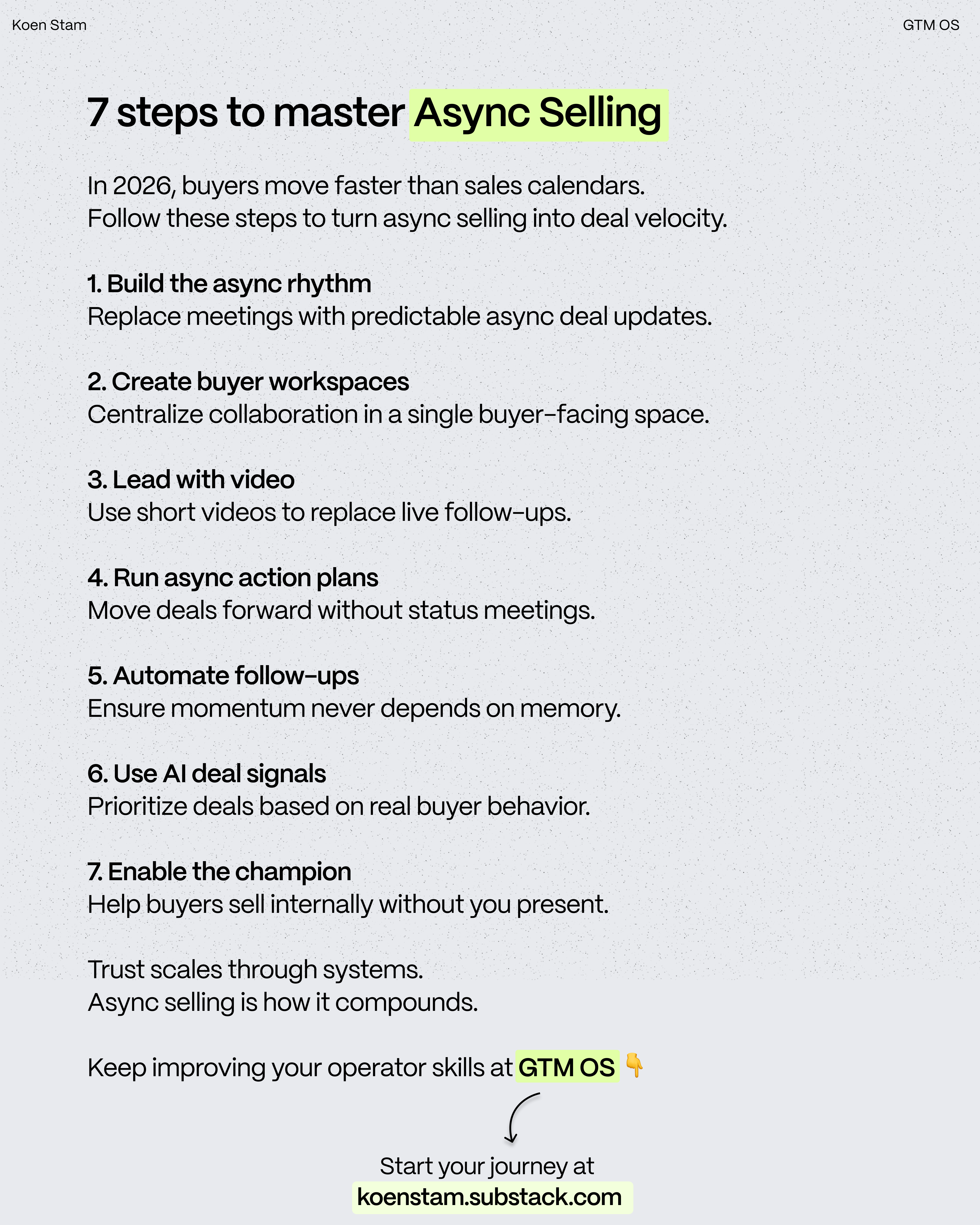
7 steps to master Async Selling
1. Build and Measure the Async Sales Rhythm
Why this matters
Async selling only works when the team replaces meetings with a predictable rhythm of short, clear updates.
How to execute it well
Replace non-essential meetings with async updates.
Set a weekly cadence of updates and recaps.
Use AI tools to summarize and assign tasks automatically.
Record short Loom or Vidyard clips after key calls.
Share updates through CRM or Slack.
Track meeting reduction rate and deal velocity.
Reward reps who create movement without meetings.
What good looks like
Buyers always know the next step without booking another call.
Common mistakes and fixes
Treating async as optional → make it part of pipeline hygiene.
Long updates → keep under two minutes.
No metrics → track velocity and engagement.
2. Starte leveraging Digital Sales Rooms
Why this matters
Sellers need a shared place to align champions and stakeholders when sellers are not there.
How to execute it well
Use a digital sales room platform such as trumpet.
Include only key assets: overview, ROI model, proposal, MAP.
Record a short video tour of the workspace.
Add comment threads for quick async updates.
Sync engagement data with your CRM.
Review who viewed which assets weekly.
Update content asynchronously as deals progress.
What good looks like
Buyers use the workspace to collaborate internally before your next meeting.
Common mistakes and fixes
Too much content → keep focused.
Ignoring analytics → use alerts to prioritize follow-up.
One template for all → customize per deal type.
3. Master Video Selling
Why this matters
Video creates trust faster than text and keeps async selling human.
How to execute it well
Record personalized videos for intros and recaps.
Use AI assistants to suggest context and tone.
Keep videos under ninety seconds and focused.
Share inside the sales room or by email.
Track open and view-through rates.
Use AI to draft follow-ups and personalize before sending.
Build a shared library of high-performing templates.
What good looks like
Every buyer touchpoint feels human, specific, and clear.
Common mistakes and fixes
Generic messaging → reference buyer goals.
Poor quality → good light, clear audio.
No CTA → always close with the next step

4. Run Mutual Action Plans Asynchronously
Why this matters
MAPs create accountability and remove the need for check-ins.
How to execute it well
Build a shared plan with milestones and dates in Digital Sales Rooms like trumpet.
Share early with all stakeholders.
Update asynchronously using short videos or notes.
Let AI send MAP reminders and summarize updates.
Review progress in deal forecasts.
Use MAP as your reference during live calls.
Measure MAP completion rate and velocity.
What good looks like
Deals progress through shared ownership, not meetings.
Common mistakes and fixes
Keeping the MAP internal → make it buyer-facing.
Overcomplicating → focus on 3–5 steps.
Ignoring analytics → review weekly.
5. Automate the Follow-Up Loop
Why this matters
Follow-ups create velocity. Automation prevents delay.
How to execute it well
Connect CRM, email, and digital sales room.
Use AI to generate meeting summaries and actions.
Send recaps as async updates within an hour.
Auto-remind for idle deals.
Prioritize by engagement score.
Personalize before sending; AI drafts, reps edit.
Track average follow-up time and conversion.
What good looks like
No buyer ever waits for the next step.
Common mistakes and fixes
Full automation → always human-review.
Generic tone → add specific insights.
Poor prioritization → use engagement data.
