The 90-second version
We sometimes, in tech, really think that everything is AI. On a scale of 1 to 10 we are maybe at a 7 or an 8. Most of our customers are at a 2 or a 3. Understand the maturity your buyer has.
An old rule kept my forecast honest this week: every Commit deal backed by deals worth 1.5 to 2 times its value. And 1 question on every Best Case deal: signed before Christmas, yes or no?
You see a future leader in what they start unasked. The bar I now hire leaders on: coaching in depth, and the automation that buys the time for it.
The European read: your partners in each country know where that market really is on adoption. Ask them before you pitch the future.
The thread: count what is really there, not what you hope is there.
Read time: ~8 min

11 working days, 7 or 8 against 2 or 3, 4 candidates, 2 partner directors, 1 lunch
Our forecast went up, for November and for Q4. We still need to work quite hard 6 weeks before Christmas.
Hi, it is Koen Stam and welcome to GTMcraft OS: The European GTM Operator. This newsletter is built from 100,000+ GTM signals collected from 100+ operators and founders, combined with 13+ years of my own lessons and failures from the trenches. I write at the intersection of go-to-market practice and AI-powered systems for founders and GTM operators scaling their next 2M, 5M or 10M ARR.
Lesson 1: in tech we think everything is AI
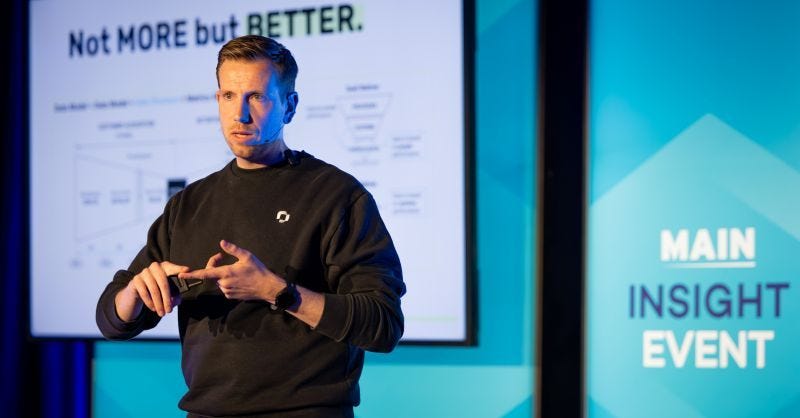
We sometimes, in tech, really think that everything is AI. I work for a technology company where the founder, the CRO and everyone in the organization are really AI-first. We want to be part of the 10% best-in-class global GTM teams that run on AI. Because we talk AI all the time, we tend to forget that most companies are not at that level.
On a scale of 1 to 10, we are maybe at a 7 or an 8. The majority of our customers are maybe at a 2 or a 3. And we say this to a lot of industries, so it is not one deal. If you pitch AI and the customer is not at that level, or does not find it the most important for now, you miss the boat. Sometimes the basics are more important than the AI features. They might see a mismatch, and not go along with you as a vendor.
At lunch on our partner day I sat with two partners, each running their own firm. One of them called it out. There are still companies that don’t use any AI, across all kinds of industries, and they are making loads of money.
My take: always do a deeper discovery: how mature and how tech savvy is your buyer, really? Know where the majority of your customers sit on adoption, and watch your first call to second meeting rate. And partners are a very valuable source of that intel: they already work inside a lot of our customers. For a new customer, that intel feeds the BDR, marketing, the AE and the partner manager. For an existing customer, it feeds the AE, the account manager and the CSM.
The European read: a partner in each country knows where that market really is on adoption. Ask your partner in each market where the buyer really is.
Do first: ask your 3 closest partners one question: of the clients you share, which are not there yet on AI, and why? Write the answers next to your open deals. Founder fallback: no partners yet? One lunch with 2 customers who know your market, same question.
Do this week: before your next 5 first calls, ask the partner closest to each account where it really is: not there yet, testing, or running. Founder fallback: the same 3 marks in your pipeline sheet, from your own calls.
Do this month: bring 2 or 3 partners together and give them time to talk to each other, not only to you. Founder fallback: repeat the customer lunch.
The rule: understand the maturity your buyer has before you sell it the future. Your partners know where it is.
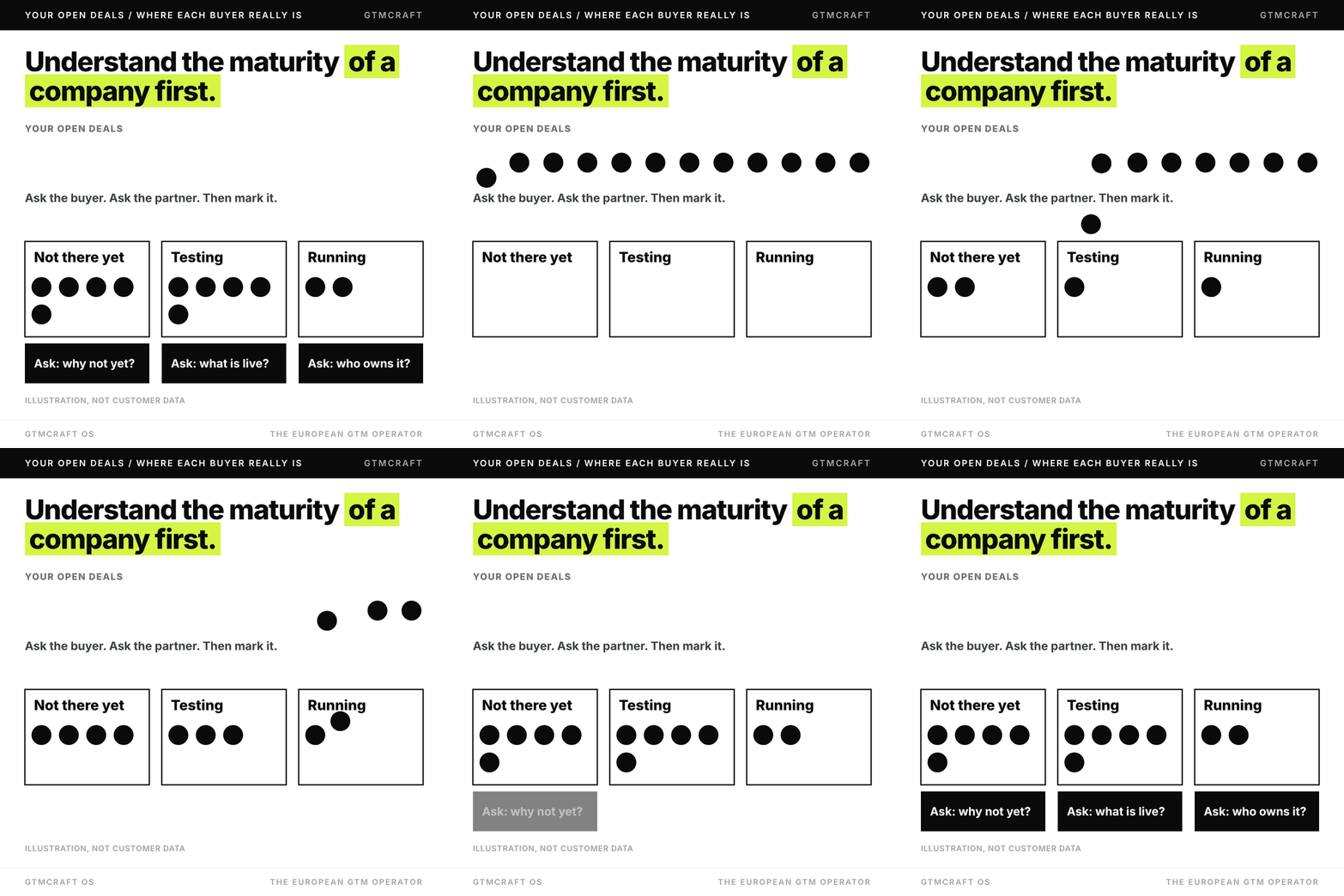
You know it worked when: every open deal carries a maturity mark, and the next step you pitch matches it. Founder read: your last 5 first calls each have a mark and a next step the buyer agreed.
The play: How to build a partner-led growth loop, in 5 steps. It turns what your partners already know about a customer into the next deal, new or existing.

Lesson 2: every Commit deal needs 1.5 to 2 times its value behind it
Our forecast went up this week, for November and for Q4. One of my markets already hit its plan in early November. That is mid-market execution: we grew our larger mid-market deals there 4 to 5x on last year. Between EUR 80k and 100k ACV each, more complex, and not standalone deals. Mid-market is not about the naming. It is about the complexity and the size of the deal.
One of those complex deals gives us better control. We can pull it forward into November, and that will most likely close the small gap we had to our overall plan. It is an old rule: always have enough upside and enough backup deals to bring you to the number.
On Friday I saw the same rule in a pipeline review with a sales team I coach. One seller had committed a number, and still had sufficient backup deals. A very solid pipeline. I suggested the question below in a sales meeting on Friday. It has not been asked yet. It needs to be asked this week, and the same counts for every AE in my own international teams.
My take: you have your deals in Commit, a deal you would bet your number on, and in Best Case, a deal that could sign but you are not yet sure. Those in Commit need to be backed by Best Case, and Best Case needs to be backed by pipeline. For each key deal you want to close, you want deals worth 1.5 to 2 times its value behind it. And for every Best Case deal, the question this week is: with only 6 weeks left before Christmas, do you see a possibility we get this signed off before Christmas? Yes or no? If yes, we work out what needs to be done so you and I can start it together. Otherwise it is simply no pipeline.
The European read: December is uneven across Europe. Holidays start on different days per country. Ask the yes-or-no question per country, against that country’s last working day before the break.
Do first: list every deal in Commit. Next to each, write the deals, worth 1.5 to 2 times its value, that would replace it if it slips. A Commit deal with nothing behind it gets a red mark. Founder fallback: your 5 biggest open deals in a sheet, 20 minutes, even alone.
Do this week: ask the question on every Best Case deal: signed before Christmas, yes or no? Yes: write what must happen, and who does it with the seller. No: out of the number. Founder fallback: ask it yourself, deal by deal, and write the answer down.
Do this month: for the team I coach, a weekly pipeline briefing goes out before the sales meeting: 1 for the team, 1 doc per seller, 1 for the CEO or head of sales. Each carries 2 follow-up suggestions from the knowledge base. Build the same. Founder fallback: run 1 prompt in Claude on your CRM export every Friday.
The rule: every Commit deal has deals worth 1.5 to 2 times its value behind it. Every Best Case deal gets a yes or a no.
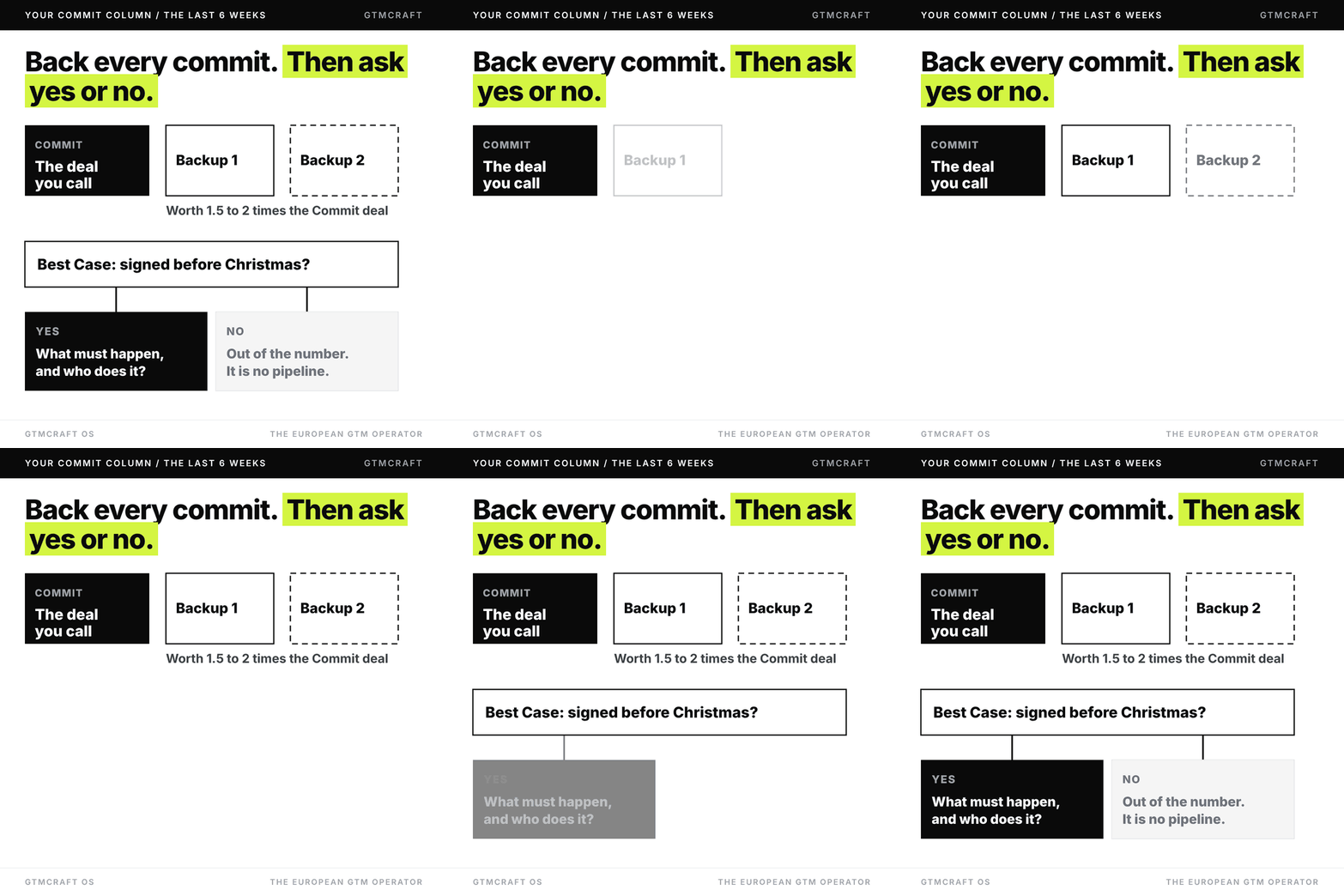
You know it worked when: every Commit deal shows its backup by name, and your forecast accuracy holds as December closes. Founder read: each of your top 5 deals has a written yes or no and a dated next step.
The play: How to strip the vanity out of your pipeline and forecast, in 5 steps. It counts only deals with a dated next step and forecasts on quality-weighted coverage. Want your own AI to write that weekly briefing on your CRM? That is the job of the GTMcraft Operator Brain, below.

Lesson 3: you see a future leader in what they start unasked
One of my leaders set up a meeting with our head of international marketing and our regional marketing manager, to discuss next year’s marketing investment. He took the initiative himself. It shows a leadership style where you understand that you need each other: partnerships need marketing for events, for co-marketing, for joint campaigns. You could see partnerships and marketing as competitors: both work for sourced opportunities. For us it is one team. Marketing helps partnerships and vice versa, because marketing knows that investing in partnerships also helps marketing-sourced opportunities.
The same week I interviewed for a sales development team lead. 4 really good candidates. 2 are further on GTM engineering and AI.
My take: future leaders you see in behaviour. And the leader of tomorrow needs more than leadership skills. You need to lead, move people and coach in depth. But you also need to know how to automate processes, how to use AI, how to become more like a GTM engineer, the person who builds the automations in your GTM stack. Why? It saves time. Time you can spend on developing your people. That is a trait I will now look for in any leader. And it is 6 weeks before Christmas. Your roles need to be filled as soon as possible, or you are already behind on capacity in early Q1. You own the momentum and the speed. If not, you will fail.
The European read: a leader across countries works with marketing per market: different events, different partners, different languages. You need each other.
Do first: write down the 2 traits for your next leader hire: coaching depth, and automation. For each, the behaviour you want to see. Founder fallback: your next hire, even if it is not a leader, same 2 lines.
Do this week: add one task to your case round: “Show me 1 process in this team you would automate, and what you would do with the hours.” Score it next to the coaching part. Founder fallback: ask it in your next hire’s interview, 10 minutes.
Do this month: look at your current leaders. Who started something across teams that nobody asked for? Write it down and name it in your next 1:1. Founder fallback: your first seller, same question.
The rule: look for what a leader starts unasked. Then hire for coaching depth, and for the automation that buys the time for it.
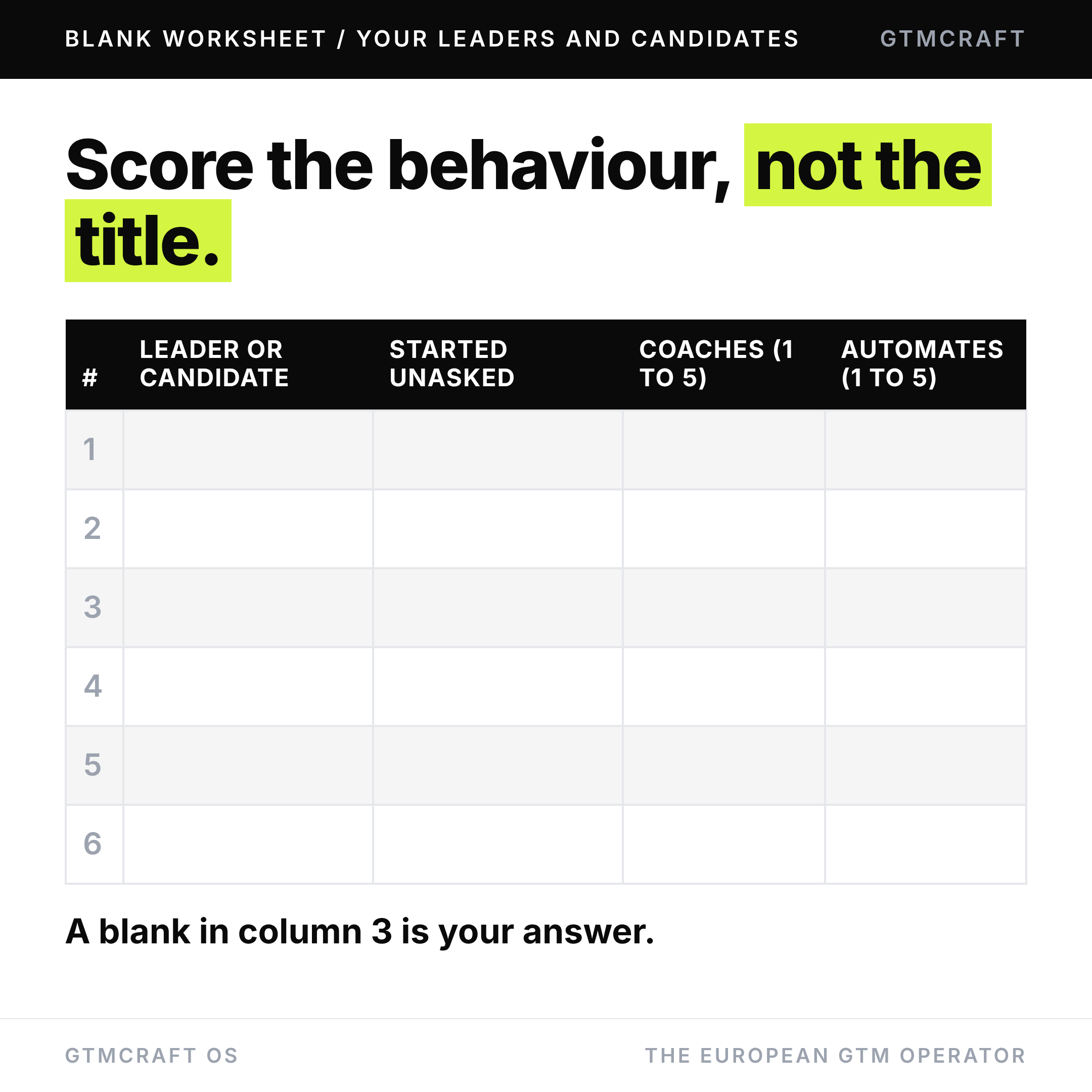
You know it worked when: every leader hire in your next round is scored on both traits. The role is filled before your first working week of January, and the new lead runs their first coaching session in week 2. Founder read: your next hire’s case included one automation task.
The play: How to hire GTM bar-raisers on a real work sample, in 5 steps. It scores candidates on a paid task against your best performers, not on a polished hour.

Save this. 3 lessons from my week, each with a play you can run today.
Send it to 1 founder whose forecast still counts every Best Case deal.
Why this matters now
November closes on Monday 30 November. From today that is 11 working days in November, and 14 more in December before Christmas week starts on Monday 21 December. A Best Case deal you ask yes or no about this morning gets all 25. Ask the question today, and start 2027 on a roll.
3 questions for the room
Which of your open deals is pitched ahead of where the buyer really is on AI, and which partner could tell you?
Which Commit deal has nothing behind it if it slips this week?
Which of your leaders started something across teams last month that nobody asked for?
Go deeper with GTMcraft Operator Brain
Scale on plays and skills, not prompts. This play and 250+ more are free and live in GTMcraft OS on Notion.
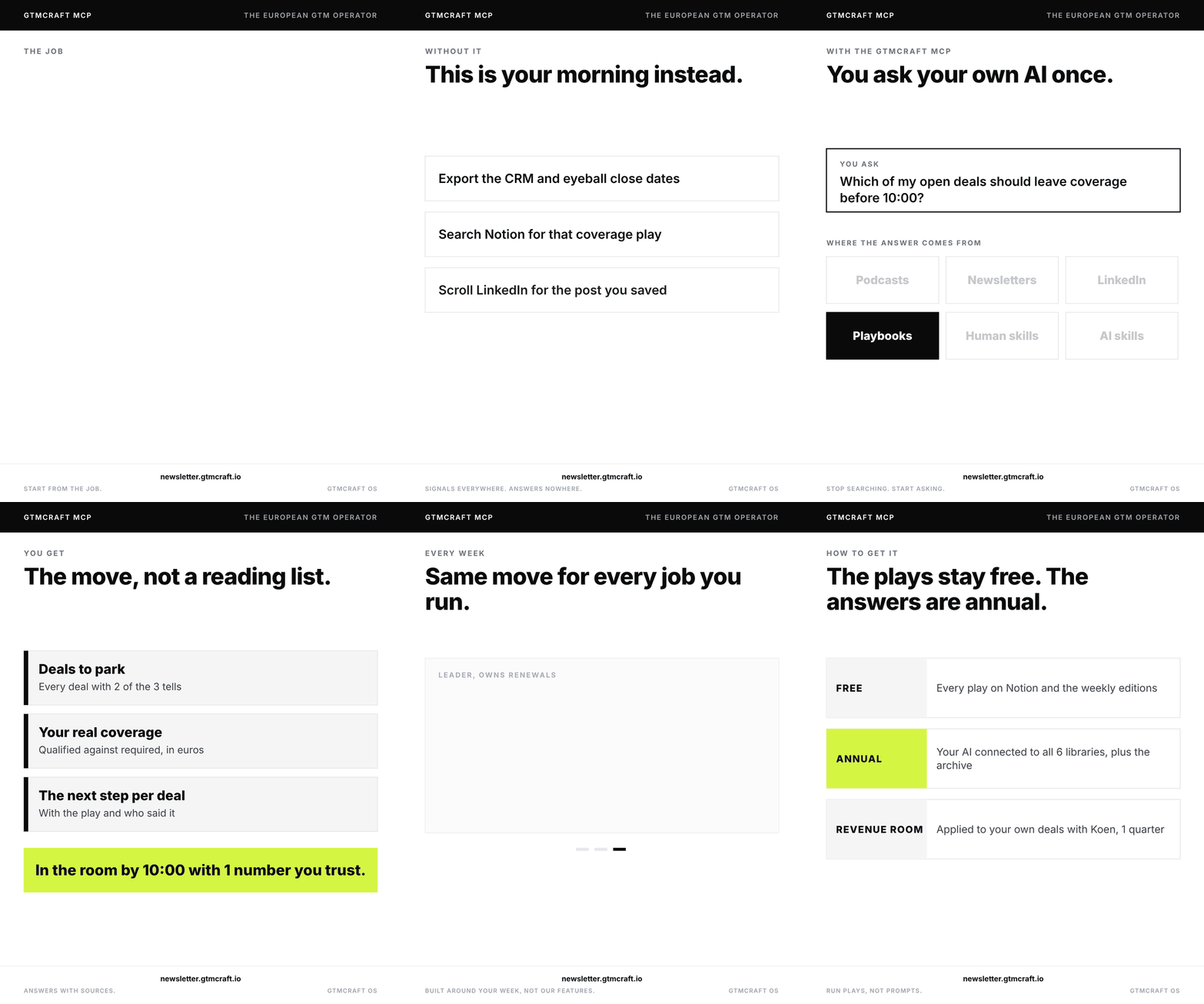
The GTMcraft Operator Brain is the connection, and you can buy it on its own: EUR 297 a year. Every play, every lesson and every source behind them, inside your own AI and next to your own deals. 6 libraries: podcasts, newsletters, LinkedIn posts refreshed daily, playbooks, human skills and AI skills. The aim is simple: 5 to 10 percent better execution on the number you own. Connect it once and ask it which Q4 deals have power, and which need that meeting by 13 November.
The first 50 keys went out this weekend.
Get your GTMcraft Operator Brain key, EUR 297 a year, or reply Operator Brain to this email.
The Revenue Room
8 people, 1 quarter. European B2B SaaS founders and GTM leaders who own the number. I tell you what I would do in your seat, you run it. A hotline with an answer within 48 hours, a case-led call every 2 weeks, and 1 private session with me.
The Q4 room started on 23 October. The Q1 2027 room opens in January. Reply JANUARY to this email to hear first, and bring your 2 coverage numbers to the first call.
Master your human GTM skills AI can’t replace inside GTMcraft,
Koen
Your (human) GTM Coach
—
PS. Co-written by Wispr Flow + my GTMcraft Newsletter Skill + Claude Opus 5.5; edited & approved by Koen