The 90-second version
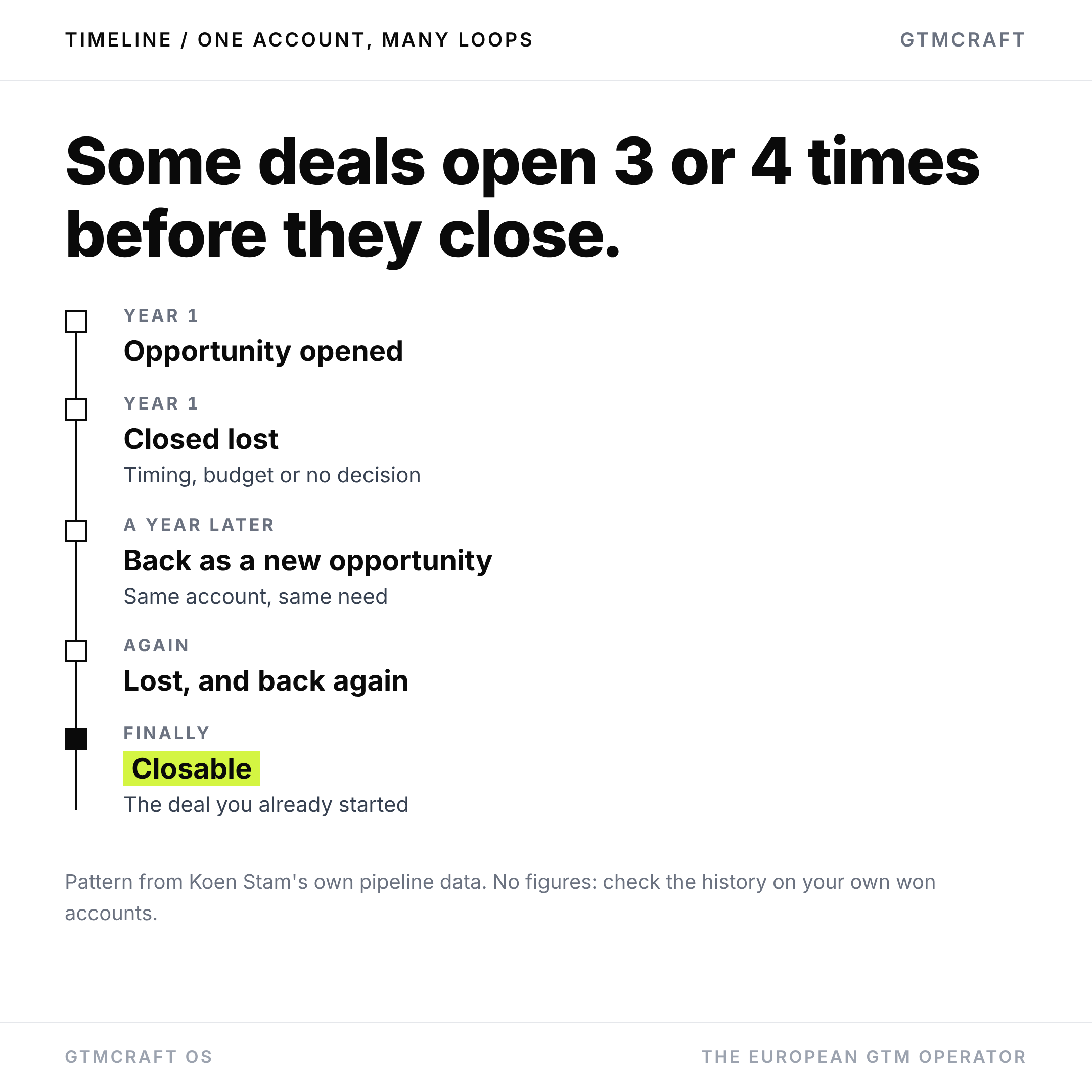
The best idea in my week came from a whiteboard session with a peer operator, not from my team. Lost deals come back. Some open 3 or 4 times before they can close.
Of 4 candidates this week, we wanted 2 and hired 1. Recruitment is sales: if you want the person, you close.
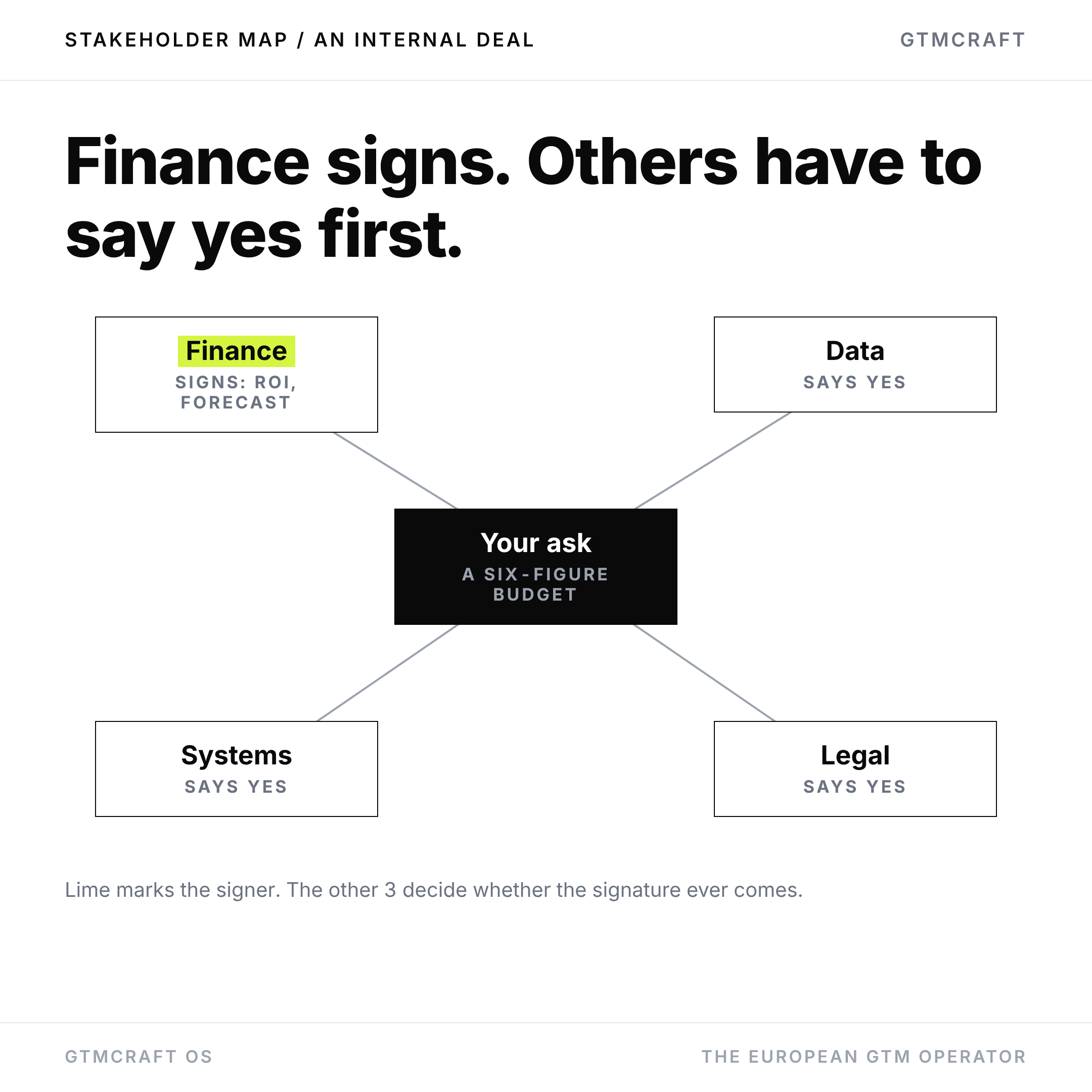
A six-figure budget is not signed by finance alone. Data, systems and legal say yes too. An internal deal runs the same play as a customer deal.
The European read: in a market with a finite list of companies, a lost deal is next year’s pipeline, and every week an offer slips moves the start date by a notice period.
The thread: the deal you already started is worth more than the one you have not, if you work it like a deal.
Read time: ~8 min

4 candidates, 3 planning 1:1s, 2 hires wanted, 1 whiteboard
Today is Monday 26 October. A 24-month pull of your closed-lost deals reaches back to 26 October 2024. An offer signed by Friday on a notice that ends 30 November starts on 1 December. Let it slip past month end and the start moves a full month.
My word for the week was compounding. A peer conversation, a hire and a budget each came back to the same lesson: run it like a deal.
Hi, it is Koen Stam and welcome to GTMcraft OS: The European GTM Operator. This newsletter is built from 100,000+ GTM signals collected from 100+ operators and founders, combined with 13+ years of my own lessons and failures from the trenches. I write at the intersection of go-to-market practice and AI-powered systems for founders and GTM operators scaling their next 2M, 5M or 10M ARR.
Lesson 1: the deals you lost are already in your 2027 plan, or should be
The idea that stuck this week came from a whiteboard session with a peer operator.
The concept was closed loops. I have seen it in our data many times. Opportunities come back as new opportunities a year later, two years later. Some open 3 or 4 times before they reach a state where they can close.
That evening we brought it into an operator dinner. I also brought it into my 2027 plan. I discussed it with my counterpart in another market, and he called it a smart idea straight away. Do not start with net new. Start with what we already have in the system, and how we get it out.
My take: founders and operators default to solving it alone. We do not dare to put the real problem on the table. What I notice is that there is usually another leader who faces the same challenge, or has already solved it. You have to ask, and you have to be a bit vulnerable. It can work best one to one: a whiteboard, an intimate dinner, a peer you trust.
The European read: in a smaller market the list of companies in your segment is finite. A lost deal is not a lost logo. It is a buyer who already knows you, in a market where you cannot buy a fresh list every quarter.
Do first: open your last 10 closed-won deals. For each, check whether the account had an earlier opportunity, open or lost, and write the loss reason. Count the wins with a prior opportunity. 20 minutes. Founder fallback: the deal history on the company record in HubSpot or Pipedrive.
Do this week: export closed-lost from the last 24 months. Drop the deals lost on hard fit. Rank the rest by fit and old deal size, and find 1 recent change per account for the top 10. Founder fallback: top 10, 1 hour.
Do this month: add a field for prior opportunities on every new deal. Report the share of wins with a prior opportunity next to net-new pipeline in your 2027 plan. Founder fallback: a column in your plan sheet, filled once.
The rule: before you plan net new, count what already came back.
You know it worked when: you can say what share of last quarter’s wins had a prior opportunity, and the lost list has an owner and a weekly slot. Founder read: you know which 10 lost accounts you will call this month.
The play: Access it here. 5 steps to revive closed-lost deals into pipeline. It drops hard-fit losses and reopens each account on a real change, not a timer.
Lesson 2: we wanted 2 hires and hired 1, because recruitment is sales
We had 4 candidates in process this week. We wanted to hire 2 of them. We hired 1.
The bar I hire on is true intrinsic motivation: why do you want to work with us, and can you grow beyond the role you are hired for? For the partner manager role, the growth pattern was the investment. The candidate did not yet have direct experience in that exact role. The case, the interviews across the board and the real willingness to work with us made the call.
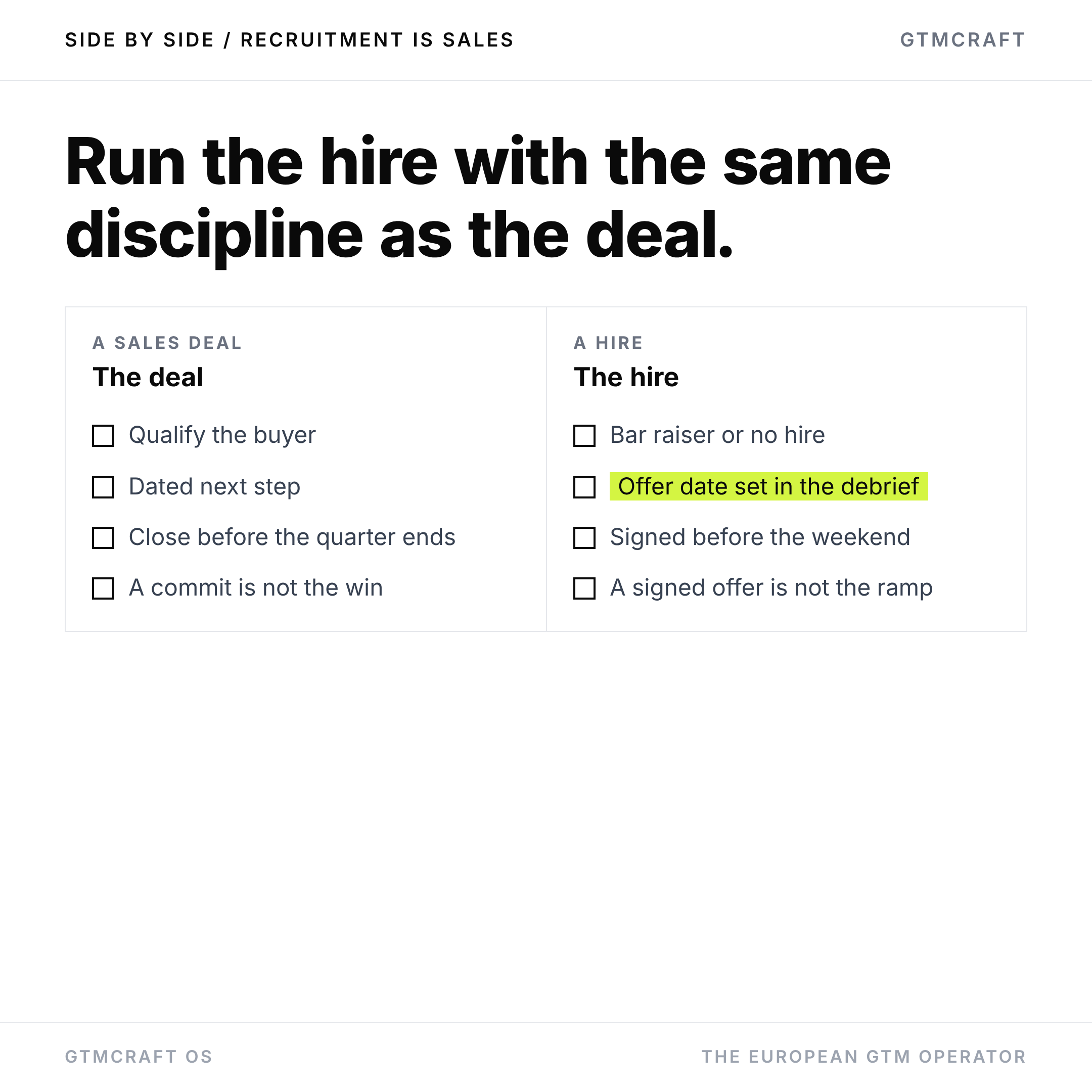
On Wednesday we knew we wanted to go to offer. The goal was simple: signed before the weekend. Do not let it slip, the same as any sales deal.
My take: many leaders say recruitment is sales. Fewer run it that way. If you really want someone, and you are convinced they want it too, you sell and you close. You put the next steps in the calendar. And if I cannot hire a bar raiser, I ask whether I should hire at all, because the alternative is more productivity from the team I already have. We still need headcount to reach our goals. That makes the closing discipline more important, not less.
The European read: in many European markets a signed offer still sits behind a notice period of 1 to 3 months. Signed by Friday 30 October on a notice that ends 30 November, your hire starts on 1 December. Slip into November and the start moves to January.
Do first: list every open role with its finalists. Next to each finalist, write the next step and its date. A finalist you want with no dated next step is a deal going cold. Founder fallback: one line per candidate in your notes app, 10 minutes.
Do this week: for every finalist you want, agree the offer date in the debrief, not after it. Book the offer call before the panel leaves the room. Founder fallback: you are the panel, so book it the same day.
Do this month: track time from final interview to signed offer per hire. Then read the new hire’s one number after their first full sales cycle. Founder fallback: 2 dates and 1 number per hire in a sheet.
The rule: a finalist you want gets a dated next step before the debrief ends.
You know it worked when: every finalist you want has a dated next step, and you know your days from final interview to signed offer. Founder read: your last hire signed inside a week of the final interview.
The play: Access it here. 5 steps to ramp a new rep to real pipeline. A signed offer is the commit, not the win. The play names the hire’s one number on day one and reads it after one full cycle.
Lesson 3: my budget request ran the same play as a customer deal
This week I worked a six-figure integration budget toward sign-off. It looks like one approval from finance. It is not.
Finance wants the ROI, the dependencies, the risks, and the forecast against the investment. Then the work needs people from data, from systems and from legal. Each one has to say yes: this is the right thing, the right investment, the right ROI. It felt almost like an internal fight.
The same week I had three 1:1s on the existing-business plan. Planning season. We worked through the stretch, the potential, the risks, the dependencies and what we need. How do they see it? How do I see it?
My take: a one-pager and a hope does not get an internal deal signed. You sell it internally. Recruitment, a budget, headcount in next year’s plan: multiple stakeholders, never decided in one go. So I put follow-up tasks in my own calendar, because these conversations go cold otherwise. Every plan is a sales play. You show ambition, because that is the job of a sales leader. You also play defense, so you prepare. I call it a healthy battle, and you only win it aligned.
The European read: when a company runs across countries, finance and legal may sit in another office and work in another language. Write the case so it survives a forward: numbers, risks and dependencies in plain words, no team slang.
Do first: take your biggest open internal ask. Write the one-page case: ROI, dependencies, risks, forecast against the investment. Then list every person who must say yes, not only the one who signs. 30 minutes. Founder fallback: your co-founder and your lead investor are the list.
Do this week: book a short conversation with each person on that list before the decision meeting. Put a follow-up task in your calendar for Friday. Founder fallback: one message to each, then a Friday reminder.
Do this month: run next year’s plan the same way. Map who signs, who must agree and who can block, and prepare the defense for the 3 numbers most likely to be challenged. Founder fallback: 1 page, the 3 numbers and your answers.
The rule: every internal ask gets a one-page case and a stakeholder list before it gets a meeting.
You know it worked when: your next internal ask arrives at the decision meeting with every stakeholder already spoken to. Founder read: your investor has seen the case before the board call.
The play: Access it here. 5 steps to engage the economic buyer before the deal stalls. Read it with yourself as the champion: name the person who signs and their goal, carry a one-page case up, and inspect your coverage every week.
Save this. 3 lessons from my week as a European operator, each with a play you can run today.
Send it to 1 founder or GTM operator building next year’s plan on net new alone.
This week’s play to steal
Lesson 1 started with a peer conversation. The same habit pays most before a senior hire. Founders and operators default to solving it alone. The fix is to buy an hour of judgment from someone who already ran the decision, then hire against a standard you can finally write.

Fixes: a senior GTM hire in a function you have never run, judged on a resume because you cannot yet grade the role.
Best for: 2-10M teams about to hire their first sales, marketing or customer success leader. Across markets, pick an advisor who ran the decision one stage ahead in a market like yours.
The 5 steps:
Name the one decision inside the role you cannot yet judge. One decision, not the whole job.
Retain one advisor for that decision, 2 to 4 hours a month. The deliverable is a standard you can hire against.
Build a keep-warm bench of 3 to 5 names, 18 to 24 months from ready.
Run one 30-minute call with each name every quarter. Ask what they are learning, not whether they want the job.
Review the bench against the advisor’s standard before you write any senior req.
Template: one bench row per name. Spikes at, has never run, the one project you would give them on day one, last contact date. Score each 1 to 5 against the advisor’s standard. A blank contact date drops the row.
Paste this into your AI:
Here is the senior role I am about to hire for and my last 2 quarters of GTM notes: [paste]. Draft 3 decisions this role makes in its first 90 days and rank them by how hard I would find it to grade a candidate’s answer. Then draft a one-page brief for an advisor on the hardest one: the decision, why I cannot judge it, the standard I need, 2 to 4 hours a month, a 90-day review. Do not invent names or facts.
Why this matters now
Most 2027 plans are being written this month, and most start with net new. Run it the other way. Count the deals that already came back. Close the hire you want before the notice period moves the start date. Sell your own budget like a customer deal, with every stakeholder on the list.
3 questions for the room
How many of your last 10 wins had an earlier opportunity on the same account?
Which finalist you want has no dated next step on your calendar today?
Who has to say yes to your biggest internal ask, besides the person who signs?
Join The Revenue Room
8 people, 1 quarter. European B2B SaaS founders between 1M and 10M ARR and GTM leaders who own the number. I tell you what I would do in your seat, you run it. No course, no content library, nothing to fall behind on.
A hotline. A private group nobody outside it sees. Post the problem that is on your desk, any working day, and you have my answer within 48 hours, plus whatever the other 7 have run into before. You never solve a complex one alone again.
A 90-minute call every 2 weeks, case-led. You post your case 48 hours ahead, 3 cases get the floor, and I tell you what I would do, stop doing and measure by Friday. Next call you come back with what happened and we keep solving problems together.
1 private 60-minute session with me, placed where it moves your number most.
I have scaled B2B SaaS to 10M ARR 3 times now and I run a GTM org pushing toward 40M ARR, in Europe. You get what I am running this quarter, not what I remember from 2019.
Master your human GTM skills AI can’t replace inside GTMcraft,
Koen
Your (human) GTM Coach
—
PS. Co-written by Wispr + 3 GTMcraft Skills + Claude Opus 5.5; edited & approved by Koen