


The 90-second version
Your champion likes the deal. Nobody has written your number into the buyer’s 2027 plan, and for most buyers finance is writing or signing that plan now. Ask for the date.
The date math: 6 Mondays are left before Friday 18 December. Your 1-page case reaches finance by 30 November.
One play, 5 steps: ask for the sign-off date, name the owner, co-write 1 page, reach finance before the CFO, fit the approval path.
The European read: the pain sits in your market, and the budget can sit at HQ in another country and language. Ask whose budget it is before you write a word.
A deal with no sign-off date and no named owner is not lost. It is a Q2 deal. Forecast it there, honestly, today.
Read time: ~9 min

Hi, it is Koen Stam and welcome to GTMcraft OS: The European GTM Operator. This newsletter is built from 100,000+ GTM signals collected from 100+ operators and founders, combined with 13+ years of my own lessons and failures from the trenches. I write at the intersection of go-to-market practice and AI-powered systems for founders and GTM operators scaling their next 2M, 5M or 10M ARR.
The problem: your best deal is not yet a line in your buyer’s 2027 plan
From my week: in the client sales team I coached on Friday, the one from Monday’s edition, a lost deal came up. I asked: “Is it a fit for our ICP? The use case that is the customer’s number 1 problem: is that exactly the use case we solve best?” And: “Ask how they stack-rank their priorities.” In the same call, a rep had a buyer who could pay part now and part in early January, because of the budget they still had this year. He checked it with me: 2 invoices, and the deal lands fully in this year. Another rep heard a prospect say no budget would be freed up. That one is for next year.
The split deal found budget that was still there. The other starts 2027 as a request.
Here is why November matters. Your buyer’s finance team writes next year’s plan in the last months of the year. Calendars differ, so ask for the date. Unbudgeted requests wait for a reforecast, and compete with every other unplanned ask.
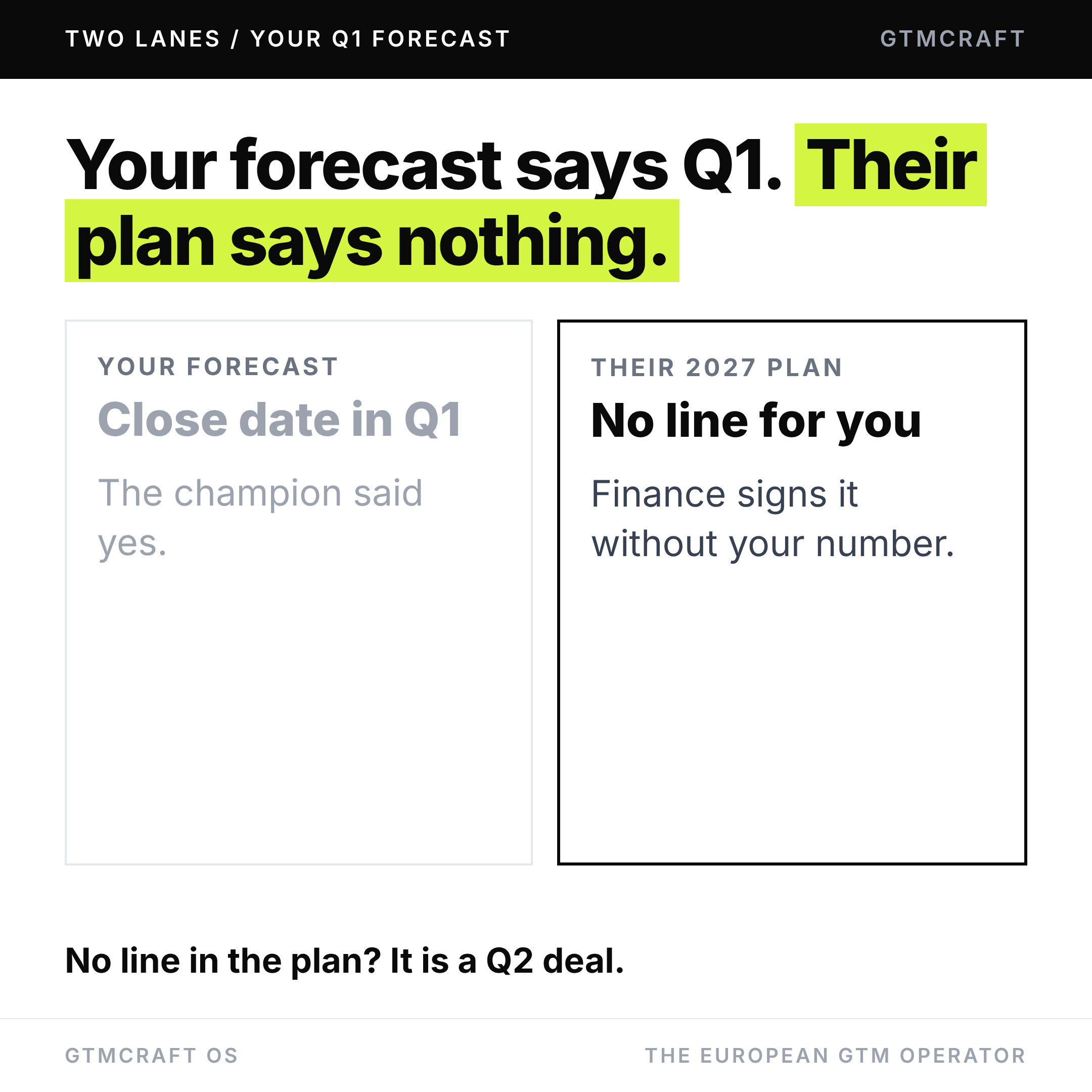
Your forecast says Q1. Their plan says nothing.
Why it happens
Chris Orlob asked a panel of CFOs how sellers should reach them (LinkedIn, 25 August). Their first answer: “We don’t want to be involved early.” The CFO shows up at the end. If nobody briefed finance, the deal arrives as a surprise. In Orlob’s words: “Surprises get rejected.”
The champion carries the gap. Collin Cadmus (LinkedIn, 5 August): buyers spend 3 to 10 times more time selling internally than sellers spend selling to them.
Krysten Conner says it about your own pipeline (LinkedIn, 29 September): “The pipeline we need in February gets built in October. It never gets built in February.” Your buyer’s plan runs on the same clock. Doug Bell (Cannonball GTM, 27 October), crediting Angela Hill, gives the rule behind it: “A pain with a clock on it beats a pain without one, every time.” That clock is finance’s sign-off date.
My take: I sit on the other side of this table too. On 2 September I wrote about a call with finance on next year’s expectations, and a session that went through next year’s plan line by line. I wrote the rule down then: “The plan is not written in the planning meeting. It is written in whichever month you still had other people’s attention.” My read: it is true for your buyer too. The vendors already in that conversation make the sheet. The rest become a request in the reforecast.
So budget is not a qualification box for me. It is a step with a date. In October I put the customer version in one question: can the buyer put us in next year’s budget as 1 fixed number. For a new logo it comes earlier. Who writes the line? When is it signed? What do they need from us to write it?
The coaching lines are the human half. A use case third on their list never makes the sheet. So I ask for the stack-rank first.
The cost is real. You ask a busy champion for work in November, and some deals will tell you there is no line. Good. That is a Q2 deal. I would rather forecast it there in November than find out in February.
The play: get your deal written into the buyer’s 2027 budget
Fixes: a deal your champion loves that is not a line in the buyer’s next-year plan. Best for: sales-led teams whose deal size needs finance sign-off. It bites hardest with multi-country buyers whose budget sits at HQ in another market. Time: 1 hour to tag your open deals. Then 1 step per Monday until 7 December, with 14 December as buffer.
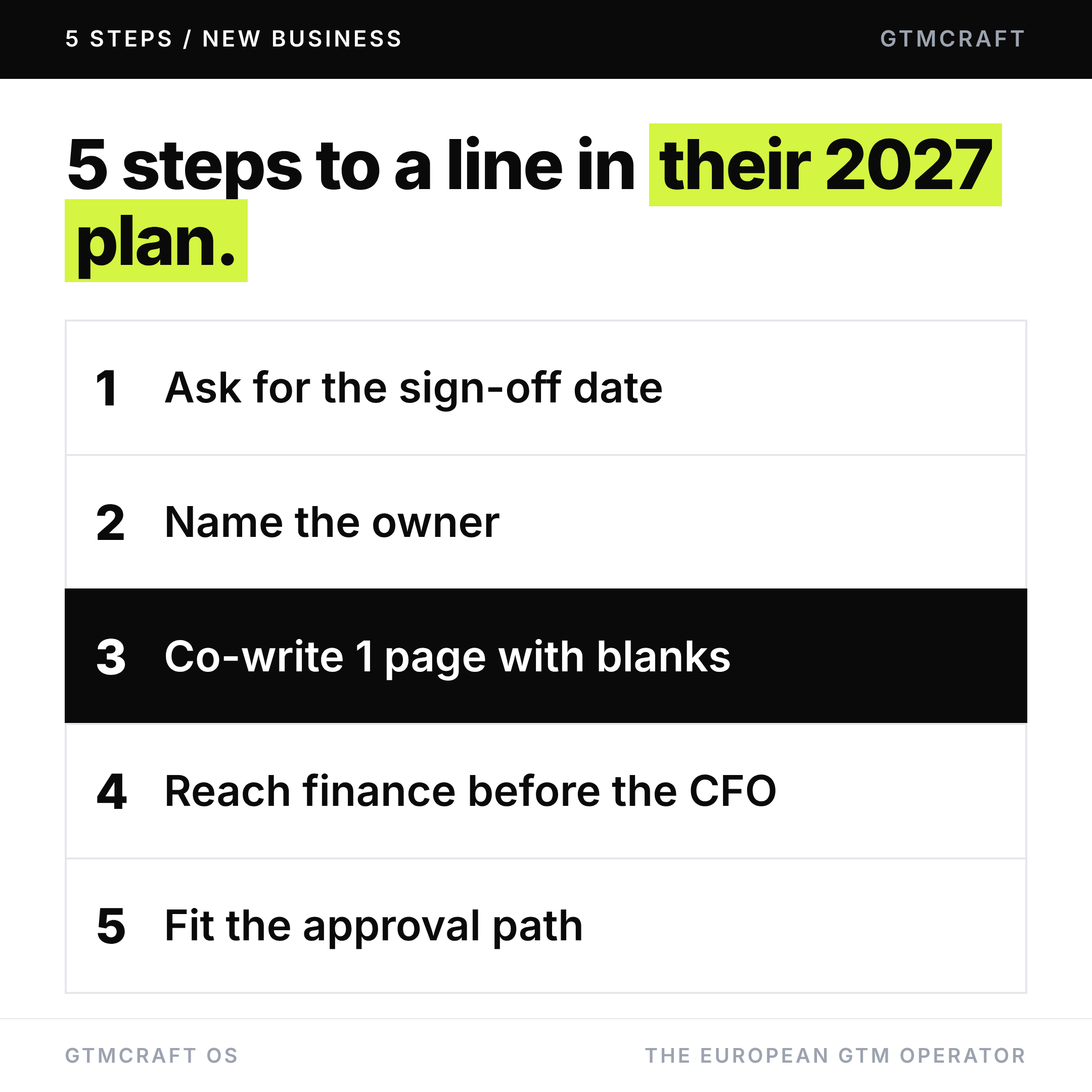
Step 1: ask for the sign-off date
You cannot work back from a date you do not have. Nate Nasralla (LinkedIn, 24 August) asks: “When will FP&A start working with you on next year’s operating plan?” FP&A is the finance team that builds the plan. CJ Gustafson (Mostly Metrics, 8 September) notes planning is going continuous, with monthly reforecasts. So the date is the default slot, not a wall. It is still the cheapest one. If their plan closed in October, go straight to Step 5: a phase 1 on this year’s remaining budget.
Do it: on every open deal above your average deal size, ask: “When does finance sign off next year’s plan, and what has to be on the sheet by then?” Write the date in the deal. In Salesforce, make it a required field from proposal stage.
Founder version: your 10 biggest open deals, 1 email or 1 line in your next call each. 30 minutes this week.
Done when: every open deal above your average size carries a sign-off date or the words “unknown, ask”. Unknown counts as no date.
Step 2: name the owner whose number breaks without you
A friendly contact is not an owner. Orlob’s CFOs were blunt: “If your champion can’t do that, you don’t have a champion. You have a contact who likes you.” His better question: “What steps does your company need to take to make a confident yes or no decision on this?”
Laura McDonald (30 Minutes to President’s Club, 15 September) adds the method. Draft the buyer’s org chart and have the champion correct it live. Every name they add, cut or skip shows who holds the budget.
Do it: per deal, write the person whose 2027 target fails without this, and the use case’s rank on their list. Rank 3 or lower: ask what would move it up. No answer means a Q2 deal.
Founder version: 1 drafted org chart per top deal, on screen in your next call. 15 minutes each.
Done when: each deal names an owner, a role and a rank, confirmed by the buyer, not guessed.
Step 3: co-write 1 page with blanks
This step does the work. Nasralla’s 5 blocks (LinkedIn, 27 August): a headline tied to an existing exec priority, the problem, the recommended approach, the target outcomes, the required investment. His warning: stacking them up at the end of the cycle is too late.
Orlob asked 3 CFOs what lands (LinkedIn, 10 August): “One page. Clear ROI. Clear timeline.” Show a best, base and worst case. And: “Co-author it. Don’t author it.” One CFO tests the champion with 1 question: “So you’re committing to this?”
Do it: draft the page in their words, with blanks marked ___ where only they know the number. Send it with 1 line: “What did I miss?”
Founder version: 1 page in a shared doc, 45 minutes, for your top 3 deals only.
Done when: the champion has edited the page and filled at least 1 blank.
Step 4: get the page to finance before the CFO sees it
Orlob’s panel named the route: the FP&A business partner, the finance person who works with your champion’s team and meets the CFO weekly. Krysten Conner on Outbound Squad (31 August): “Sometimes we need to bring in finance because they’re going to have a say right away.”
Do it: ask your champion: “Who in finance works with your team on next year’s plan?” Ask the champion to send them the page, not you.
Founder version: the same question, 1 line in your follow-up email. No finance partner? The owner from Step 2 sends it to whoever signs.
Done when: your champion confirms a named finance person has the page, before the sign-off date.
Step 5: fit the number to the approval path
A line can still stall at signature. Nasralla asks: “What’s the threshold for single-signature approvals?” Then trim the deal to sit under that limit, or split the order across 2 budget years. Conner (LinkedIn, 6 October) shows the late version: a deal sold in month 5, frozen by a new CTO as final approver. “By the time we find the stranger, we have 3 weeks and a holiday calendar.”
Do it: per deal, write the approver, their limit and the route. Offer phase 1 on this year’s remaining budget, phase 2 as the 2027 line.
Founder version: 1 question in your next call: “Who signs at this amount, and is there a faster route?” 2 minutes.
Done when: the deal’s euro value sits under a named approver’s limit, or on a named 2027 line.
The template
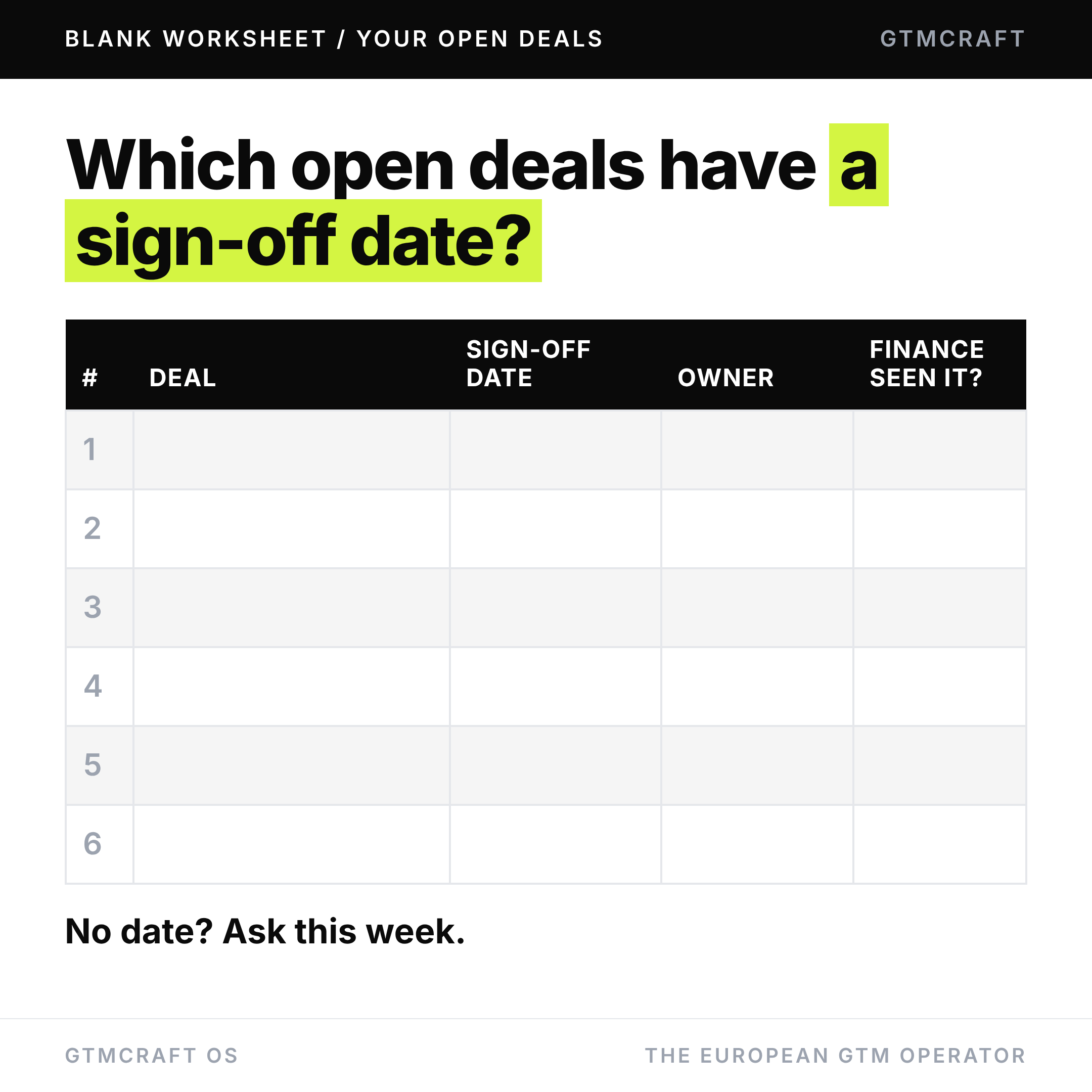
One row per deal: euro value, sign-off date, owner and rank, page edited, finance aware, approver and limit. Score the person who signs on Orlob’s scale (LinkedIn, 11 August): 1 unaware to 5 engaged.
Paste this into your AI:
Here are my call notes per open deal: [paste]. For each deal, give the buyer’s finance sign-off date, or “unknown, ask”. Name the owner whose target depends on this, or write “missing”. Give the use case’s rank on their priority list. Draft a 1-page case in 5 blocks: headline tied to their priority, problem, approach, outcomes, investment. Add a best, base and worst case, with blanks marked ___ where only the buyer knows the number. Score the person who signs from 1 to 5, with the line of evidence. End with the 1 question to ask this week. Do not invent dates, names or numbers. Mark anything missing as missing.
With the GTMcraft MCP, your AI already has the play, the skill and the sources: no paste.
The European read: the pain sits in your market, and the budget can sit at HQ in another country. Your champion may not own the line. Ask whose budget it is and which entity pays before you write the page. Then write it in the language finance reads.
The rule: a deal without a sign-off date and a named owner is not Q1 pipeline.
You know it worked when: every open deal above your average size shows a sign-off date and an owner. Your Q1 forecast counts only deals with a sign-off date and a named owner. Fewer deals slip out of Q1 at your first January forecast. Founder read: you can name the sign-off date of your 5 biggest deals without opening the CRM.
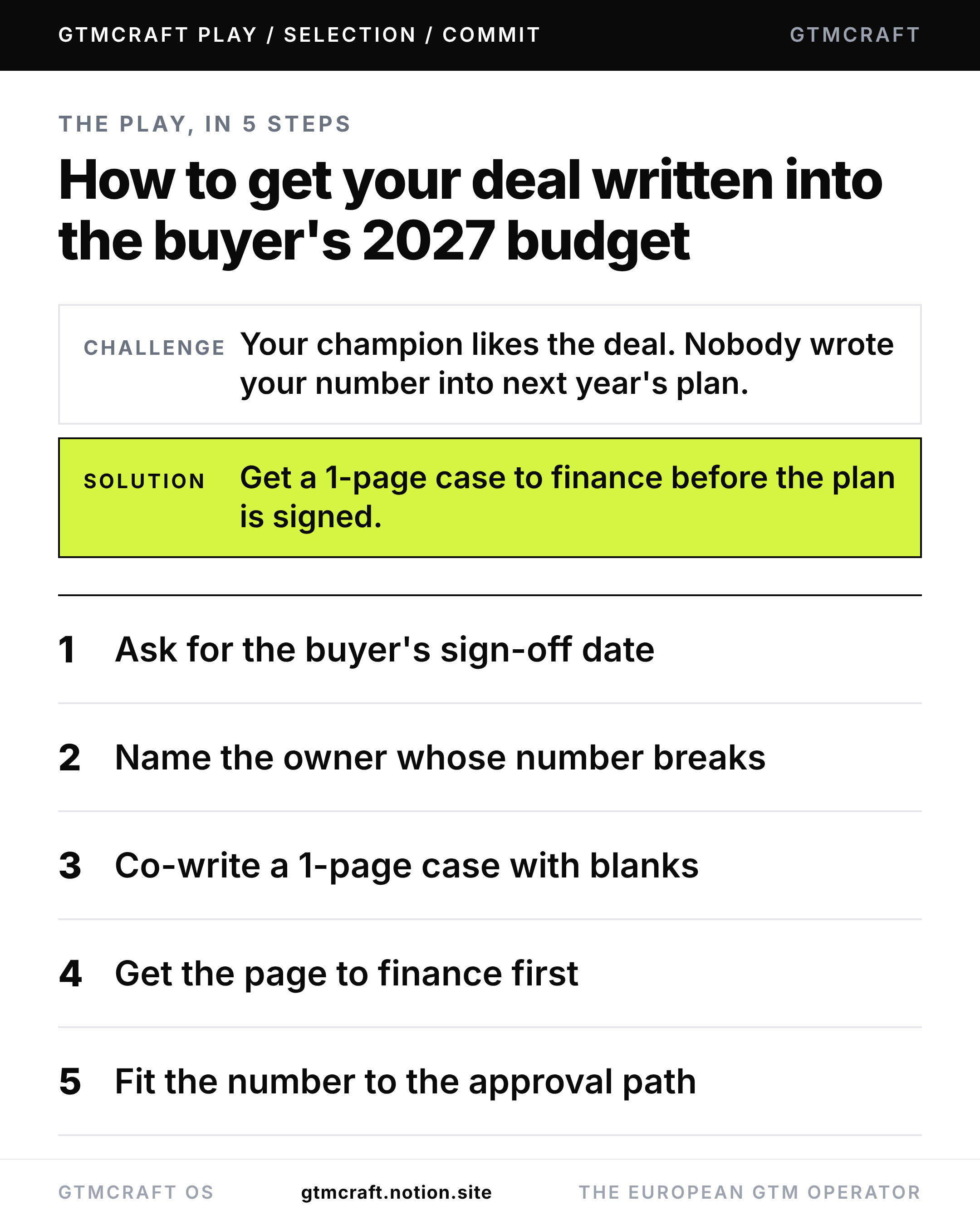
Where this play sits on your bowtie
A budget line is won in Selection and cashed in Commit. 3 plays that connect to this one, all free:
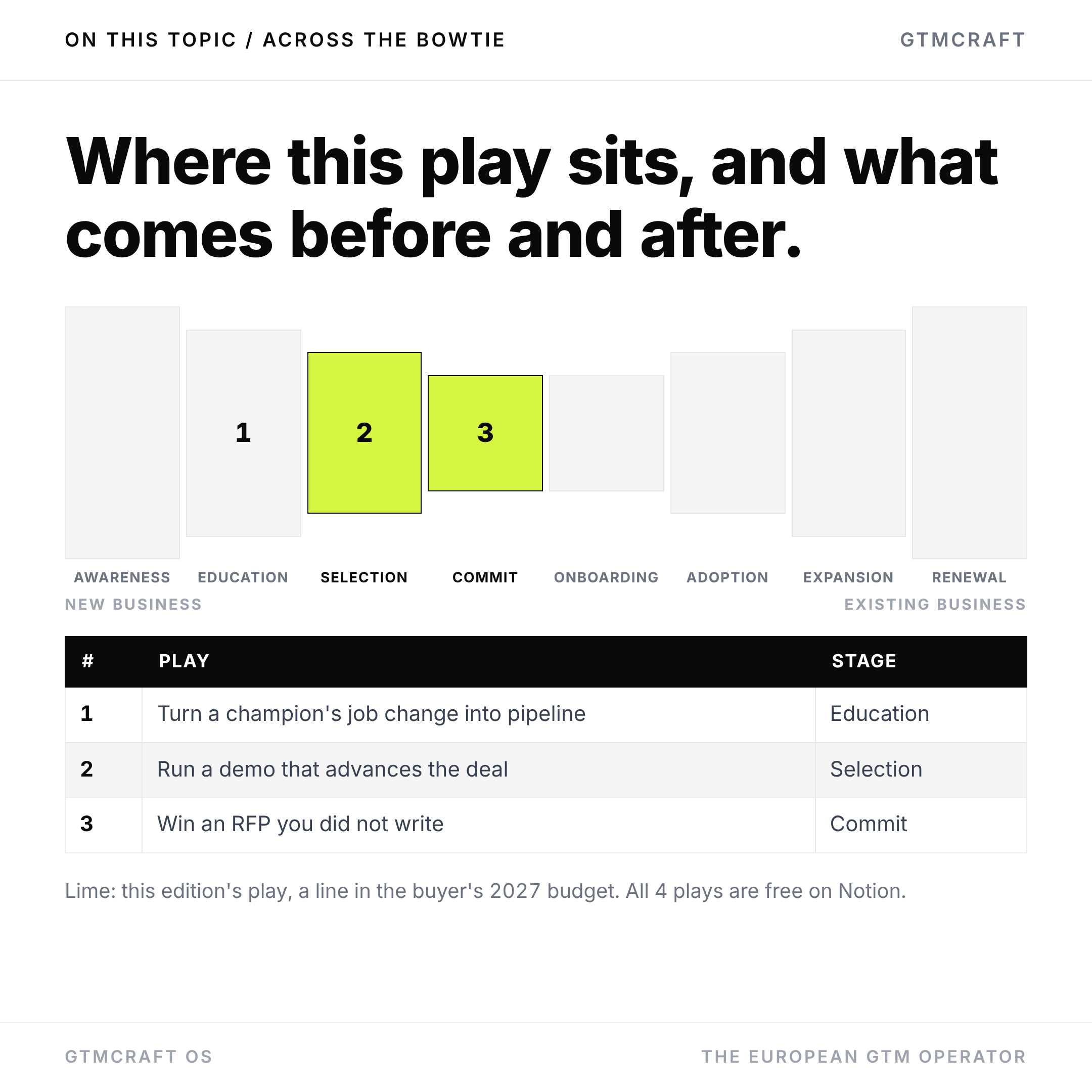
1. Before, Education:
How to turn a champion’s job change into pipeline, in 5 steps.
A champion who moved jobs knows how your page gets written.2. Alongside, Selection:
How to run a demo that advances the deal, in 5 steps.
Ask the sign-off question while everyone is in the room.3. After, Commit:
How to win an RFP you did not write, in 5 steps.
Some budget lines become a tender. Shape it before it lands.
All 250+ plays across the bowtie are free in GTMcraft Plays on Notion.
Save this for your next forecast call. Send it to 1 founder whose Q1 depends on deals nobody has budgeted.
Key sources
The 6 sources that shaped this play. The full list of 13 lives in the play.
LinkedIn. Chris Orlob, “I interviewed 3 CFOs on how to sell to finance approvers” (10 August 2026). One page, 3 cases, and the champion who must commit to it.
LinkedIn. Nate Nasralla, the dark budget and the finance calendar (24 August 2026). The sign-off question and the approval limit behind Steps 1 and 5.
Newsletter. Cannonball GTM (Doug Bell), “Nobody Owns Your Buyer’s Pain: Find It First” (27 October 2026). Why a pain with a clock wins.
Newsletter. Outbound Kitchen (Elric Legloire), “Your 5-step system for outbound Q4” (8 October 2026). 14 selling days in December, and Christmas week attendance down 78% (Gong).
Podcast. 30 Minutes to President’s Club with Laura McDonald, “How Mapping the ‘Shadow’ Org Chart Got Me to 305% of Quota” (15 September 2026). The live org chart in Step 2.
Podcast. Outbound Squad (Jason Bay) with Krysten Conner, “Tackling new territories, multi-threading, and more” (31 August 2026). Why finance comes in early.
Why this matters now
From Wednesday 4 November to Friday 18 December there are 33 weekdays and 6 Mondays, fewer where your buyer has a public holiday, such as 11 November in Belgium or 8 December in Spain. One step per Monday: dates by 9 November, owners by 16 November, pages by 23 November, finance by 30 November, the approval path by 7 December. Monday 14 December is your buffer. In Christmas week, Gong found meeting attendance fell 78%. Ask the first question today.
One question for the room
How many of your open deals above your average size have a finance sign-off date written on them?
Go deeper with GTMcraft MCP
Scale on plays and skills, not prompts. This play and 250+ more are free and live in GTMcraft OS on Notion.
The GTMcraft MCP is the connection, and you can buy it on its own: EUR 297 a year. Every play, every lesson and every source behind them, inside your own AI and next to your own deals. 6 libraries: podcasts, newsletters, LinkedIn posts refreshed daily, playbooks, human skills and AI skills. The aim is simple: 5 to 10 percent better execution on the number you own. Connect it once and ask it which Q4 deals have power, and which need that meeting by 13 November.
The first 50 keys went out this weekend. Get your GTMcraft MCP key, EUR 297 a year, or reply MCP to this email.

The Revenue Room
8 people, 1 quarter. European B2B SaaS founders and GTM leaders who own the number. I tell you what I would do in your seat, you run it. A hotline with an answer within 48 hours, a case-led call every 2 weeks, and 1 private session with me.
The Q4 room started on 23 October. The Q1 2027 room opens in January. Reply JANUARY to this email to hear first, and bring your 2 coverage numbers to the first call.
Master your human GTM skills AI can’t replace inside GTMcraft,
Koen
Your (human) GTM Coach
—
PS. Co-written by Wispr + 3 GTMcraft Skills + Claude Opus 5.5; edited & approved by Koen

"A deal with no sign-off date and no named owner is not lost. It is a Q2 deal." That's a more honest forecast than most pipelines carry in November. Asking for the date feels awkward, and it's still cheaper than finding out in January.