The 90-second version
Awareness: open on the account’s own words, not a line a machine could have written from a funding announcement.
Education: about 95% of your buyers are not in market this quarter, and they decide later on something you are probably not funding.
Selection: commit your board to the account timeline before you start, because the first quiet quarter is when the programme gets cut.
The European read: EUR ACV, several languages and consent-based outreach change how each of these runs, not whether you run them.
The thread: what you fund in the next 2 weeks shows up as pipeline in Q1, so concentration beats a new channel.
Read time: ~10 min

This week’s number 1 move
List every growth motion you run, write who actually runs each one, and fund only the 1 or 2 that compound.
Most founders at this stage run 5 or 6 at once. Founder outreach, inbound, outbound, partner, community, and a self-serve trickle. Each gets a slice of the week. None gets enough to pay back.
This matters now because of timing, not tidiness. Acquisition pays back on a lag. What you fund now produces pipeline in Q1, and what you cut now is a Q1 hole you will not see until February.
From my week: I spent 90 minutes on Friday with the executive I report to, going through next year’s investment cases and where the marketing money goes. We kept landing on the same bottleneck, which is where new pipeline actually comes from.
My take: I made this call once and it was not comfortable. We were running too many motions across several markets, each one half-fed. I pulled the data through the bow tie and looked at where growth actually compounded. Then we did the hard thing. No new channels, same team, same budget, and we executed better on what already worked. My rule has not changed since. Pick one market, one segment, or one motion, and win it before you add another. If your growth stops the moment your spend stops, you are running a campaign, not a system. Most founders find their own name next to 4 or 5 motions. That is the real cap.
Do first: write down every motion you run and put your own weekly hours next to each. Founder fallback: one line per motion on paper, no CRM report needed.
One row per motion. Your hours, the owner, the pipeline. The blank column is the answer.
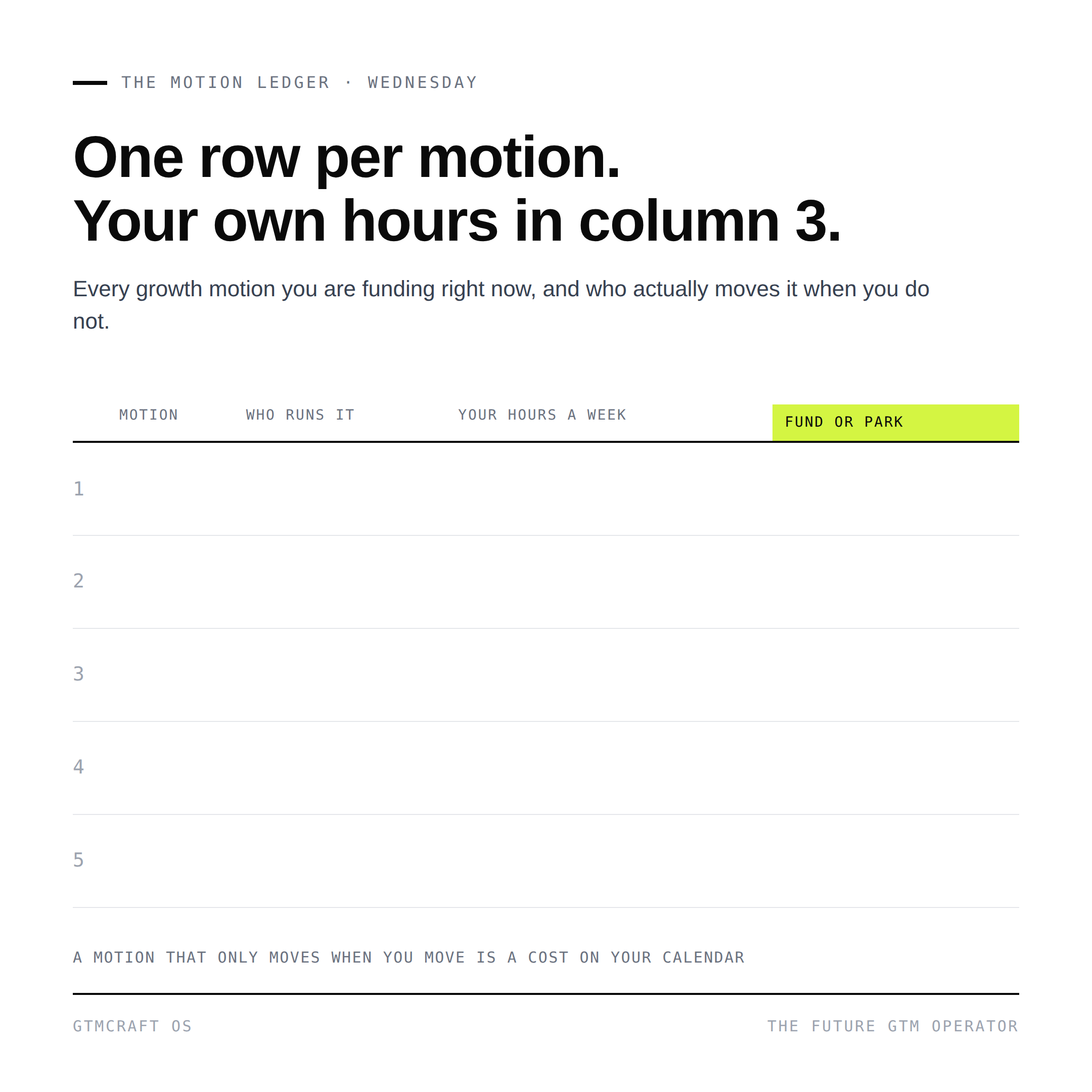
The rule: if a motion only moves when you move, it is a cost on your calendar, not a channel. Park it or hand it to an owner who is not you.
Sources: Winning by Design (David Gordo), “How to evaluate your GTM motions to optimize revenue efficiency”; Koen Stam, “Three years ago, we made a hard call. No new channels. Same team. Same budget.” (LinkedIn)
Hi, it is Koen Stam and welcome to GTMcraft OS: The European GTM Operator. This newsletter is built from 100,000+ GTM signals collected from 100+ operators and founders, combined with 13+ years of my own lessons and failures from the trenches. I write at the intersection of go-to-market practice and AI-powered systems for founders and GTM operators scaling their next 2M, 5M or 10M ARR.
Problem 1: your first line proves you read the news, not the business
From my week: This week I reviewed a pilot that scores first and third-party intent and points the outbound team at a much shorter list. The targeting got sharper in a fortnight. Nothing in it changed what the first line says once a rep gets there.
Your first touch is the whole bet. A senior buyer decides in about 3 seconds whether that line was written for them. A funding-round mention proves you read the news. It does not prove you understand their business.
The failure is not effort. Your reps are sending plenty. Nobody set the standard for what the first line has to do, so 10 reps improvise 10 openers and you have no method to coach.
AI made token personalization free, so a first name and a round size now read as automation. Elric Legloire showed a rep booking VP-level meetings by turning a company’s own tagline into the opener, then tying it to the problem the rep solves.
My take: I closed a EUR 50k deal earlier this year on a first impression I had made 12 months before it, and that does not scale as a tactic. What scales is the standard behind it. A better tool does not fix a weak first line. It delivers it to a better list. My job as the owner is not to send more. It is to set the layer the number rides on. So I make the standard the account’s own words, prove it by hand on 10 accounts first, then let AI carry the research. The judgment about whether a connection is real stays with me and the rep, never with the tool.
The European read: in several of your markets the buyer’s own words are not in English, and the line that carries their identity sits on a local-language site. Mine the local positioning, then write the opener in the buyer’s language, not a translated guess. Consent-based outreach also means the relevance has to be real and specific to the account.
Do first: export 20 recent first lines across every rep and read them side by side. Founder fallback: read your own last 20 sent openers, no sequencer report needed.
Do this week: write the one first-line standard, the account’s own brand or positioning line, tied to the problem you solve.
Do this month: run the standard by hand on 10 accounts, then automate only the research, never the send.
The rule: if you cannot find a real connection between their words and your problem, drop the account. Never force a line that reads as a trick.
You know it worked when: your meeting to opportunity rate rises, not just your reply rate. Founder read: 3 of your last 10 openers quote something only that account says.
The play: 5 steps to make your first line the account’s own words (2026 series). Inlined in full below.

Sources: Outbound Kitchen (Elric Legloire), “Why this enterprise rep’s outbound stands out”; Backlinko and Pitchbox, “We analyzed 12 million outreach emails, here is what we learned”; Koen Stam, “Last week we closed a EUR 50k deal using a strategy you rarely see anymore” (LinkedIn)
Problem 2: you filled the room and never built the follow-up
From my week: Two rooms in 2 weeks. 320 people at one, 35 senior buyers at the other. On Friday the executive I report to asked me what the real follow-up is, and how my managers hold anyone to it. I did not have a good answer.
Your demand generation probably only sells to the 5% ready to buy this quarter. About 95% of your buyers are not in market. Content and events that only chase the form leave the real game unplayed.
Capture plays look efficient on a weekly dashboard, because form fills are easy to count. They also starve the pipeline 90 days out, when the buyers you never courted pick someone else.
The creation line is the first thing cut when the plan gets squeezed, because its payoff lands on a lag. Chris Walker’s read is blunt: most spend chases the few actively buying, and true demand gets built over time, not switched on.
My take: filling a room is the easy half, and I got the easy half right twice this month. The half that produces pipeline is what happens in the 6 weeks afterwards, and that is the half I had not put a goal or an owner against. That is the honest version. An audience you can contact is worth more than reach you rent, but an audience with no follow-up cadence is a mailing list you are proud of. So the fix I am running is not more events. It is one named owner, one goal, and a weekly number for the 6 weeks after every room we fill.
The European read: an owned audience beats rented reach harder here, because consent rules make cold lists expensive and legally thin. A first-party audience of engagers, followers and event contacts is one you can actually contact. Run the creation motion per market in local language, and read the lagged pipeline per market, not one blended number.
Do first: open your last 5 campaigns or events and label each one capture for the 5% or creation for the 95%. Founder fallback: label your last 5 posts or emails, no ad account needed.
Do this week: name 1 owner and 1 weekly number for the follow-up on your most recent room, and ring-fence a creation budget the weekly form count cannot raid.
Do this month: build a first-party audience you own, and split the dashboard so creation reads on a 90-day lag.
The rule: if you judge a creation play on this week’s forms, you will cut it right before it pays. Read it on a 90-day lag and on leading signals.
You know it worked when: new pipeline starts self-reporting that they followed your content or attended your event months ago. Founder read: you can name the person who owns follow-up, and they report a number every Friday.
The play: 5 steps to measure and grow the 80% of buying your CRM never sees (2026 series). Builds the measurement layer for the buying that happens before anyone fills in a form, so the creation motion stops looking like a cost.

Sources: Chris Walker, “Capturing demand versus creating demand”; Cognism (Alice de Courcy), “Transition from lead gen to demand gen”
Problem 3: your board agreed the target and never agreed the clock
From my week: This week I worked through a plan that asks for more growth next year, which means the pre-investment has to start now. Campaigns and seats both. The closed revenue from any of it will not land until well into next year, and that gap is what nobody signs up for in advance.
Your account program pays back late, and your board rarely knows that going in. Mid-market runs 4 to 6 months from accepted to closed won. So work you do this quarter shows up as closed pipeline 2 or 3 quarters out.
The board approved the target but never agreed the horizon. So the first quiet quarter reads as a failing program and it gets cut right before it pays. The number that would have warned them, leading coverage, was never on the deck.
Andrei Zinkevich makes the point directly: leadership buy-in on a long, multi-touch horizon is the real challenge, and impatient companies squeeze short-term pipeline the moment they miss.
My take: I learned this the expensive way. I missed a pipeline number in one quarter and I paid for it 2 quarters later. The gap I created in January arrived in Q2, then again in Q3. So I now split active pipeline and future pipeline into 2 programs with 2 clocks. On a named-account program those accounts will not buy for months. If the board has not agreed that horizon, a quiet quarter reads as failure. So I commit the timeline in writing first, with the leading metric they watch weekly. Then a slow quarter is on plan. I refuse to quote a 400-touchpoint enterprise benchmark as if it were mine. I measure my own cycle.
The European read: a multi-market programme runs a different clock per region, because brand presence and buying committees differ across your markets. Commit a horizon per market, not one blended date, or a strong region hides a slow one. In EUR terms a 25k to 100k ACV band runs a shorter cycle than your largest accounts, so tier the timeline.
Do first: export your top 5 to 7 deals from the last 24 months and read the real cycle length behind each. Founder fallback: a HubSpot or Pipedrive export into a spreadsheet is enough, no attribution platform needed.
Do this week: replace the enterprise benchmark with your own measured cycle, and draft the dated milestones.
Do this month: bring a one-page timeline commitment to your board or your investors, and get the horizon and the leading metric agreed in writing.
The rule: if they sign the target but not the clock, any quiet quarter reads as failure. Commit the horizon before the first quarter, not after the first quiet one.
You know it worked when: coverage on named accounts is reported weekly and climbing, and nobody asks why revenue has not moved yet. Founder read: your investor update carries the leading number, not an apology.
The play: 5 steps to commit your board to the account timeline before you start (2026 series). Turns the horizon into a written, dated commitment with the leading metric attached, so a slow quarter is on plan.

Sources: Full-Funnel B2B (Andrei Zinkevich and Vladimir Blagojevic), “72-touchpoints ABM playbooks”; Boomerang, “B2B sales cycle length benchmarks by industry”; Koen Stam, “We missed our pipeline number in Q1” (LinkedIn)
Save this for your planning fortnight. Send it to 1 founder who is funding 6 motions thin.
Also on the radar
Two plays that protect the choice you just made, rather than adding a new one.
The focus defence. Once you have named the 1 or 2 motions that compound, the next threat is the channel someone in your own building wants to try in January.
Signal-triggered outbound. If you keep the outbound motion, stop running it on a fixed weekly cadence and start it on a buying signal instead. Same team, better timing, and it pairs directly with the first-line standard above.
Steal this move: write the one first-line standard in 4 weeks

Fixes: 10 reps improvising 10 openers with no standard, so the first line cannot be coached and reads as automation.
Best for: 2-5M and 5-10M teams running outbound into senior buyers across more than 1 language, where the account list is finite and a burned account does not come back.
The 5 steps (over 4 weeks):
Week 1, read what you send: export 20 recent first lines across every rep and sort them into account-specific and generic. Count the split before you change anything.
Week 1, write the standard: one sentence. The opener quotes the account’s own brand or positioning line, then ties it to the problem you solve. Nothing else qualifies.
Week 2, prove it by hand: run the standard on 10 named accounts yourself. In a non-English market, mine the local-language site, not the translated one.
Week 3, automate the research only: point your AI at the account’s own site, careers page and recent posts, and have it return the quotable line plus the source. The send stays human.
Week 4, coach against it: score every new opener 1-5 on the standard in your weekly review. Anything under 3 does not go out.
Template: a 1-5 rubric, one row per opener. Columns: the account’s own line quoted, the source it came from, the problem it ties to, whether a competitor could send the same sentence, and the score. Anything a competitor could send is a 1.
Paste this into your AI:
Here are 20 first lines my team sent in the last month: [paste]. For each one, tell me whether it could have been sent to any company in the same industry without changing a word. Then rewrite the 5 weakest, using only language from the account’s own website, and show me the exact sentence you took it from.
Full play, template and workbook inside GTMcraft OS. Reply or DM me to get access.
Why this matters now
It is the second half of September, and next year’s plan is open on the desk right now. A founder’s week is the scarcest input a lean team has.
The temptation in a planning fortnight is to add a motion. The evidence points the other way. High-growth companies pull most of their pipeline from a concentrated set of motions.
Cycles are 20 to 30% longer than in 2021, and buying committees have grown to 6 to 10 stakeholders. So acquisition pays back later, and a split effort pays back not at all.
The three stages sit on one clock. Awareness earns the reply. Education courts the 95%. Selection commits the board to the horizon before the quiet quarter arrives.
The craft in every stage is the human move. AI runs the research, the volume and the coverage maths, so a lean team can do less, better.
3 questions for the room
Which 1 or 2 motions would you defend on pipeline per founder hour, rather than on affection?
Who owns the follow-up on the last room you filled, and what number do they report on Friday?
Has your board agreed the account horizon in writing, or only the target?
Go deeper with GTMcraft OS
Scale on plays and skills, not prompts.
You do not need another newsletter, podcast or LinkedIn post.
You need the system under it.
Read the plays. Every single play is free and live in GTMcraft OS on Notion. Click through from any edition.
Build your own. GTMcraft OS members connect the full libraries, 100+ plays plus 100,000+ LinkedIn, newsletter and podcast signals, straight into their own AI or Claude context, so their team builds on the whole corpus instead of one-off prompts.
The single plays are free to read. Wiring the whole corpus into your own operating system, and keeping it current, is what the membership gives you.
Master your human GTM skills AI can’t replace inside GTMcraft,
Koen
Your (human) GTM Coach
—
PS. Co-written by Wispr + 3 GTMcraft Skills + Claude Opus 5; edited & approved by Koen