


The 90-second version
Your coverage ratio counts euros. Euros carry no clock, so a deal that moved its close date 3 times still counts at full value.
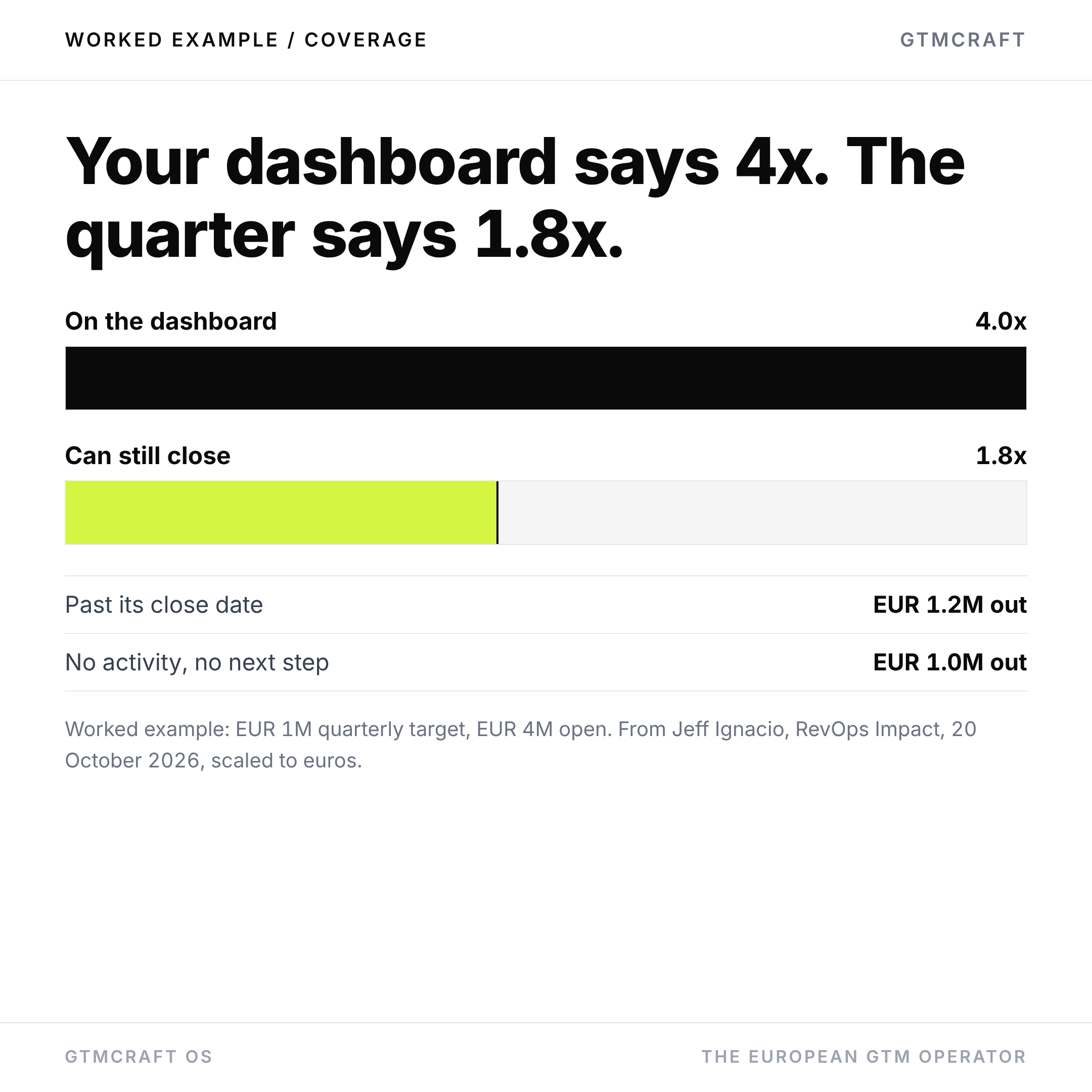
One worked example: a EUR 1M quarterly target with EUR 4M open reads 4x. Take out the deals past their date or with no next step, and 1.8x is left.
One play, 5 steps: count the pushes, draw your curve, strip the kicked cans, report 4 numbers, repeat every Monday.
The European read: mark 24 December to 1 January as non-working before you trust any December close date.
Stripped is not deleted. Lost deals come back, so the stripped list is the first place you look for next quarter’s pipeline.
Read time: ~9 min

Hi, it is Koen Stam and welcome to GTMcraft OS: The European GTM Operator. This newsletter is built from 100,000+ GTM signals collected from 100+ operators and founders, combined with 13+ years of my own lessons and failures from the trenches. I write at the intersection of go-to-market practice and AI-powered systems for founders and GTM operators scaling their next 2M, 5M or 10M ARR.
The problem: your coverage ratio counts deals the buyer never dated
From my week: as I wrote earlier this week, I keep seeing it in the data. Opportunities come back a year or two later, and some open 3 or 4 times before they are closable. My principle for next year’s plan: net-new pipeline matters, but so does how we improve win rates. Both start with knowing which open deals are real.
Coverage is the first number a board or a CRO asks for. The ratio has one blind spot. It counts euros, and a euro has no clock.
A deal that moved its close date 3 times counts at full value.
A deal with no meeting booked counts at full value.
A deal whose date sits on the last Friday of your quarter, because that is when your quarter ends, counts at full value.
So the dashboard says 4x while the pipeline that can still close sits closer to 2x. You find out in the last 2 weeks of the quarter.
Why it happens
Jeff Ignacio of RevOps Impact showed it on 20 October with one example. A $10M quarterly target. $40M open. 4x on the slide. Then $12M sits past its close date, and another $10M has no recent activity and no next step. That leaves $18M, or 1.8x. Divide by 10 for a EUR 1M quarterly target: EUR 1.8M of EUR 4M can still close.
He names the cause: the kicked can. The close date moves. The stage, the next step and the buyer stay the same. Reps push dates because killing a deal feels like losing pipeline.
There is a counter-case, and it matters. Krysten Conner wrote on 18 October that big deals always almost die. Silence on a large deal is a normal stage, not a verdict. So the play does not delete anything. It moves deals out of this quarter’s number and gives each one a way back.
My take: coverage is the number a board asks for first, and the one I trust least until I strip it. I have written the failure state in my own words: “We close hard in December, celebrate, and clean the pipe halfway.” Every January the same lesson. “You remove the maybe deals. The wishful thinking. The stuff that was never real.” What is left is the net pipeline. This play does that cleaning in October, with a counter instead of a mood.
In August I put the rule in 3 words: age beats stage. Green feels safer than a smaller honest number, so nobody pulls the deal. My test is simple. If I cannot name the next step and the date, it is not pipeline. I sort what is left into Must-Win, Optional and Dead, and I build coverage on the first 2 only.
The second reason is win rate. Moving from 25% to 30% is 20% more closed deals from the same pipeline. You cannot work on win rate while the denominator is full of deals that were never going to close. Strip first, then you see where you really lose.
The cost is real. Your number drops before you have the fix, and the board sees it. I would rather report 1.8x I can defend than 4x I cannot. And stripped is not deleted. I have watched those deals come back. They go in a bucket I mine first when I build next quarter.
The play: strip dead pipeline out of your coverage ratio
Fixes: a coverage ratio that looks safe because it counts deals that stopped moving.
Best for: founders who report one coverage number to a board, and GTM leads running it by team. It bites hardest in December, when holidays turn buyer dates into hopes.
Time: one afternoon to the first strip list. 10 minutes every Monday after that.
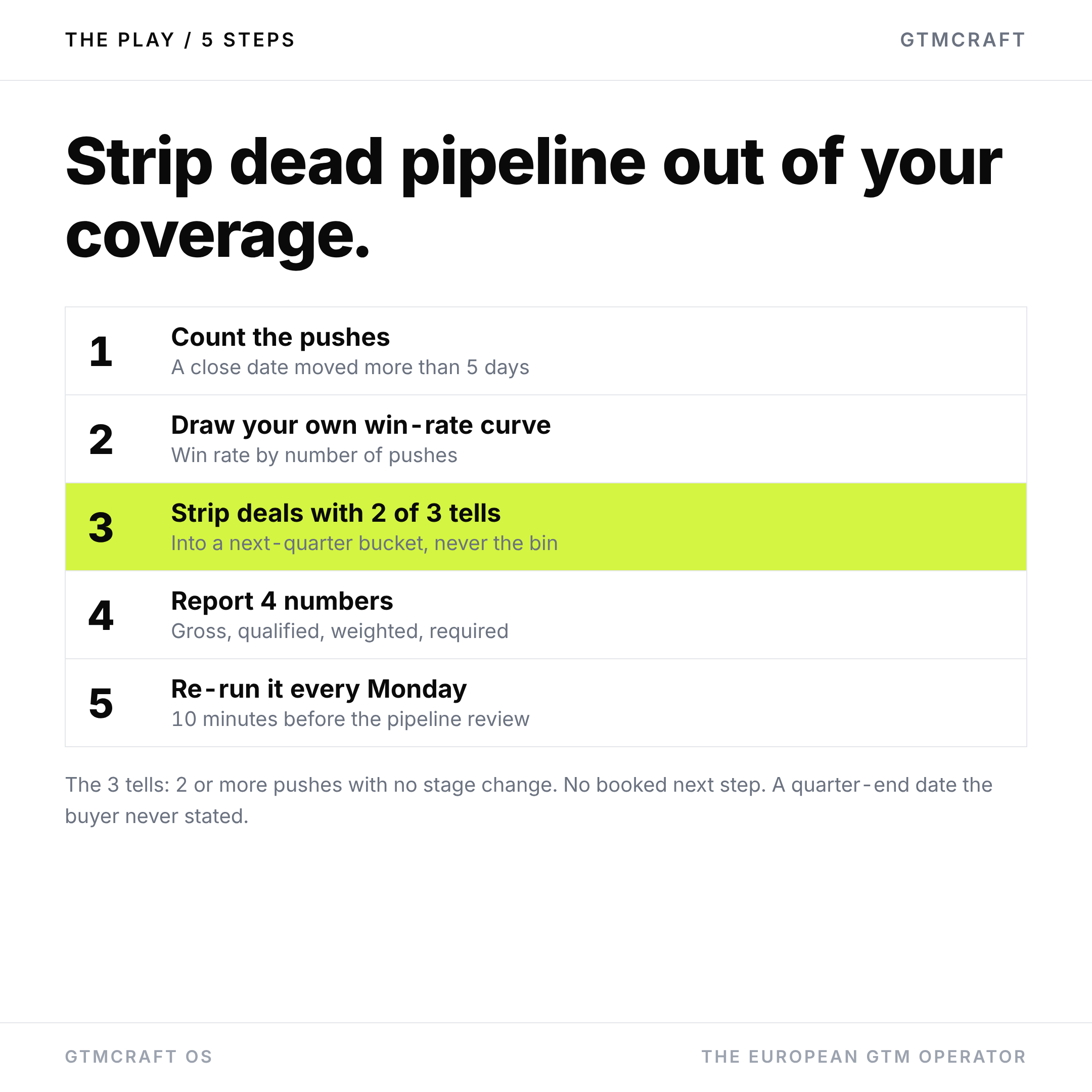
Step 1: count the close-date pushes on every open deal
A ratio of euros cannot see time. The close date is the one field that records when a buyer’s date stopped being real.
Gong analysed 13,439 opportunities and found win rates highest when the date moved 0 to 5 days, and falling once it moved 30 days or more. So you ignore small corrections. A push is a close date moved later by more than 5 days.
Do it: export every open deal for this quarter and next, with close-date history. Count pushes per deal. Note the date of the last stage change. Store the original close date in its own field, so a cloned deal cannot reset the count. Sum the open euros by push bucket: 0, 1, 2, 3 or more.
Founder version: if your CRM exports no field history, add a number field called close date moves today. Fill it for your 10 biggest deals from their timelines. 45 minutes alone.
Done when: every open deal has a push count and an original close date, and you can say the euros in the 2-plus bucket out loud.
Step 2: draw your own win-rate curve
Ignacio suggests bucketing your closed deals, won and lost, by how often the date moved, then reading the win rate per bucket. In his data it falls with each move. It also rises again at 5 or more moves, which he reads as reps keeping stalled deals alive and as merged records. So do not copy his curve. Draw yours.
Do it: pull 12 months of closed deals with push counts. Bucket them 0, 1, 2, 3 to 4, 5 or more. Write the deal count next to every win rate. Merge any bucket under 5 deals into its neighbour.
Founder version: under 40 closed deals, use 3 buckets: 0, 1 to 2, 3 or more. One table, 1 hour.
Done when: you can name the push count where your win rate drops below your overall rate. That is your strip line. 2 is the default until your table says otherwise.
Step 3: strip the kicked cans, and park them
Ignacio gives 3 tells. The play strips a deal that shows 2 of them:
2 or more pushes, no stage change since the first date.
No next step booked with the buyer. “Follow up” does not count.
A date in the last 14 days of your quarter that the buyer never stated.
Tell 3 needs one question. John Barrows, on Make It Happen on 15 October: what date do you want to go live, and what happens to the business if you miss it? His team found deals with a real answer closed 90 plus percent of the time, and deals without one about 32 percent. That is his team’s count with no sample size, so read it as direction.
Do it: apply the tells to every open deal. Move each stripped deal to a next-quarter bucket with the strip date and the tells that fired. Give it one way back: a buyer-stated date and a booked next step within 14 days. Keep any deal with a logged buyer milestone, such as a procurement or board date.
Founder version: start with your 10 biggest deals. Write the buyer-stated date, who gave it, and the next step with its date. A deal missing both leaves coverage today. 30 minutes in your CRM view.
Done when: the strip list names each deal and the tell that fired, and nothing went in the bin.
Step 4: rebuild coverage in 4 numbers
One ratio hides 2 problems. Ignacio tracks 3, and the play adds a fourth:
Gross: every open euro in the period, divided by target.
Qualified: the open euros left after the Step 3 strip.
Weighted: qualified euros multiplied by your own stage conversion.
Then compare qualified with required coverage: 1 divided by your win rate. At 25% you need 4.0x. At 30% you need 3.3x.
Matt Green adds a filter worth stealing (18 October). Tag each deal with the most senior person who attended a meeting. Count only deals where that person is a director or above. A deal without one gets 2 weeks to get there, or it moves to next quarter.
Do it: write the 4 numbers in one line, with the gap in euros.
Founder version: one sheet with 4 cells and 1 formula each. No stage data? Skip weighted and compare qualified with required. 20 minutes.
Done when: you can state the gap between qualified and required coverage in euros, before the board asks.
Step 5: run the strip every Monday
Pipeline decays weekly. Barrows’ guest Mark Siciliano (Make It Happen, 19 October) makes the same case for evidence-based deal reviews: clear criteria per stage, a short review, a score that ranks which deals to work today.
Do it: every Monday, before the pipeline review, re-run the strip. A second unexplained push fires tell 1. If a second tell fires too, the deal leaves coverage that day. When a stripped deal gives a clear no, close it lost that day and thank the rep in the review. A no clears pipeline faster than another follow-up.
Founder version: one saved view in HubSpot or Pipedrive, or one Notion table. Paste Monday’s export next to last week’s and ask your AI what changed. 10 minutes alone.
Done when: the 4-number line exists before the review starts, and no deal in coverage carries 2 unexplained pushes.
The template
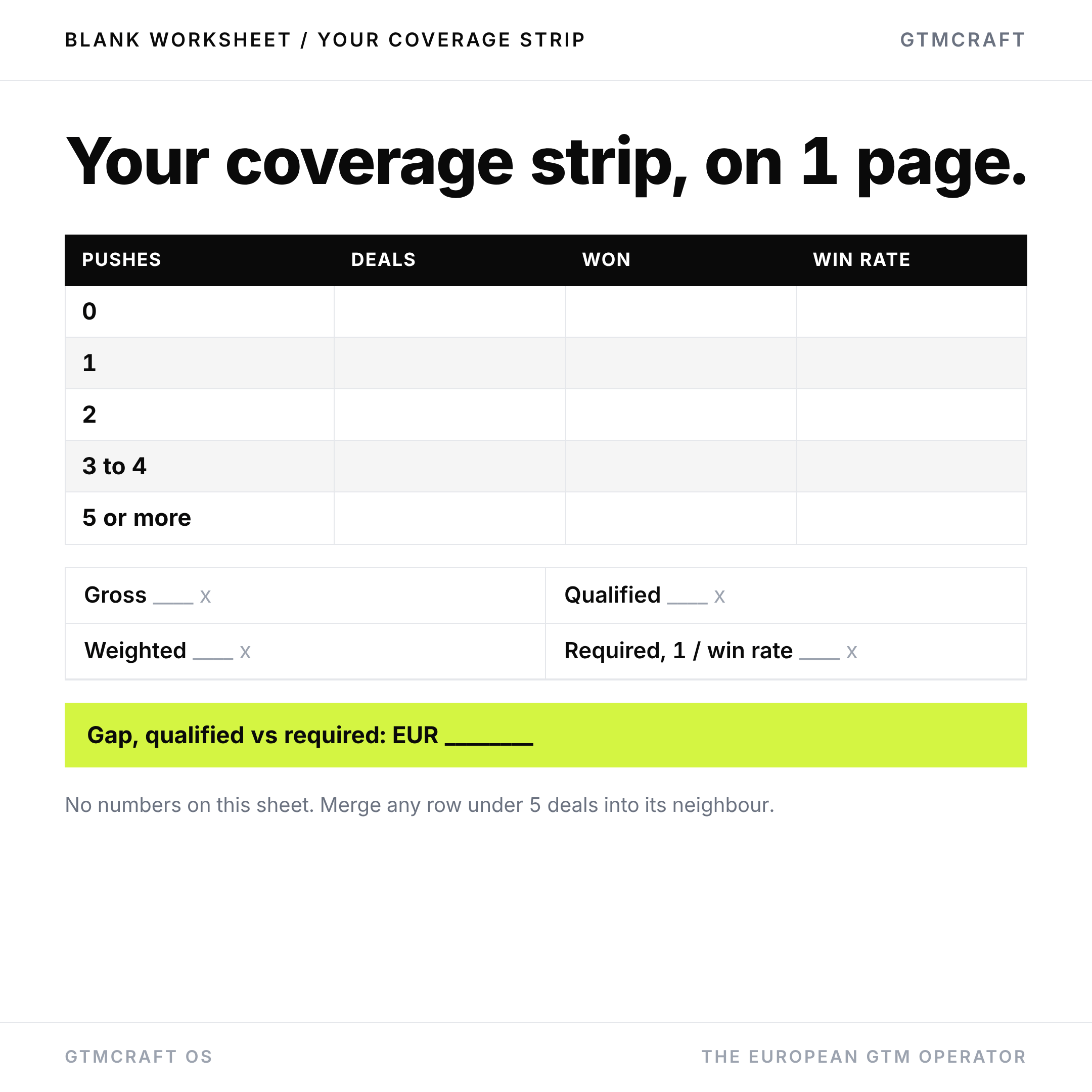
One sheet: the push rule, your win rate by pushes, the 3 tells, and 4 coverage lines with the gap in euros.
Paste this into your AI:
Here is my open-deal export with close-date history, last activity date and next step: [paste]. Count pushes per deal, where a push is a close date moved later by more than 5 days. Apply 3 tells: 2 or more pushes with no stage change, no booked next step with the buyer, and a date in the last 14 days of my quarter the buyer never stated. List every deal with 2 or more tells and the tells that fired. Then compute gross, qualified and weighted coverage against a target of [EUR], and required coverage at a win rate of [%]. Do not invent activity the export does not show.
The European read: mark 24 December to 1 January as non-working in your sheet. Across most European markets, decisions stop for that week. A buyer date inside that range needs a named signer and the day that person signs. If nobody can say, move the date to Monday 4 January and count the deal next quarter.
The rule: a deal with no buyer date and no booked next step is not coverage.
You know it worked when: your qualified coverage sits next to your required coverage every Monday, and no deal in coverage has 2 unexplained pushes. Founder read: you can say your qualified coverage without opening the CRM.
Where this play sits on your bowtie
Coverage is a Selection problem. Before it sits the pipeline you create, after it the deals you close. 3 plays that connect to this one, all free:
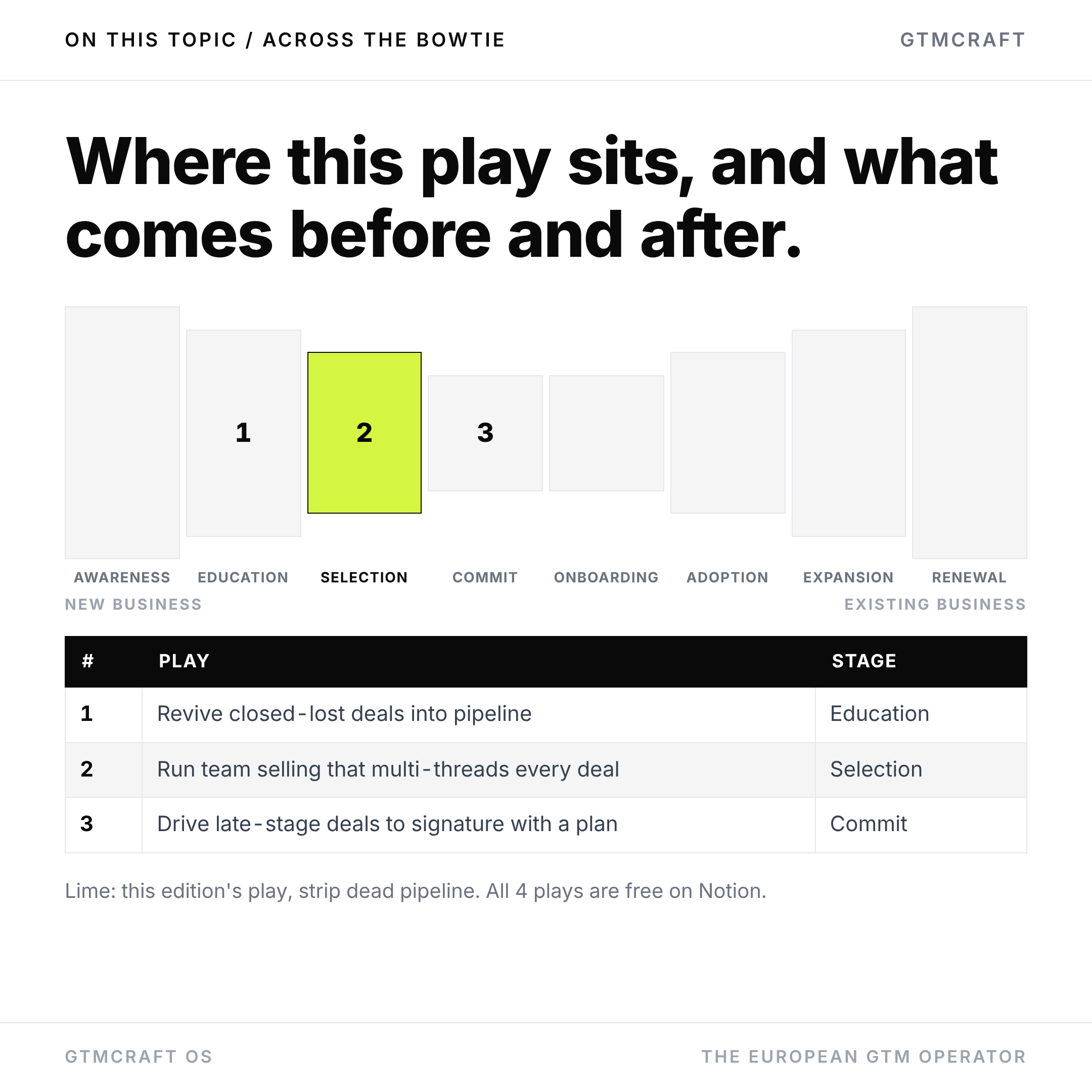
1. Before, Education: 5 steps to revive closed-lost deals into pipeline. Where your stripped deals go next quarter.
2. Alongside, Selection: 5 steps to run team selling that multi-threads every deal. Get a director into a deal before the 2-week timer runs out.
3. After, Commit: 5 steps to drive late-stage deals to signature with a mutual action plan. Every surviving deal gets a dated plan to signature.
All 250+ plays across the bowtie are free in GTMcraft Plays on Notion.
Save this for your Q4 forecast review. Send it to 1 founder whose coverage ratio still reads 4x.
The 5 sources that shaped this play. The full list of 30 lives in the play.
Newsletter. RevOps Impact (Jeff Ignacio), “Making coverage ratios helpful” (20 October 2026). The worked example, the kicked can and the 3 coverage numbers. Paid; this edition uses the free section only.
Podcast. Make It Happen (John Barrows), “Driving to Close: Uncovering Urgency” (15 October 2026). The go-live question behind Tell 3.
Podcast. Make It Happen (John Barrows with Mark Siciliano), “How to Run Evidence-Based Deal Reviews That Predict Revenue” (19 October 2026). Why the strip runs every week, not once.
LinkedIn. Matt Green, coverage with power (18 October 2026). The senior-attendee filter in Step 4.
LinkedIn. Krysten Conner, “Big deals always almost die” (18 October 2026). The counter-case: why stripped deals are parked, never deleted.
Why this matters now
The last 14 days of calendar Q4 open on Friday 18 December, about 7 weeks away. Strip on Monday 2 November, and a deal that earns its way back within 14 days returns by Monday 16 November, with 32 days left to close it. Run the count this week.
One question for the room
What share of your open euros carries a date the buyer stated and a next step on the calendar?
Join The Revenue Room
8 people, 1 quarter. European B2B SaaS founders between 1M and 10M ARR and GTM leaders who own the number. I tell you what I would do in your seat, you run it. No course, no content library, nothing to fall behind on.
A hotline. A private group nobody outside it sees. Post the problem that is on your desk, any working day, and you have my answer within 48 hours, plus whatever the other 7 have run into before. You never solve a complex one alone again.
A 90-minute call every 2 weeks, case-led. You post your case 48 hours ahead, 3 cases get the floor, and I tell you what I would do, stop doing and measure by Friday. Next call you come back with what happened and we keep solving problems together.
1 private 60-minute session with me, placed where it moves your number most.
I have scaled B2B SaaS to 10M ARR 3 times now and I run a GTM org pushing toward 40M ARR, in Europe. You get what I am running this quarter, not what I remember from 2019.
Master your human GTM skills AI can’t replace inside GTMcraft,
Koen
Your (human) GTM Coach
—
PS. Co-written by Wispr + 3 GTMcraft Skills + Claude Opus 5.5; edited & approved by Koen

"Stripped is not deleted" is the bit most teams get wrong. They either leave the dead deals in to protect the number or bin them in January and forget they existed. The other test I'd add to the next-step one is whether anyone else at the account is still showing up. A deal with a single contact who's gone quiet is a very different thing from one where the champion's slow to reply but three other people at the company are reading your content and seeing your ads. The first is usually dead. The second is often just a big deal doing what Krysten describes. Most CRMs can't see that difference, so both get the same treatment. The December point is a good one too, and it's very European. Do you strip the deals that only went quiet in December, or give them until the second week of January?