


The 90-second version
My CRO booked 30 minutes and we ran 90. The hardest thing he asked was whether my own agenda reflects my number 1 goal. It does not.
We posted 4 GTM roles this week. People read that as speed. It is the opposite: notice periods mean a seat posted in November carries nothing until Q2.
Three new leaders walked into a plan set in 2024 and asked whether 5 big rocks should be 4. Nobody in that room had cut them, including me.
The European read: notice periods run 1 to 3 months and differ by market, so your hiring clock is set by contract law, not by your budget calendar.
The thread: next year is being decided in the next 2 weeks, in meetings that will not move this quarter’s number.
Read time: ~8 min

90 minutes on a 30-minute call, 5 rocks questioned, 4 roles posted, 2 months of notice
This is the second half of September. Everything here shows up in next year’s number and in none of this quarter’s reporting.
That is why it gets postponed. Three things this week sat in that gap.
One was a mirror I did not enjoy.
Hi, it is Koen Stam and welcome to GTMcraft OS: The European GTM Operator. This newsletter is built from 100,000+ GTM signals collected from 100+ operators and founders, combined with 13+ years of my own lessons and failures from the trenches. I write at the intersection of go-to-market practice and AI-powered systems for founders and GTM operators scaling their next 2M, 5M or 10M ARR.
Lesson 1: my number 1 goal is not in my own agenda
Friday at 16:00. My bi-weekly with my CRO, booked for 30 minutes. We ran 90, and it is not the first time.
I turn up with a long prepared list. This week it was next year’s investment cases and where the marketing money goes.
We went deep on pipeline generation, because that is my number 1 bottleneck for next year.
Then he asked two questions I did not have good answers for.
The first was about follow-up. We had filled two rooms in two weeks. What is the actual follow-up, and how do my managers hold people to it?
The second was worse. Does my agenda reflect my number 1 focus?
I went back through my recurring meetings. Pipeline generation is not a standing item in my 1:1s. It is not a standing item in my team meetings either.
My take: I have been treating pipeline generation as a goal rather than a block of time, and those are different things. If I am not spending my hours on it, my managers will not, and their teams will not. Attention cascades faster than any target does. Nobody could have told me this from a dashboard. It shows up only when someone puts your calendar next to your stated priority and asks you to explain the gap. That is what 90 minutes with a good executive buys you, and it is why I turn up with a list instead of a status update. A status update gets you 30 minutes. A prepared list gets you the mirror.
The European read: across several markets, your attention is the only thing that travels without a budget line. A goal that is not a standing agenda item in every country 1:1 gets interpreted locally, and 4 markets quietly run 4 different definitions of pipeline.
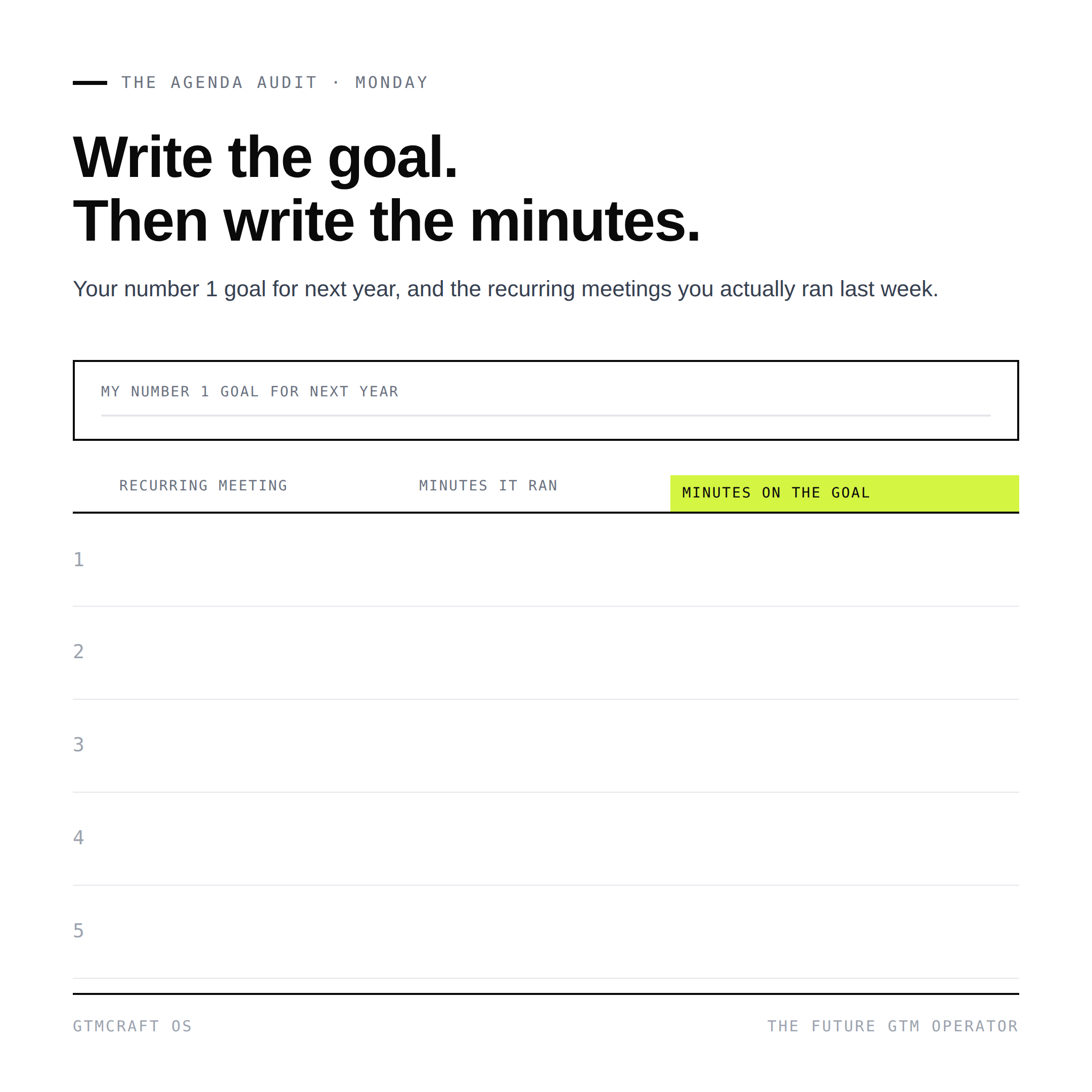
Do first: open your last 10 recurring meetings. Write your stated number 1 goal at the top, then write how many minutes of those 10 meetings went to it. No calendar history? Count the agendas.
Do this week: make it the first item, not the last, in every 1:1 you own. Last is where things go to be skipped.
Do this month: give the goal a named owner per team and a number they report weekly. No formal review cycle? One shared doc, one line per owner, updated Friday.
The rule: your calendar is your real strategy. If your number 1 goal is not a standing line in your own week, it is a preference.
Write the goal at the top. Then write the minutes. The gap is the strategy.
You know it worked when: your managers bring the pipeline number to the 1:1 without being asked, 4 weeks running. Founder read: you can name the 3 hours last week that went to pipeline and what they produced.
The play: 5 steps to make every AE own pipeline generation in their book (2026 series). Moves pipeline generation from a marketing dependency to an owned line in every book, which is the only version that survives a busy quarter.

Lesson 2: 4 roles posted in September, and September is already late
We posted 4 go-to-market roles this week. From the outside it looked fast, and people said so.
It is the opposite of fast. Here is the arithmetic.
Post now, run interviews for 3 to 4 weeks, make an offer in mid-October. Then the notice period starts, and in most of our markets that is 1 to 2 months.
So the person starts in December or January. Then they ramp. Real pipeline from a new seat lands in March at the earliest.
So a role posted in November is not a Q1 seat. It is a Q2 seat, and the plan that counted on it is short.
My take: the thing nobody outside the process sees is that hiring is the longest-lead item in the whole plan, and it is the one we always start last. We build the number first, then the campaigns, then we get to headcount in November when finance signs off. By then the arithmetic has already decided the answer for us. So I now do it in the other order. I start with the ramp date I need, subtract the cycle, subtract the ramp, subtract the notice, subtract the search, and that gives me the week the req has to be live. This week was that week. It does not feel urgent, which is exactly why it gets missed.
The European read: notice periods here are contractual and they differ by market, 1 month in some, 2 or 3 in others. A seat in one country and the same seat in the next country do not have the same lead time, so a single hiring date across your markets is wrong in at least one of them.
Do first: list every open or planned req and write 2 dates next to each, the start date and the first-real-pipeline date. No talent function? A 5-row table in a doc does the same job.
Do this week: work backwards from the quarter each seat has to carry, and mark every req whose maths no longer lands.
Do this month: write the reqs that must be live before the end of October, and post the ones you can already justify.
The rule: count backwards from the ramp, not forwards from the budget. The budget calendar has never once matched a notice period.
You know it worked when: every open req has a quarter written next to it that it carries, and you can say which quarter goes short if it slips. Founder read: you know which single hire, if delayed 6 weeks, breaks your H1 plan.
The play: 5 steps to build next year’s plan early enough to hit it (2026 series). Back-dates every initiative from the quarter its revenue has to land, which is where the hiring clock stops being an HR detail and becomes a plan risk.

Lesson 3: 3 new leaders asked whether 4 big rocks should be 3
On Wednesday I sat with a regional leadership team for a full-day offsite. Three leaders in the room are new, all hired externally.
The plan in front of us has 4 big rocks. They were cut in 2025. The leadership team that followed carried them forward on continuity, and then the leader who owned them left.
They inherited them. They were not in the room when they were written.
Within the first hour, the new leaders pushed back. Should it be 4, or should it be 3. Should we simplify. What is the goal underneath each of these.
Nobody who had built the rocks was there to defend them, and that turned out to be the useful part.
My take: I have spent years arguing that retention of leadership is an asset, and I still believe it. What I saw on Wednesday is the cost side of that argument. People who were in the room when a plan was written carry a reverence for it that has nothing to do with whether it still works. Three people who joined from outside asked the obvious question in the first hour, and none of us who inherited the plan had asked it in 2 years. So I have stopped treating a challenge to the plan as a loyalty problem. If a rock cannot survive being explained to someone who was not there, it is not a rock. It is a habit with a slide behind it.
The European read: a plan written centrally travels across markets as a slogan. Each country then runs its own interpretation and reports against the slogan, so the number looks aligned and the work is not. Re-arguing the plan with the people who run each market is the only version that transfers.
Do first: take your current top goals and ask the newest person on your leadership team to explain each one back to you, without the slide. No leadership team? Ask your newest hire.
Do this week: for every goal older than 2 planning cycles, write down why it is still there. If the only answer is that it was there last year, mark it.
Do this month: re-cut the list with the people who will run it, and give every goal a single named owner.
The rule: a plan carried on continuity is a plan nobody owns. Anything older than 2 cycles gets re-argued or retired.
You know it worked when: every goal has an owner who states it in their own words, and at least 1 goal from last year is gone. Founder read: your team can name the top 3 in the same order you would.
The play: 5 steps to reset the quarter with your leaders and 3 owned initiatives (2026 series). Cuts the list down to what leaders will actually own, with their names on it, instead of a carried-forward slide.

Save this. 3 lessons from my week as a European operator, each with a play you can run today and my own take from the trenches.
Send it to 1 founder or GTM operator scaling toward 10M in Europe who is about to write next year’s plan.
This week’s play to steal
All 3 lessons point at the same document, and it is open on most desks right now. Next year’s plan. The failure I see most is a growth target hung on programmes that have never converted, while the ones that do get last year’s budget. That is the play I am taking into the next 4 weeks.

Fixes: a growth number resting on unproven programmes, so the plan is a wish and the proven core never gets funded to carry it.
Best for: 2-5M and 5-10M teams planning an ambitious next year across more than 1 market, where the temptation is to add channels rather than fund the ones that convert.
The 5 steps (over 4 weeks):
Week 1, name your currency: list every programme across marketing, partnerships and sales, add conversion to revenue from the last 4 quarters, and mark only the ones you would forecast on.
Week 2, ring-fence the bets: set the bets budget as a separate line with its own owner, funded in tranches against milestones, so neither bucket can drain the other.
Week 3, size the split: cap your top-down ambition against your own multi-year trend, fund the currency to carry most of the number, and size the bets pool to the gap it cannot close.
Week 4, sequence it: add up ramp, build time and 1 sales cycle, then back-date every programme from the quarter its revenue has to land.
Week 4, set the cadence: re-forecast monthly, rebalance 10 to 15% of budget each quarter, graduate the bets that earned a tracked rate and kill the rest.
Template: one row per program. Columns: conversion to revenue, cost, verdict of currency or bet, the quarter revenue must land, and the build-start date. Any program funded like currency without a tracked rate is the gap between your plan and your year.
Paste this into your AI:
Here is my program list with spend, sourced pipeline and closed revenue for the last 4 quarters: [paste]. Compute conversion to revenue and cost per programme, split them into currency and bets, then show me how much of next year’s target my currency can carry at its current rate. Name the shortfall.
Full play, template and workbook inside GTMcraft OS. Reply or DM me to get access.
One question for the room
Open your calendar for last week and write your number 1 goal above it. Then tell me the honest number of minutes. Reply or send me a DM with what you found.
Go deeper with GTMcraft OS
Scale on plays and skills, not prompts.
You do not need another newsletter, podcast or LinkedIn post.
You need the system under it.
Read the plays. Every single play is free and live in GTMcraft OS on Notion. Click through from any edition.
Build your own. GTMcraft OS members connect the full libraries, 100+ plays plus 100,000+ LinkedIn, newsletter and podcast signals, straight into their own AI or Claude context, so their team builds on the whole corpus instead of one-off prompts.
The single plays are free to read. Wiring the whole corpus into your own operating system, and keeping it current, is what the membership gives you.
Master your human GTM skills AI can’t replace inside GTMcraft,
Koen
Your (human) GTM Coach
—
PS. Co-written by Wispr + 3 GTMcraft Skills + Claude Opus 5; edited & approved by Koen

The Future GTM Operator is a reader-supported publication. To receive new posts and support my work, consider becoming a free or paid subscriber.