The 90-second version
Your customers’ finance teams draft their 2027 budgets this month. Whatever you are to them in October is the number they write down.
Onboarding projects slip on dates the client never agreed to. Write the response windows into the plan at kickoff.
Run the referral fit test before you build anything. On a long sales-led cycle, the program is a person, not a button.
47% of vendors say buyers turn AI features down for unpredictable pricing, against 39% for price. Give finance 1 fixed number.
The European read: most of your buyers budget once a year and procurement reads every variable line. The thread: retention and referrals are decided by what the customer can count on.
Read time: ~10 min

This week’s number 1 move
Run 1 weekly customer review on 1 set of records before you automate any part of retention.
Wednesday’s number 1 move ran this spine on the acquisition side. Brendan Short’s case on XBOW is usually told as a sales story: 12 tools cut to 5 and the data model fixed before any agent was built. The same case has a retention half. XBOW’s internal tool includes a Friday customer review of about 90 minutes, and that review feeds expansion.
Sangram Vajre shows the other road. In 1 of his cases, ticket resolution time dropped 40% and net revenue retention fell anyway. Faster answers did not keep the customer.
SaaStr’s own agent build points the same way. Its renewal agent prepares a deck per customer and routes it to the right person. My read: the agent prepares the conversation, a person still has it.
From my week: I am graded on NRR, not on new business. I cannot hit it by winning logos alone.
My take: after the signature is where the money compounds, and it is where I review before I automate. I would rather have 1 human review a week, on 1 set of numbers everyone trusts, than 5 retention agents each reading their own copy of the account. CS sits in that room, or it is not a customer review. So my order is fixed. First the review, with CS, sales and whoever owns the bill in it. Then 1 record per account that all 3 agree on. Only then an agent that prepares the review, never 1 that replaces it.
Do first: book 1 recurring customer review this week, 60 to 90 minutes, and list the 3 numbers per account it reads. Founder fallback: no CS lead? The review is you and whoever answers customer email, with 1 sheet, top 20 accounts.
The rule: review, then agree the record, then automate. A faster answer on a record nobody trusts is still a churn.
The play: 5 steps to architect your AI rollout instead of cleaning up after it. 1 reference build, 1 owner and a measured handoff, set before anything launches.

Sources: The Signal (Brendan Short), “XBOW” (22 September 2026) · Run on GTM OS (Sangram Vajre), “AI isn’t breaking marketing or sales or CS. The real answer will annoy you” (23 September 2026) · The Official SaaStr Podcast (Jason Lemkin, Amelia Lerutte), “We Doubled Revenue with Agents. Here’s Exactly How” (18 September 2026)
Hi, it is Koen Stam and welcome to GTMcraft OS: The European GTM Operator. This newsletter is built from 100,000+ GTM signals collected from 100+ operators and founders, combined with 13+ years of my own lessons and failures from the trenches. I write at the intersection of go-to-market practice and AI-powered systems for founders and GTM operators scaling their next 2M, 5M or 10M ARR.
Problem 1: your onboarding slips on dates the client never agreed to
From my week: one story at our customer wall last week: a new account team had built momentum with a steady customer, then a third-party integration escalated and the account became a churn risk. The team brought it back.
An integration someone else owns is the dependency that belongs on the kickoff slide.
Your delivery team has owners, dates and a plan. The client side has an admin with a day job and no stated commitment. So the project waits on a file, an access request or a security review, and nobody logged the day it was asked for.
Hakan Ozturk framed this as a missing system, not a chasing problem. His line on AI is the honest one: it cannot make their admin send the file, but it can own the record and fire the reminder.
The fix is written. Pull your last 5 onboardings and log every point where your team waited on the client, in working days. Cut the list to the 5 that cost the most. At the next kickoff, put those 5 on 1 slide with a response window and a named client owner each, and say the reset rule out loud: if a dependency is N days late, go-live moves by N.
On Make It Happen, Elizabeth Salmoun treats the timing of the handoff from AE to CSM as a retention lever, not an admin step. The promises made in the sale belong on that same list.
My take: every implementation problem I have seen is the sales problem 1 step later. Something important was agreed in a conversation and never written into a system. It holds while 1 person carries it and breaks when the account count goes up. A response window is not bureaucracy at any size. It is the cheapest thing you will build this quarter: no hire, no tool, just the dates said out loud while everyone is still happy.
The European read: security review and data processing sign-off are real gates in many of your buyers’ companies, with their own queues. Give them a window of their own and name the person, not the department.
Do first: list every client dependency from your last 5 onboardings with the working days each took. Founder fallback: 5 projects, 1 sheet, 30 minutes from your inbox.
Do this week: turn the top 5 into 1 kickoff slide with windows, client owners and the reset rule. Founder fallback: you run the kickoff, so you say the windows out loud yourself.
Do this month: pull the sales-call promises for every live implementation and rule each one in scope, out, or paid extension, with the sponsor. Founder fallback: the promise list comes from your own deal notes.
The rule: state the response window before anything is late. Said at kickoff it is a plan. Said in week 6 it is an accusation.
You know it worked when: client-caused delay days are logged per account and read at the renewal review, and renewal win rate separates on accounts with a clean onboarding. Founder read: your last 3 kickoffs each ended with 5 named client owners.
The play: 5 steps to stop onboarding slipping on what the client owes you.

Sources: The CS Cafe (Hakan Ozturk), “The SLA that ends client-caused delays” (9 August 2026) · Make It Happen (John Barrows) with Elizabeth Salmoun, “How Customer Success Drives Retention, Revenue & Growth” (7 September 2026)
Problem 2: your referral button is waiting for customers who will never click it
From my week: one customer at our wall last week has grown 19x in 5 years, module by module. It is now a reference for 2 other companies.
Your happiest customers would introduce you. Almost nobody asks them at the right moment. Then a team swings the other way and builds a referral program the product has not earned.
Maja Voje, with Stefan Bader and Elena Verna, sets the test before the build. 3 conditions: high lifetime value, fast time to value, high engagement. 2 of the 3 usually suffice.
Outside them sits what they call the death valley: under about 500 monthly active users, an ACV too low to fund a reward, or a cycle so long the referrer waits months. The answer there is not yet. Fix the product first.
For a sales-led team the reframe is simple. The program is a customer success ask, made at NPS 9 or 10 and at milestones, naming 2 or 3 specific people. The GTMnow team adds why it pays: warm introductions get roughly 3 times the response of cold outreach.
The referred customer is worth more once signed. A Wharton study found referred customers churned 18% less and were worth about 16% more. That was a German bank in 2011, so read it as direction.
My take: I have watched founders copy a referral button into a sales-led product with 40 customers and wait for nothing. If you sell at a real ACV on a long cycle, your referral program is a person, not a button. Give CS the ask at NPS 9 and at every milestone, name the targets, and write the intro blurb for the customer. My one rule: never let goodwill sit uncounted. Tag the source, or the motion never earns its budget.
The European read: your customers’ networks are local and often not in English. Name targets inside the referrer’s own market and language, and match any thank-you to their company’s gift policy, which is stricter in many of our markets.
Do first: score your product high, medium or low on lifetime value, time to value and engagement, and write the verdict: program, CS-owned ask, or not yet. Founder fallback: 3 numbers from your CRM and 1 honest line.
Do this week: list customers with NPS 9 or 10, a milestone or a signed renewal in the last 90 days. Cap it at 10. No NPS survey? Your last 10 renewals will do.
Do this month: make 10 named asks with a ready blurb, reply to every intro within 24 hours, and tag the source. No CS team? You make the asks yourself, 2 a week.
The rule: test fit before you build, and ask at the moment of delight. A vague “know anyone” is not an ask.
You know it worked when: advocacy participation, the share of asked customers who sent at least 1 intro, is a number you report. Founder read: referral shows up as its own source in your last 20 opportunities.
The play: 5 steps to run a referral sprint that turns customers into pipeline.

Sources: GTM Strategist (Maja Voje) with Stefan Bader and Elena Verna, “How to Build a B2B User Referral Program (and How to Know You’re Not Ready)” (25 September 2026) · GTMnow (Sophie Buonassisi), “Inside LinkedIn: buyer behavior, how to social sell, and why warm intros get 3x the response” (23 September 2026) · Schmitt, Skiera and Van den Bulte, “Referral Programs and Customer Value”, Journal of Marketing (2011)
Problem 3: your usage bill is losing the renewal before the renewal call
From my week: one customer at our wall grows by acquisition. It adds seats in blocks of a few hundred, and the next block is already planned for early next year. That is what predictable looks like from the customer’s side.
Your usage model works on the way in. Then a busy quarter lands a bill 40% above plan. Your champion has to explain a budget miss to a CFO who never approved it. At renewal, that CFO asks for a cap, a discount or a smaller commit.
Rob Litterst, sharing Teneo’s research, calls buyer pushback on unpredictable pricing the most important stat in the deck. 47% of vendors say buyers turn AI features down for unpredictable pricing. 39% say it is the price.
The market moved anyway. Hybrid fixed-plus-usage pricing now sits at 66% of vendors, up from 45% in 2023. The fix he describes is structure, not discount: commit tiers in T-shirt sizes with usage included, a brake for finance, and a wallet, the prepaid balance the customer can see.
Stripe’s CRO for AI companies makes the same call on SaaStr: get hybrid seat-plus-usage pricing right early, because it drives retention.
My take: with usage pricing, the renewal is often lost in the invoice long before the renewal call. So I start with 1 question: can the buyer put us in next year’s budget as 1 fixed number. The mistake I see most is treating the bill as a finance output. It is a customer experience. If CS is not in the room when you review the wallet, you are running a billing review, not a revenue review. AI can scan the burn, meaning monthly usage per account, and size the tiers in minutes. How much risk I ask a customer to carry stays my call.
The European read: most of your buyers budget once a year and procurement reads every variable line. Price tiers in euros, and send the renewal offer inside the buyer’s budget month, not in the last month of the term.
Do first: export 12 months of invoices per account and flag every month 20% or more above that account’s average. Founder fallback: your top 20 accounts, 1 billing export. Seat pricing? Flag every true-up or overage invoice instead.
Do this week: plot burn per account and draft 3 commit tiers with usage included, sized on real burn. On seat pricing? Run the same test on true-ups and overage invoices.
Do this month: switch on balance alerts at 50%, 80% and 100% to the budget owner, and send 1 renewal offer built from the burn curve. No billing platform? A monthly email your AI drafts from the export.
The rule: no customer should learn about a budget miss from your invoice. Sell predictability before you sell volume.
You know it worked when: net revenue retention rises while renewals with a discount fall, and spike accounts shrink to a named list. Founder read: your top 10 accounts each know their balance before the invoice lands.
The play: 5 steps to make usage bills predictable so renewals and expansions close.

Sources: PricingSaaS (Rob Litterst) with Teneo, “14 Trends in AI Monetization” (25 September 2026) · The Official SaaStr Podcast (Jason Lemkin), “175% Growth, 120 Countries, Agents as Buyers: Stripe’s CRO of AI on The New AI GTM Playbook” (23 September 2026)
Save this for the week your customers write their budgets. Send it to 1 operator whose renewal book runs on usage.
Also on the radar
2 plays that make the 3 moves land, rather than adding a fourth.
The up-tier from burn. Once the bill is predictable, usage becomes the expansion signal. This builds the motion off it.
The room referrals come from. If the fit test says not yet, a customer community is where goodwill builds while the product catches up.
Steal this move: make the renewal bill 1 fixed number in 4 weeks

Fixes: a usage or credit bill that surprises the buyer’s CFO, so renewals stall and expansions die in procurement.
Best for: 2-10M and 10-25M teams on usage, credit or hybrid pricing, selling into buyers who budget once a year across 1 or more markets.
The 5 steps (over 4 weeks):
Week 1, find the surprises: 12 months of invoices per account, every month 20% or more above average flagged, plus accounts that cut usage after a spike.
Week 2, package usage into 3 commit tiers in euros, sized on median and 80th-percentile burn.
Week 3, give finance a brake: alerts at 50%, 80% and 100% to the budget owner, a soft cap, and flex usage, a temporary allowance above the tier, in place of overage.
Week 3, hand the wallet to CS: a monthly review of burn, balance and forecast exhaustion date.
Week 4, send 1 renewal offer 90 days before renewal, or in the buyer’s budget month if that comes first, with 2 options: the tier that covers real burn, and the next tier at a better rate.
Template: one row per account. Columns: average monthly bill, highest month, spike months, usage cut after a spike, recommended tier, annual commit, budget month, forecast exhaustion date, owner.
Paste this into your AI:
Here are 12 months of invoice totals and usage per account: [paste]. Flag every month 20% or more above each account’s average, and every account that cut usage after a spike. Then propose 3 commit tiers with usage included, sized on real burn, and tell me which tier each account lands in. Flag any account where a commit would run above what it actually uses.
Why this matters now
Your customers’ finance teams are drafting their 2027 budgets this month. What they write down for you is decided by what they can predict now.
A slipped go-live, a referral ask at the wrong moment and a surprise invoice all land in the same budget meeting.
The 3 problems are 1 argument at 3 stages. Dates the client agreed to. An ask made at the moment of delight. A bill finance can write as 1 line.
3 questions for the room
Which client dependency slipped most in your last 5 onboardings, and who on their side owned it?
Does your product pass 2 of the 3 referral conditions, or are you building in the death valley?
Which of your top 20 accounts had a month 20% over its average this year, and did anyone call them?
Join The Revenue Room
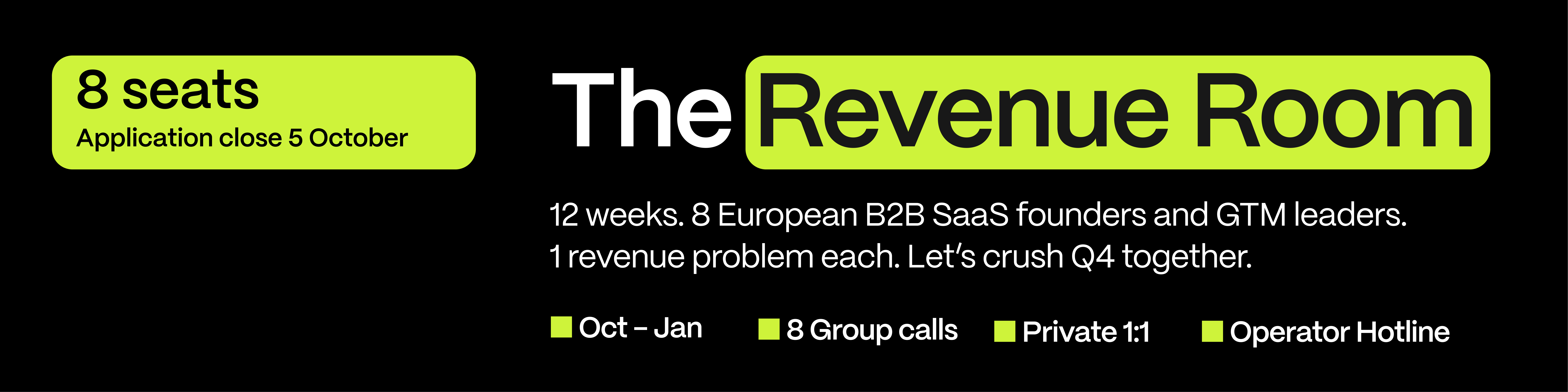
8 people, 1 quarter. European B2B SaaS founders between 1M and 10M ARR and GTM leaders who own the number. I tell you what I would do in your seat, you run it. No course, no content library, nothing to fall behind on.
A hotline. A private group nobody outside it sees. Post the problem that is on your desk, any working day, and you have my answer within 48 hours, plus whatever the other 7 have run into before. You never solve a complex one alone again.
A 90-minute call every 2 weeks, case-led. You post your case 48 hours ahead, 3 cases get the floor, and I tell you what I would do, stop doing and measure by Friday. Next call you come back with what happened and we keep solving problems together.
1 private 60-minute session with me, placed where it moves your number most.
I have scaled B2B SaaS to 10M ARR 3 times now and I run a GTM org pushing toward 40M ARR, in Europe. You get what I am running this quarter, not what I remember from 2019.
Master your human GTM skills AI can’t replace inside GTMcraft,
Koen
Your (human) GTM Coach
—
PS. Co-written by Wispr + 3 GTMcraft Skills + Claude Opus 5; edited & approved by Koen