


The 90-second version
Andrei on FullFunnel Live podcast last week said marketing should sit in deal reviews. I wrote it down mid-answer, because marketing is in every room I run except that one.
A mid-market account opened 3 times and closed lost 3 times. We won it on the 4th. The CRM credits a web demo request.
Every region I run has 4 to 5 leaders on 4 to 5 different numbers. I have not fixed that with a KPI. I meet it in a room.
The European read: a buying committee spread across 2 markets reads you in 2 languages, and your local marketer is often the only person with a line to the second one.
The thread: marketing and sales do not align on a number. They align in a room.
Read time: ~8 min

35 leaders in one room, up to 5 leaders per region, 3 closed-lost cycles, 2 to 4 silent weeks, 1 line written down live
Q4 starts on 1 October. Every deal that closes before Christmas is already open.
Most of the large ones will go quiet for 2 to 4 weeks at least once before then. What decides whether they come back is who is in the room when they do.
Last week I got asked about that on the FullFunnel podcast, and my honest answer was not flattering.
Hi, it is Koen Stam and welcome to GTMcraft OS: The European GTM Operator. This newsletter is built from 100,000+ GTM signals collected from 100+ operators and founders, combined with 13+ years of my own lessons and failures from the trenches. I write at the intersection of go-to-market practice and AI-powered systems for founders and GTM operators scaling their next 2M, 5M or 10M ARR.
Lesson 1: marketing is not in the room where my deals go quiet
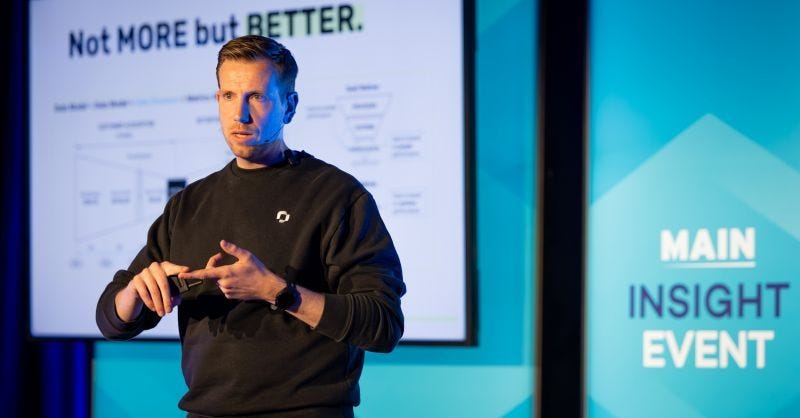
Last week I was a guest on a live podcast about account-based marketing and alignment. An hour in, Andrei made a point about deal reviews and I stopped mid-answer to write it down.
Marketing should sit in deal reviews. They are experts in accelerating active pipeline.
I run deal reviews. Marketing is not in them.
They are in plenty of other rooms. The quarterly account plans. The team meetings. Every event. In our offices the marketer sits next to the sales lead.
So the rooms where pipeline gets created are covered. The room where pipeline gets stuck is not.
Earlier this month we had 35 senior leaders in our office. Customers were in that room. Prospects were in that room. After every event we now write down which pipeline was in the room and who owns it.
The instinct is there. My invite list has not caught up.
My take: I have been treating marketing as a top of funnel function and then treating conversion as a sales-only problem. That split is mine, not theirs. Inside a large mid-market cycle there are stretches of 2 to 4 weeks with no heartbeat at all, and people join the committee late who have never heard of us. Reaching a committee member the AE has no line to is exactly what marketing is good at. I am not going to put a marketer in every deal review, because time is real. But the quiet ones, yes. If marketing can only touch a deal before it becomes an opportunity, I have hired half a function.
The European read: a mid-market committee often sits across 2 countries, and the late joiner reads in their own language. Your regional marketer usually has the local assets, the local event and the local partner that reach that person. The AE rarely does.
Do first: list the deals in your pipeline with no buyer activity in the last 14 days. Founder fallback: sort your CRM by last activity date, no report needed.
Do this week: pick the 5 largest of those and put your marketer in the next review of each. No deal review? A 30-minute call with whoever owns marketing, the 5 deals on one screen.
Do this month: give marketing 1 named committee member per quiet deal to reach, with a 2-week window. No marketer? You own that 1 contact yourself.
The rule: marketing’s job does not end at the opportunity. A deal that goes quiet is a marketing problem with a sales deadline.
You know it worked when: days in stage drop on the deals marketing touched, against the ones it did not. Founder read: 2 of your 5 quiet deals have a new named contact within a month.
The play: 5 steps to run team selling that multi-threads every deal. Puts every function with a line to the buying committee on the deal, which is the version where marketing has a job after the opportunity opens.

Lesson 2: opened 3 times, credited to a form
One of our mid-market accounts was opened 3 times and closed lost 3 times. The 4th time it opened, we won it.
The CRM credits a web demo request.
The form is real. Someone filled it in on our website, and by our own rule the latest lead source takes the revenue.
The years before that form are also real. Events. BDR calls. A partner who kept us in the conversation. Marketing nurture while the account was not ready and the risk was too big to move.
The form was the last touch. It was nowhere near the first.
I keep the rule anyway. We count latest lead source, and nobody edits that field without a ticket.
My take: on mid-market I could not care less which source gets the credit. It took the whole team, and any single-source story about that account is fiction. What I do care about is the argument, because the argument costs more than the misattribution. So I ask 2 things of my leaders. If it happens once, let it go. If it keeps happening, do not fight it deal by deal. Marketing collects the 5 or 10 debatable ones from the last 2 months and sits down with the sales leader to go through them together. The point is not the correction. It is that both sides see the same pattern. When the credit argument gets loud, the buyer has usually already left the conversation.
The European read: in a smaller market, a larger share of the path runs through partners and events, because cold channels are thinner. A last-touch rule undercounts exactly the work that builds a market from scratch. Read the debatable ones per market, not blended.
Do first: pull your last 10 closed-won deals and write every touch you remember, in order. Founder fallback: 30 minutes and 1 spreadsheet, no attribution tool.
Do this week: agree one rule for comp and a separate view for reporting. They answer different questions.
Do this month: put a monthly 30-minute review of disputed credits on the calendar, marketing and sales in one sitting.
The rule: keep the simple credit rule and run the conversation the rule cannot handle. The field is not the fix. The review is.
You know it worked when: credit disputes stop appearing in forecast calls and appear only in the monthly review. Founder read: you can name the first touch on your last 5 wins, not only the last one.
The play: 5 steps to own the logic behind your quotes and deal credit. Splits the comp rule from the reporting rule, which is what stops the quarterly re-argument.

Lesson 3: up to 5 leaders per region, each on their own number
Every region I run has 4 or 5 leaders. Country manager, regional marketing, BDR lead, implementation, and account management with customer success.
Each has a department KPI. Marketing owns marketing-sourced pipeline. Partner managers carry partner-sourced. AEs carry closed won.
Each number is defensible on its own. Together they pull in different directions.
I have not fixed that, and I am not sure one shared KPI is the fix.
Instead, my regional leaders meet every week or two, in one room. Pipeline progress. Implementation. Renewals and expansion. The problems nobody wants to raise yet.
You say where you are stuck, and you ask someone in the room for help.
My take: I have learned that more leaders means more sub-KPIs. That is arithmetic, not culture, and I will not remove it. I only get to choose where the friction surfaces. In a room every week or two, while it is cheap. Or in a forecast call in the last week of the quarter, when it is not. The room does something a dashboard cannot. It makes the other department’s problem visible while it is still small, and curiosity follows. None of it holds without the layer above, though. If the senior leaders are not visibly aligned, the room turns into a negotiation. So I start alignment with the people who set the numbers, and the room is where I test it.
The European read: across several markets, each region builds its own version of the friction, with its own leaders and its own history. A central alignment programme will not reach it. A regional room with the local leaders in it will.
Do first: write down every leader who owns a number in one region, and the number next to their name. Founder fallback: if 3 names are yours, that is the finding.
Do this week: book 45 minutes every 2 weeks with whoever owns demand, closing and the customer after the signature. One question each: where are you stuck.
Do this month: after 2 sessions, count the problems raised that crossed a department line. Zero means it is still a status update.
The rule: you will not remove the friction between departments. Choose to meet it every 2 weeks, not in the last week of the quarter.
You know it worked when: a problem gets raised by one department and solved by another before it reaches the forecast call. Founder read: your marketer asked your seller for help, unprompted, in the last month.
The play: How to create cross-functional GTM alignment. Builds the shared operating rhythm under the separate KPIs, rather than pretending one number can replace them.

Save this. 3 lessons from my week as a European operator, each with a play you can run today.
Send it to 1 founder or GTM operator whose marketing and sales teams are graded on different numbers.
This week’s play to steal
All 3 lessons are about the same thing: which room the work happens in. The cheapest room I have is the one we already pay rent on. When I came into my first market here, nobody knew us outside a small circle. There was no marketing motion and no partner motion. I had an office, and I went looking for the partners my buyers already trusted. That is the play I would run before Christmas.
Play: The events and community system, pipeline in the room
Fixes: events that fill a room and produce no tracked pipeline, because nobody wrote down which open deals and customers were there, or who owns the next step.
Best for: 2-10M and 10-25M teams selling mid-market across more than 1 market, with an office or a proud customer in each market and no event budget to speak of.
The 5 steps (over 4 weeks):
Week 1, pick the room you already pay for: your office, or a customer’s who will host.
Week 1, pick a topic your buyers already argue about, and 1 partner their audience trusts more than they trust you. Low agenda, no pitch.
Week 2, before invites go out, list the open opportunities and customers you want in the room, with an owner per name.
Week 3, run it. The same day, write the pipeline-in-the-room document: which opportunities, which customers, who owns each next step.
Week 4, review that document in the next deal review, with marketing present. Compare stage movement on those deals against the rest.
Template: one row per account in the room. Columns: open opportunity yes or no, stage, owner, next step, date. Any open deal with no next step by the end of the day is the follow-up you already lost.
Paste this into your AI:
Here is the attendee list from my last event with company names and titles: [paste]. Here is my open pipeline export: [paste]. Match the two, list every open opportunity and existing customer that was in the room, and draft 1 next step per account for the named owner. Flag the accounts where nobody from my team spoke to them.

Why this matters now
Q4 starts on 1 October. The number you close by Christmas is sitting in your pipeline today, and a large share of it will go quiet at least once.
Three weeks before quarter-end is the wrong time to discover marketing had no job on those deals, or that 2 departments were arguing about credit while the buyer drifted.
Move the friction into a room now, while it is cheap.
3 questions for the room
Which of your quiet deals would move if your marketer owned 1 committee member on it?
When did your last credit argument happen in a forecast call instead of a review?
If your regional leaders met every 2 weeks, what problem would surface first?
Go deeper with GTMcraft OS
Scale on plays and skills, not prompts.
You do not need another newsletter, podcast or LinkedIn post.
You need the system under it.
Read the plays. Every single play is free and live in GTMcraft OS on Notion. Click through from any edition.
Build your own. GTMcraft OS members connect the full libraries, 100+ plays plus 100,000+ LinkedIn, newsletter and podcast signals, straight into their own AI or Claude context, so their team builds on the whole corpus instead of one-off prompts.
The single plays are free to read. Wiring the whole corpus into your own operating system, and keeping it current, is what the membership gives you.
Master your human GTM skills AI can’t replace inside GTMcraft,
Koen
Your (human) GTM Coach
—
PS. Co-written by Wispr + 3 GTMcraft Skills + Claude Opus 5; edited & approved by Koen
The Future GTM Operator is a reader-supported publication. To receive new posts and support my work, consider becoming a free or paid subscriber.