Your home market has about 5% of accounts in play this quarter
12 signals from 40 GTM newsletters. 3 problems. 1 play. Why a lean European team scaling toward 10M wins on depth, not reach. ~5 min.
Save this. The 3 GTM problems behind a stalling pipeline, each injected with the sharpest thinking this week and reframed for an operator scaling motion in Europe.
Send it to 1 founder scaling toward 10M in Europe who reads everything and ships none of it.
The 90-second version
Only ~5% of your market is actively buying this quarter. In a single European country, that pool is small and everyone is fishing in it.
Your outbound is a measurement problem before a message problem. A meeting-booked rate ≤0.25% means the list is wrong. Stop rewriting subject lines.
70–80% of the buying happens before a buyer contacts you. Your pipeline review sees the 20% that left a CRM trace.
Sorting accounts by size gives you the org chart you already have. Sorting by real signal gives you a list a competitor cannot buy.
The European read: scaling one motion in one country, your TAM is already small. Depth on fewer accounts beats reach across a market you cannot serve yet.
The thread: fewer accounts, scored on real pain, worked deeper: how a lean team turns a small home market into a path to 10M.
Read time ~5 min.
This week’s number 1 move
Score every booked meeting on pain, before you score anything else.
Cannonball GTM’s reminder: only ~5% of any market is actively buying in a quarter (Prof. John Dawes, Ehrenberg-Bass). Companies switch ~every 5 years, so ~20%/year, ~5%/quarter in play. Cold untargeted outbound books at ~0.025%. Pain-based outbound at accounts with a real un-shopped problem runs 1–4%.
For a lean European team this is the whole game. Stop measuring activity, start scoring need.
Start here: score last month’s booked meetings for pain intensity 1–5. Below a 4 is not pipeline yet. That one column resets your forecast.
Source: Cannonball GTM, “The 5% problem,” May 22.
Hi, it is Koen Stam and welcome to GTMcraft: The Future GTM Operator. This newsletter is built from 100,000+ GTM signals collected from 100+ operators and founders, combined with 13+ years of my own lessons and failures from the trenches. I write at the intersection of go-to-market practice and AI-powered systems for founders scaling 0 to 10M+ ARR.
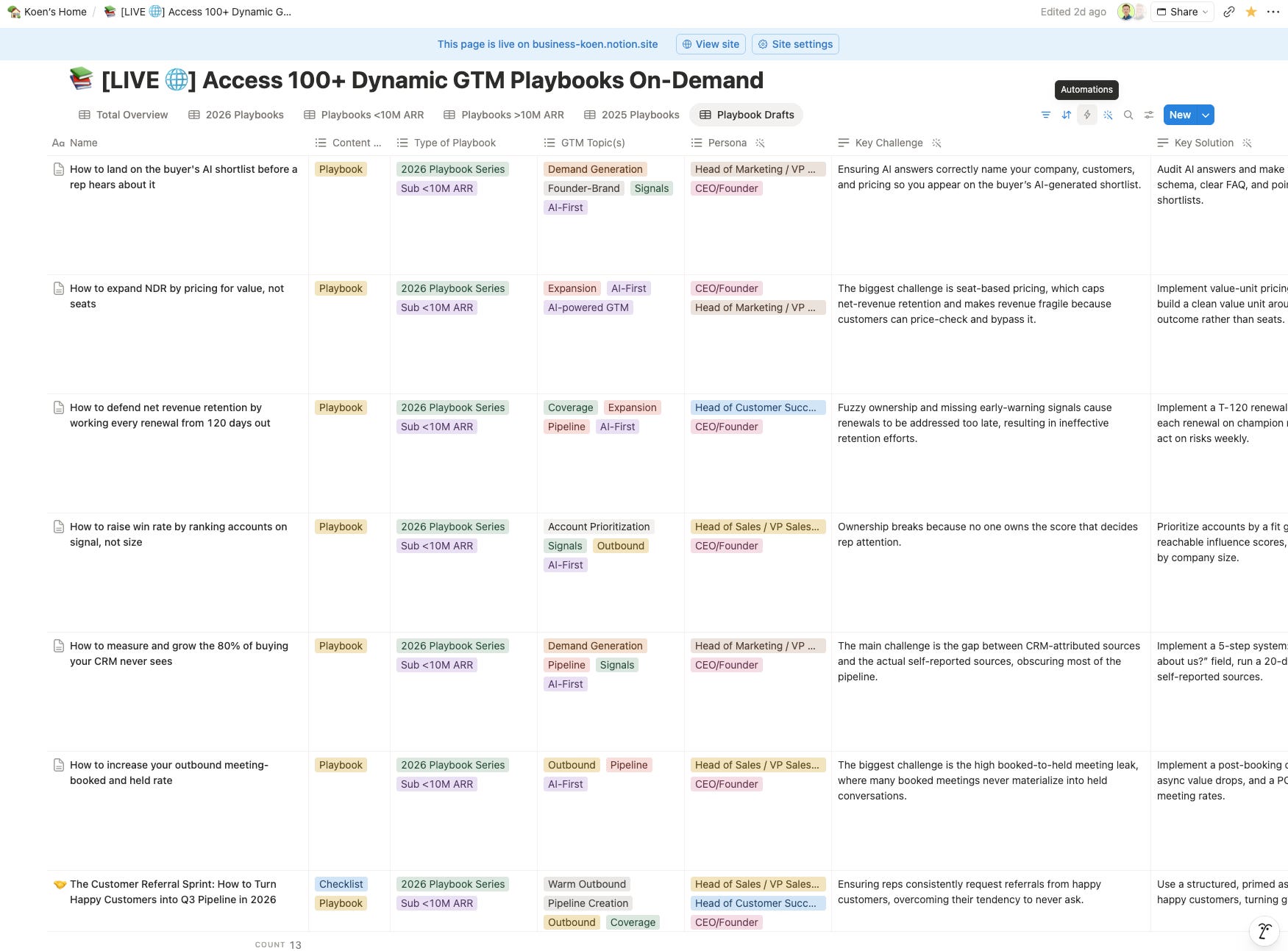
100,000+ GTM relevant signals from LinkedIn, Newsletters and Podcasts indexed. Translated into 100+ GTM plays for you to implement tomorrow.
14+ years over 3 GTM operator jobs across 3 GTM motions (SMB, MM, ENT). Scaling from 2-10M+ ARR multiple times. Same recipe. Different motions.
Now all part of the GTMcraft Operator Room. Interested? DM me.
This week’s number 1 move
Score every booked meeting on pain, before you score anything else.
The sharpest signal this week is Cannonball GTM’s reminder that only about 5% of any market is actively buying in a given quarter, a number from Professor John Dawes at the Ehrenberg-Bass Institute. Companies switch providers roughly every 5 years, so only 20% of your market is in play in a year and about 5% in a quarter. Cold, untargeted outbound books meetings at about 0.025%. Pain-based outbound, aimed at accounts with a real problem they have not started shopping for yet, runs 1 to 4%.
For a lean European team this is the whole game. You do not have the headcount to spray, and in a single country your in-play pool is small. So you stop measuring activity and start scoring need.
Start here: take last month’s booked meetings and score each one for pain intensity on a 1 to 5 scale. Anything below a 4 is not pipeline yet. That one column will reset your forecast.
Source: Cannonball GTM, "The 5% problem," May 22.
Problem 1: Your outbound is busy but not booking
Two posts this week land in the same place from different angles. Cannonball GTM argues the only outbound metric that matters is meeting booked rate, meetings divided by activities, and almost no benchmark publishes it. At or below 0.25% you are spraying, and the list is the cause, so do not touch the message. Tightly targeted lists under 50 contacts run far higher reply rates than big sends. Outbound Kitchen says the same thing about the stack: a funnel where every stage compounds beats more volume, and no AI SDR rescues a bad list.
Filtered for a lean team in 2026: none of this needs a new tool. It needs the numbers you already have and a smaller, better list.
The European read: in a fragmented market your beachhead country might hold a few hundred real accounts, not a few thousand. Spray and you burn the only market you can service this year. A sub-50 list built on one named pain is not a constraint here, it is the correct size for your stage.
Start here: calculate your meeting booked rate on last month’s outbound. At or below 0.25%, rebuild one sub-50 list in your home country around a single pain, and leave the copy alone.
The rule: at or below 0.25% fix the list, at or above 1% with flat replies fix the message.
The play: The Pain-Acuity Targeting Play. Builds the sub-50 list and scores it before a rep sends anything. Best for the 2-5M leg, land motion, single country. Inlined below.
Sources: Cannonball GTM, May 22; Outbound Kitchen, June 14.
Problem 2: You are reviewing the 20% of the funnel you can see
Jeff Ignacio at RevOps Impact makes the structural case: most of the buying process, 70 to 80% by Forrester’s data, happens before a buyer ever contacts you. The winning vendor is already on the day-one shortlist about 95% of the time. Your pipeline review sees the fraction that left a trace in the CRM and misses the rest, the brand and word-of-mouth work that decided the deal before a rep got involved.
Filtered for a lean team in 2026: you cannot buy your way onto that shortlist with budget. You earn it with a point of view and with happy customers who talk.
The European read: in one country, word of mouth compounds faster and travels further than in a market of 330 million. The community is smaller, the conferences are the same 200 faces, the buyers know each other. That is your cheapest channel, and it is invisible in your CRM. When you are deep in one market, reputation is pipeline.
Start here: pull your last 10 closed-won deals and read the AE notes for one thing, how did they first hear about you. Tag each as found-us, campaign, or outbound.
The rule: if your found-us deals win more and close faster than outbound-sourced, that gap is your case for going deeper in one market, not wider across many.
The play: The Found-Us Cohort Play. Surfaces the invisible 80% so you can fund it. Best for the 5-10M leg, expansion within a country. Get access to the play in GTMcraft.
Sources: RevOps Impact, June 8; April Dunford, Positioning, June 11.
Problem 3: Your account list is sorted by the wrong thing
Two posts attack the same lazy default, ranking accounts by company size. Jordan Crawford at Blueprint scored more than 1,000 accounts on their owner’s real influence, board seats, stages, podcasts, not revenue, and found the few worth a personal ask were almost never the biggest logos. The data was public; assembling it was the work nobody does. Full-Funnel’s breakdown of Backbase, a Dutch company, shows the prospect-side version: a focused account function that picks the next action per account from real signals beats a broad list worked by filter.
Filtered for a lean team in 2026: AI does the assembling now. The judgment about which signal matters is still yours.
The European read: in a multi-language market, the signal that matters includes things a size filter never sees. Which country the buyer actually operates in. Which language their team sells in. Whether they have local presence in your beachhead. Re-sort on those and you stop wasting a small team on accounts you cannot serve or speak to yet.
Start here: take your current top-20 target list and re-sort it by one real signal, active pain or local presence in your home country, instead of company size. The reorder is your real priority list.
The rule: if you cannot name the signal that puts an account in your top 20 this week, it does not belong there yet.
Sources: Blueprint, June 10; Full-Funnel B2B, June 12.
Steal this move: The Pain-Acuity Targeting Play
Play: The Pain-Acuity Targeting Play (v1)
Fixes: Your team sprays a small home market and books meetings with no need behind them. The pipeline looks full and forecasts like fiction.
Best for: The 2-5M leg of scale, land motion, single beachhead country. The point where your in-play pool is small and every meeting has to count.
The 5 steps:
Size the real pool. Take your home-country TAM and cut it to the roughly 5% likely in play this quarter. That is your honest top of funnel.
Pick one pain. Name the single problem you close fastest on. One pain, one list.
Build the sub-50. Find up to 50 accounts in your country showing that pain on public signal, not firmographic filter.
Score before you send. Band every account 1 to 5 on pain intensity and 1 to 5 on urgency. Work only the 4s and 5s this week.
Go deeper, not wider. For every 4-5 account, run a real multi-thread sequence in the buyer’s language. Leave the rest for nurture.
Template (the Pain-Acuity Rubric):
Pain intensity 5: a crisis with a named consequence. Someone is accountable for fixing it now.
Pain intensity 4: an active, recognised problem. Leadership is already discussing it.
Pain intensity 3 or below: known friction they have normalised. Not pipeline yet.
Urgency 5: an external deadline, a contract end, a board directive.
Urgency 4: pressure that is getting worse and they know it.
Band = lower of the 2 scores. Work 4-5 this week. Develop the mixed. Drop the 1-2.
Paste this into your AI:
Here is a list of target accounts in [country] with public signals [paste]. For each account, find evidence of [the one pain], then score pain intensity 1 to 5 and urgency 1 to 5 using the rubric above. Output a table sorted by band, highest first, with the one signal that justifies each score and the buyer’s likely working language.
Get access to the full GTMcraft play in the Operator Room. Reply or DM me for access.
Also on the radar
GTMnow, “The Distribution Era,” May 29: as AI collapses the cost of building software, the product stops being the moat. Distribution, trust, and GTM execution become the edge. For a lean European team, that edge is depth in a market you own.
PricingSaaS, June 12: monetization is being re-cut in public every week. Worth a quarterly check on your own packaging before a competitor forces it.
Questions to you as Founder or GTM Operator ↓
What is your meeting booked rate on last month’s outbound, and is the list or the message the problem?
How many of your last 10 wins first heard about you through a channel your CRM never recorded?
If you re-sorted your top 20 by local signal instead of size, how many accounts would fall off?
What is your number 1 takeaway this week? Reply or send me a DM.
Go deeper with GTMcraft, the room for Founders & Operators
You do not need another newsletter, podcast or LinkedIn post. You need the system under it.
Read the plays. Every play, live and current, in the Operator Room.
Download for your archive. Take the PDF or workbook offline.
Get the markdown. Drop the raw play into your own stack or AI tool.
Build your own. Use the GTMcraft Notion databases (100,000+ signals) to spin up a play for your exact motion.
The full Plays database is over 100 plays and growing every week.
Curious to see a sneakpeak of GTMcraft, DM me or reply on this email.
See you inside GTMcraft’s Operator Room,
Koen
Your (human) GTM Agent


thanks so much for including my newsletter on this one! it means a lot! 🫡