The 90-second version
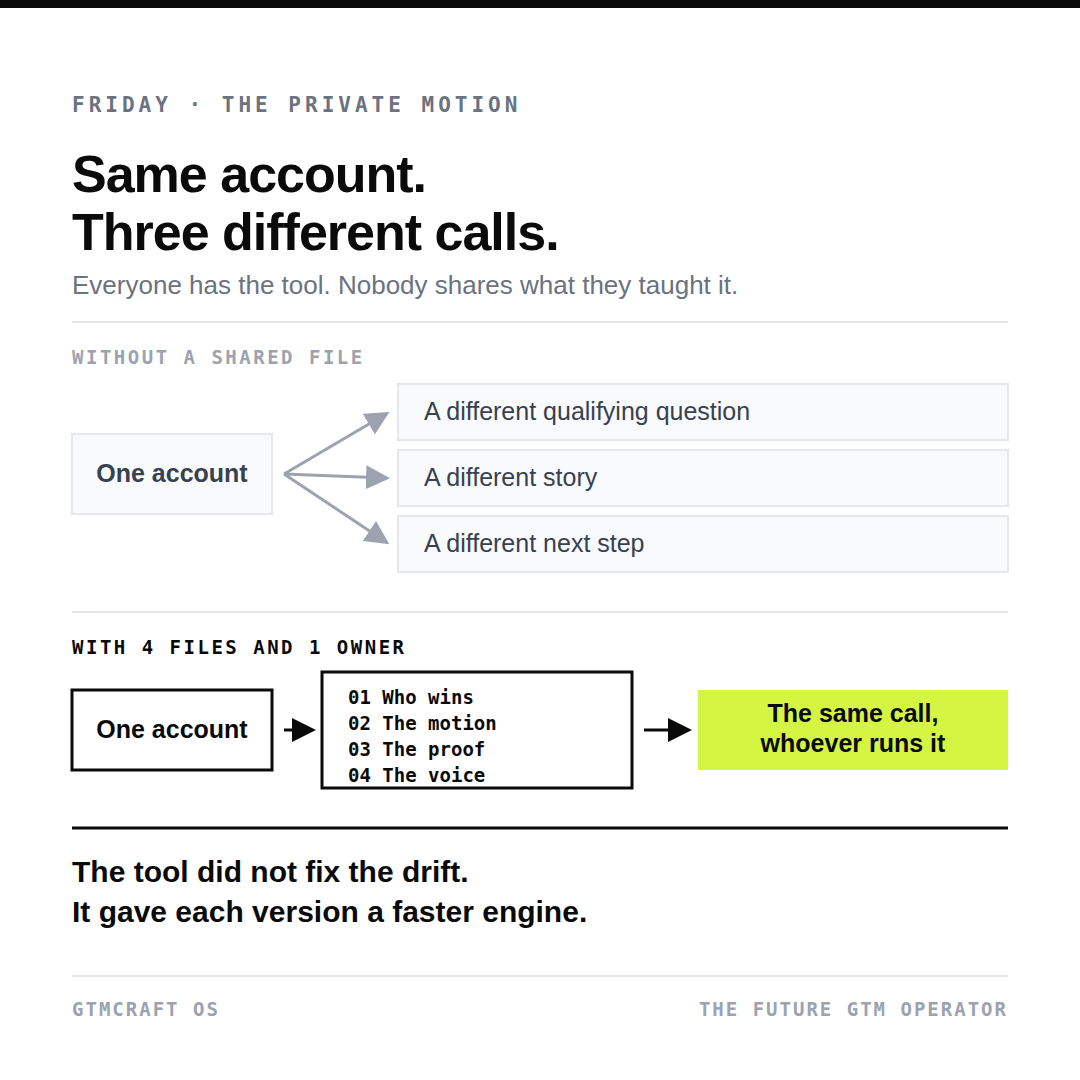
Everyone has the tool. Nobody shares what they taught it. So the same account gets 3 different qualification calls and your motion quietly forks 6 ways.
Your outbound agent scores every row you feed it, including the rows a rule could have removed for free.
Your AI invoice arrives as 4 opaque lines, so the spend grows unchallenged or gets cut on a feeling. Neither is a decision.
The European read: none of this needs a new vendor or a warehouse. Point it at the CRM you already pay for, keep the sensitive half on a local model, and start Monday.
The thread: AI amplifies whatever you already wrote down. Where nothing is written down, it amplifies the drift.
Read time: ~10 min

This week’s number 1 move
Put your motion in 4 files with 1 named owner, and judge it on win rate rather than on seats.
Four files your whole GTM team reads before any AI task. Who wins and who does not. The stages and their exit criteria. Ten closed-won stories with real numbers. Five voice rules and 5 nevers. One owner per file, one review date. The motion then runs the same way whoever is at the keyboard.
From my week: I have run Claude for 3 years and run it hard for the last one. The gap between a good setup and a bad one was never the model, it was the system around it. I built a Head of Sales on Demand for a coaching client over one weekend: 6 agents on their stack, 1 shared context, 1 weekly deal review that runs itself. Their 90-minute review became a 12-minute scan.
My take: foundation files beat prompt libraries. A prompt that worked on one model version ages badly on the next. A file describing who you serve, what you sell and how they buy ages slowly. That is why I put the context first, ahead of the seat and ahead of the model. The unglamorous part is the owner. A file with no name against it is stale inside 6 weeks, and a stale context file is worse than none, because people trust it.
Do first (30 minutes): open one doc. Write the 4 file names. Fill the first one, who wins and who does not, from your last 20 won deals.
The rule: if a good output cannot be traced to a file the whole team reads, it is a private trick, not a team asset.
Sources: MKT1 (Emily Kramer), “Inside the multiplayer AI setups at Mintlify, LangChain, and Buffer” (September 2); The Signal (Brendan Short), “What everyone is missing about Claudeforce” (September 4); Koen Stam, “Three years on ChatGPT” (LinkedIn)
Hi, it is Koen Stam and welcome to GTMcraft OS: The European GTM Operator. This newsletter is built from 100,000+ GTM signals collected from 100+ operators and founders, combined with 13+ years of my own lessons and failures from the trenches. I write at the intersection of go-to-market practice and AI-powered systems for founders and GTM operators scaling their next 2M, 5M or 10M ARR.
Problem 1: your motion has 6 private versions, and your win rate is the average of them
From my week: I watched 7 teams in one room cluster the same account list 7 different ways, with no tool involved at all. That is the human version of this problem. The tool does not create the drift. It just gives each version of it a faster engine.
Everyone has the tool. Nobody shares what they taught it. So the same account gets 3 different qualification calls, 3 different stories and 3 different next steps. The AI did not fix the inconsistency. It scaled it, one private chat at a time.
Emily Kramer went inside the multiplayer setups at Mintlify, LangChain and Buffer this week. The pattern is the same everywhere it works. The shared asset is a small set of files, not a clever prompt. Brendan Short makes the harder point about the platforms racing to own this layer. The model keeps getting cheaper and more capable. The only durable asset is the context, and that is the part you own.
My take: this is where lean teams lose without noticing. Six people, 6 private AI habits, 6 versions of the same motion, everyone faster at their own. I have said for a while that AI does the first draft and a human does the second and sends it. What I did not say clearly enough: the first draft has to come from somewhere the whole team can see. Otherwise the second draft is personal taste with a deadline. The measure is not adoption. It is whether a new rep can run your motion in week one from files, not from your calendar.
The European read: on a team spread across 3 countries and 2 languages, the corridor conversation that patches an inconsistent motion does not exist. The written file is the only version that survives the distance. It lets your second market start from something other than zero.
Do first: name 1 owner for a shared context folder. Put the 4 files in it. Fill the first one today from your closed-won list.
Do this week: make 1 rule the team runs. Any prompt that produced a good output gets its context written back into a file, or it does not count. Ten minutes in your pipeline meeting.
Do this month: compare win rate on deals run through the shared context against deals run private. Keep the version that wins. No deal review? Compare the last 10 proposals side by side.
The rule: measure the context, not the seats. A tool everyone uses privately is 6 tools.
You know it worked when: a new joiner runs your motion in week one from the files, not from your calendar. Founder read: you stop being the person every draft has to pass through.
The play: 5 steps to run your whole team on one shared AI context (2026 series). Inlined in full below.

Sources: MKT1 (Emily Kramer), “Inside the multiplayer AI setups at Mintlify, LangChain, and Buffer” (September 2); The Signal (Brendan Short), “What everyone is missing about Claudeforce” (September 4); Marketing Against the Grain, “Build a second brain you can plug into any AI model” (August 13)
Problem 2: your agent pays to score rows a rule should have killed
From my week: my own signal engine runs a hard recency gate and a fixed watch list before a single row reaches a model. The rule removes more rows every week than the model ever does, and it costs nothing to run.
Your outbound agent scores every account you feed it. So you pay a model to reason about companies that were never buyable, and the list still needs your eyes. The expensive part is not the model. It is sending it rows a rule could have removed for free.
Jordan Crawford built an agent live this week and published what it cost to run. The number is small, and that is the point. Cost stops being the story once the input list is clean, and output quality rises with it. On the SaaStr podcast, the product leaders at Rubrik, Glean and Harvey said the same thing from the build side. Any part of an agent that can be a fixed rule should be a fixed rule.
My take: my rule is simple. Anything I can state as a fact never reaches a step that guesses. That is not an AI rule, it is qualification. I lost a deal recently where the process had been telling us something for weeks. Nobody had written the doubt down as a rule anyone could act on. A model would have made that mistake faster and with more confidence. The gain is not a smaller bill. It is a shorter list your reps trust, built from accounts that could have bought.
The European read: your addressable list is smaller here, so a bad row costs more attention. Country, entity and language are all hard facts, which makes them free kills. Spend the model on the judgment calls.
Do first: write 9 hard kills against your closed-won pattern. Wrong headcount band, wrong country, no local entity, wrong core system, already a customer, lost in the last 12 months.
Do this week: run the kill list before any model call. Log 2 numbers: rows removed, and cost per run.
Do this month: feed only survivors into the scoring step, and track meetings booked per 100 rows reviewed. Founder read: track the share of your own review time that ends in a real conversation.
The rule: anything you can state as a fact never reaches a step that guesses.
You know it worked when: your reviewed list gets shorter and your meeting rate per reviewed account goes up. Founder read: self-sourced pipeline share rises without more hours of review.
The play: 5 steps to filter your outbound list before the model ever sees it (2026 series). Turns your closed-won pattern into fixed rules that run first, so the model only ever judges rows that could actually buy.

Sources: On the Edge (Jordan Crawford), “I built a job search agent live, it cost 1.41 dollars to run” (September 4); The Official SaaStr Podcast, “Shipping enterprise AI agents with the CPOs of Rubrik, Glean and Harvey” (September 2)
Problem 3: you cannot say what your AI spend buys per closed-won deal
From my week: the coaching call I had on Monday ended on isolating one motion so it could be judged on its own. Isolating a motion means costing it separately. That is the discipline I am taking into my own AI spend, rather than reading one line on an invoice and guessing.
Your AI invoice arrives with 4 opaque lines, so the spend is unarguable in both directions. It grows unchallenged, or gets cut on a feeling in the same budget round that funds your pipeline. Neither is a decision, because the number is never expressed in anything your CFO already watches.
CJ Gustafson published the reconciliation method this week, and it takes an hour. Kyle Poyar supplies the reason it matters beyond your own P and L. Buying agents now read pricing pages and form a view on you before a human does. Jonathan Kvarfordt made the sharpest version on the GTM AI Podcast. He works through what a lead costs once every hidden input is counted. AI spend only becomes governable when it is attached to a revenue unit.
My take: I do not want an AI budget. I want a cost per closed-won deal that includes it. Expressed that way it stops being a tooling argument and becomes a normal efficiency conversation, which I can win or lose on evidence. A line item nobody can explain gets cut in the first tight quarter. It usually takes something that was working with it. Name the number before somebody else names it for you.
The European read: you are funding this in the same plan as headcount, and your plan has less room in it than a US comparable at the same ARR. A defensible euro per closed-won deal is what keeps the spend when the budget round gets short.
Do first: paste your invoice and usage export into your AI and ask for a line-by-line reconciliation. Name every euro that does not match.
Do this week: divide total AI spend by closed-won deals last quarter, and again by qualified meetings. Two numbers, 10 minutes.
Do this month: carry euro of AI spend per closed-won deal into your planning pack, beside cost per qualified meeting. No board pack? Put it beside your CAC payback and review it monthly.
The rule: if you cannot name what a line bought in revenue terms, it is not a budget, it is a leak.
You know it worked when: you can defend or cut any AI line with a number rather than a feeling, and the number is per deal. Founder read: your cost per qualified meeting moves in the direction you predicted.
The play: 5 steps to prove your AI spend in the number your CFO watches (2026 series). Converts the invoice into cost per qualified meeting and per closed-won deal, so the spend gets defended on revenue rather than on enthusiasm.

Sources: Mostly Metrics (CJ Gustafson), “How to audit your AI bill for savings” (September 1); Growth Unhinged (Kyle Poyar), “What AI agents really think about your pricing” (September 2); GTM AI Podcast (Jonathan Kvarfordt), “The 1,800 dollar lead, why your social media ads keep failing” (September 2)
Save this. 3 AI problems from my own week, each landing on a revenue number, each wired to a play you can run today.
Send it to 1 founder or GTM operator who is about to buy a seat to fix a writing-it-down problem.
Also on the radar
Agents are starting to write to the systems your renewals live in, which moves the question from which tool to who owns the record. Action: name the 1 system of record your agents may write to, and log every write. The Official SaaStr Podcast, “Who owns your data now, agents versus systems of record” (August 28)
Running the private half of your work on a local model means the folder you refuse to paste anywhere finally gets used. Action: pick 1 sensitive workflow and test it locally. Marketing Against the Grain, “How I turned Codex into my personal research assistant” (September 1)
Steal this move: put the motion in 4 files in 4 weeks

Fixes: the motion that forks into 1 private version per rep, so your win rate is an average of 6 different sales processes.
Best for: 2-5M and 5-10M teams on the new-country or upmarket leg, where the motion lives in 2 or 3 people and the second market starts from something written down.
The 5 steps (over 4 weeks):
Week 1, name the owner: 1 person owns the folder, 1 person owns each file, each file carries a review date. No owner means no file.
Week 1, write who wins: from your last 20 won and 10 lost deals, write who wins, who does not, and the trigger that started each win.
Week 2, write the motion and the proof: your stages with exit criteria, then 10 closed-won stories with real numbers.
Week 3, write the voice: 5 rules and 5 nevers, from emails your buyers actually replied to, not a brand guide.
Week 4, gate it: every agent and every rep reads the folder first. Any good output that cannot be traced to a file gets written back into one, in the pipeline meeting, that week.
Template: a 1-5 rubric scored per file. Rows: named owner, review date set, built from real deals not opinion, referenced by an agent in the last 2 weeks, a new joiner could run it unaided. Under 3 on the last row means you still have the motion, not the team.
Paste this into your AI:
Here are 20 closed-won and 10 closed-lost deals with segment, trigger, stage history and outcome: [paste]. Write me a who-wins-and-who-does-not file: the 5 patterns that repeat in the wins, the 5 that repeat in the losses, and the 9 hard kills I could apply before any human or model looks at a list.
Full play, template and workbook inside GTMcraft OS. Reply or DM me to get access.
Why this matters now
October brings event season and budget sign-off in the same month. September is the last one with slack in it. Whatever is not written down in the next 3 weeks stays in somebody’s head until January.
All 3 problems are the same problem. A motion that lives in 6 private chats cannot be improved, only repeated differently. A list nobody wrote rules for gets judged by a model that guesses. Spend nobody attached to a revenue unit gets cut by someone who never knew what it bought.
AI is not the subject in any of them. It is the amplifier, and it amplifies whatever you already wrote down. Where you wrote nothing, it amplifies the drift, faster and with more confidence than a person.
The model keeps getting cheaper. The system around it is still yours to build.
3 questions for the room
If your best rep left on Friday, which part of your motion leaves with them?
How many rows did your last agent run score that a rule could have removed for nothing?
What is your AI spend per closed-won deal, and could you defend it in a budget meeting on Monday?
Reply or send me a DM.
Go deeper with GTMcraft OS
Scale on plays and skills, not prompts.
You do not need another newsletter, podcast or LinkedIn post.
You need the system under it.
Read the plays. Every single play is free and live in GTMcraft OS on Notion. Click through from any edition.
Build your own. GTMcraft OS members connect the full libraries, 100+ plays plus 100,000+ LinkedIn, newsletter and podcast signals, straight into their own AI or Claude context, so their team builds on the whole corpus instead of one-off prompts.
The single plays are free to read. Wiring the whole corpus into your own operating system, and keeping it current, is what the membership gives you.
Master your human GTM skills AI can’t replace inside GTMcraft,
Koen
Your (human) GTM Coach
—
PS. Co-written by Wispr + 3 GTMcraft Skills + Claude Opus 5; edited & approved by Koen