The 90-second version
On Monday the first Q4 leaderboard goes up. Whatever it ranks, your team will chase for the rest of the quarter. Fix what it measures before it goes up.
Outside signals are a commodity now. Pair every trigger with a record only you hold, and give each pairing a kill date.
Your events produce pipeline only when sales picks the names, invites by phone and calls the next day.
A blended leaderboard grades the lead source. Grade reps inside one source, on deals won per 100 leads.
The European read: in a finite market you cannot buy your way to more accounts, so your own records and your conversion are the edge. The thread: fix the records only you hold before you point money or agents at them.
Read time: ~10 min

This week’s number 1 move
Fix the base before you add another agent. Cut the stack, agree one data model, then automate.
The first thing many teams switch on in a new quarter is another agent, often on a stack nobody has cut.
Brendan Short’s case on XBOW runs the other way. The first 6 months went into the stack and the data model. The sales stack went from 12 tools to 5 before a single agent was built. Then 1 internal tool ran the whole customer journey, from first touch to renewal, and a team of 3 people built the first version.
Sangram Vajre names what happens when you skip that. AI does not break your go-to-market, it exposes the debt you already had. 10 times more content with flat pipeline. More meetings and a falling close rate, because the AI booked outside the ideal customer profile.
Zapier’s CMO put a number on the discipline: only about 24% of GTM workflows truly need AI. The rest want a fixed rule.
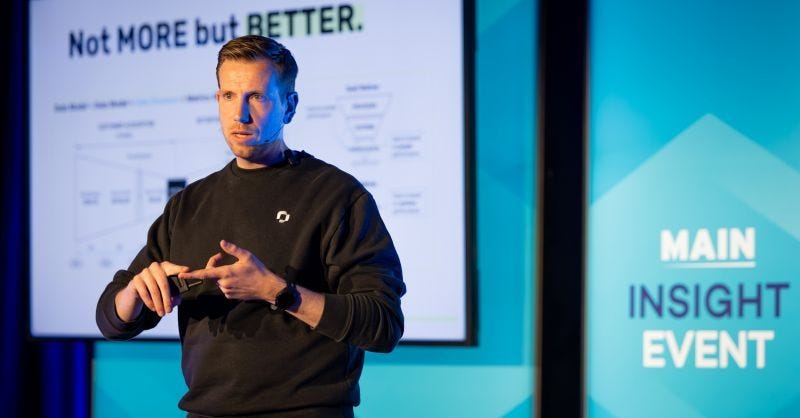
From my week: on stage last week I asked a room of founders to please not buy any more tooling. The daily deal summary I get is built into a tool we already pay for.
My take: AI amplifies, it does not fix. I have said it for years and I will keep saying it. Point an agent at a CRM that is half guesswork and the agent reads the guesswork as truth and acts on it faster. What I take from XBOW is not the funding. It is the order of work. Cut the tools first, because every tool you keep is a data model someone has to reconcile. Then agree what a stage, a lead source and a loss reason mean. Only then does an agent have something worth amplifying. My rule for 2026 is simple: earn the right to amplify before you deploy.
Do first: list every GTM tool you pay for and mark the ones that hold their own version of an account. Founder fallback: if you run HubSpot plus 3 tools, it takes 10 minutes, and the finding is usually 1 tool nobody opened this month.
The rule: cut, then define, then automate. An agent on an uncut stack scales the disagreement between your tools.
Sources: The Signal (Brendan Short), “XBOW” (22 September 2026) · Run on GTM OS (Sangram Vajre), “AI isn’t breaking marketing or sales or CS. The real answer will annoy you” (23 September 2026) · The Founder-Led Marketing Show, “The future of the CMO role w/ Zapier’s CMO and Chief AI Transformation Officer” (22 September 2026)
The play: 5 steps to fix the base before you point an agent at it. A readiness check on the data and the process, run before any agent touches a motion.

Hi, it is Koen Stam and welcome to GTMcraft OS: The European GTM Operator. This newsletter is built from 100,000+ GTM signals collected from 100+ operators and founders, combined with 13+ years of my own lessons and failures from the trenches. I write at the intersection of go-to-market practice and AI-powered systems for founders and GTM operators scaling their next 2M, 5M or 10M ARR.
Problem 1: your intent signals reach the buyer the same morning as everyone else’s
From my week: at our customer wall last week, one story started with an outbound call in 2021. We were not a fit for them yet. In 2025 they changed a tool next to ours, and our product had matured. In August they signed with us, after 3 demos and 3 onsites.
Your signal program runs on the same funding news, job posts and tech changes every competitor buys. The account hears from several vendors on the same morning.
Kyle Poyar calls it an arms race that turned his old standby signals into a commodity. The edge moved to the other half of the pair: your own records.
He names 4 pairings. A past champion plus a job change, then wait about a month before you call. A lost deal plus a change that matches the loss reason. A pricing-page visit plus a target-list account. Several users on personal-email signups at 1 company, rolled up to the account.
His benchmark explains why the second one matters. Only about 1 in 4 qualified opportunities becomes a customer. The other 3 already know you.
Heath Barnett adds the filter: fit, a trigger and the right person, scored so the rep sees why it fired.
My take: I fund signal plays the way I fund channels, on what they convert, never on what they produce. So no outside signal fires in my team unless it joins a record only we hold, and every pairing should get a kill date before it gets a sequence. A lost account does not come back because you sent more email. It comes back when something changes, and your own notes tell you what to say. A signal play that books meetings and closes nothing is the most expensive pipeline you own.
The European read: consent rules make bought contact data thinner here, and your market has fewer accounts to begin with. The records you already hold are worth more per account, because your list does not refill. Match loss reasons per country, because budget cycles differ.
Do first: export closed-lost deals from the last 18 months and tag each loss reason as timing, budget, priority or product. Founder fallback: your last 20 losses, tagged by hand in 1 sitting.
Do this week: match 1 outside trigger to each reason. Budget waits for funding or a new finance leader. Priority waits for a new initiative. Founder fallback: free job-change alerts on your past champions.
Do this month: launch 4 pairings with 1 owner each, record your outbound baseline, and set a kill date 1 quarter out. Founder fallback: 1 pairing, lost deals plus a job change, tracked by hand in HubSpot.
The rule: no outside signal fires alone. Lead the touch with your own context and let the trigger set the timing.
You know it worked when: pipeline creation rate from paired plays beats your outbound baseline inside 1 quarter, on the same cost per opportunity. Founder read: 1 lost deal reopened this quarter on a trigger you matched on purpose.
The play: 5 steps to create pipeline by pairing your own data with outside buying signals. Builds the pairing map, 4 plays, a baseline and a kill date per play.

Sources: Growth Unhinged (Kyle Poyar), “The new battleground in GTM” (20 September 2026) · Outbound Squad (Jason Bay), “Building an AI-native sales motion with Heath Barnett” (7 September 2026)
Problem 2: your field event filled the room and sales never picked the names
From my week: September was wall-to-wall events for my teams: an award show, a live podcast in our office, an evening talk series. Last week I asked my regional marketing managers to sharpen the execution, because events are one of our 3 core sources of closed-won revenue and their impact is still hard to measure.
Marketing fills your events from the newsletter list. The follow-up waits for a clean attendee list.
Andrei Zinkevich and Lisa Schoberl show the opposite at Agicap, a French treasury software company selling to CFOs in the German-speaking market. Their cycle stretched from about 2 weeks to about 6 months. So they flipped who fills the room. Signups went from 80% via marketing email to 80% via sales and customer success.
Sales builds the list from its own pools: closed-lost on bad timing, stalled late-stage deals, old inbound. Reps invite by phone. After the event, every account lands in 1 of 4 tiers, each with its own next step.
Their failure case is the one to copy. Follow-ups ran 10 to 15 days late because the list waited on enrichment.
My take: on 24 September I wrote about who owns the pipeline in the room. The half I still missed was the invite list. So this is the split I am taking to my marketing managers: sales picks the names and owns the next step, marketing owns everything that makes the room worth the trip: the venue, the story, the briefing and the count. A room of 15 senior buyers in 1 city can be a real share of your segment in that country. That is too valuable to fill from a newsletter list.
The European read: a call from a rep the buyer knows still beats a polished email in most of our markets. Language matters too. Invite in the buyer’s language even if the room runs in English.
Do first: take your next event and ask each rep to name 5 accounts from the 4 pools, with 1 line of reason per name. Founder fallback: 1 dinner for 12, and you make every call yourself from a CRM export.
Do this week: set a payback bar for the event in pipeline per euro, before a single invite goes out. Founder fallback: 1 line, the 3 deals this dinner should move.
Do this month: tier every attendee account within 24 hours of the event, call the top tier the next day, and count pipeline you sped up and pipeline you created separately at 30 days. Founder fallback: tag every attendee hot, warm or later the same evening, and call the hot list yourself.
The rule: sales owns the names and the next step, marketing owns the room. Never let enrichment hold up a follow-up call.
You know it worked when: marketing influenced pipeline per event is counted once, split sped-up from created, and clears the bar you set before invites. Founder read: every attendee from your last dinner has an owner and a dated next step.
The play: 5 steps to turn field events into pipeline your sales team owns. The invite pools, the 4 follow-up tiers and the pipeline count sheet.

Sources: Full-Funnel B2B (Andrei Zinkevich) with Lisa Schoberl, “Field marketing playbook” (25 September 2026) · FullFunnel.io, “How to run a global field marketing that generates pipeline” (11 September 2026)
Problem 3: your rep leaderboard is grading the lead source, not the rep
From my week: I closed the week with mid-year coaching conversations: progress, and constructive feedback.
In my 26 September edition I showed my channel conversion rates: marketing 38%, outbound 12%, partners 50%.
Your leaderboard ranks reps on bookings, so the rep with the partner leads looks best. Your activity report rewards the busiest.
Jordan Crawford followed every lead to the deal it became on a real team, and the story flipped. Same-day contact won at about 7%, the same as contact a week later. Days of contact in week 1 did the work. None won about 3%, 1 day about 5, 2 days about 11, 3 or more about 17.
The busiest rep sat second from the bottom on revenue per 100 leads. Partner leads returned about 1.5 times inbound.
His measure is deals won per 100 leads, inside 1 source. If a gap could be chance, call it a tie.
On Outbound Squad, a first-time sales manager adds the cadence: a monthly 1:1 on each rep’s numbers, kept separate from deal reviews.
My take: I stopped grading reps on a blended leaderboard when I saw my channels convert at 12, 38 and 50 percent. Put a partner-heavy rep next to an outbound-heavy rep and you are grading the lead, not the person. The rep who carries a third of our revenue and the rep who stalled after a segment move had the same manager and the same stack. The gap was craft. My rule: every rep gets 1 number to move and the name of a teammate who already hits it.
The European read: your lead sources differ by country, because partner density and inbound volume differ. Grade inside 1 source and 1 market, or you grade the country as well as the lead.
Do first: export last quarter’s leads with source, first owner and the deal each became, then count deals won per 100 leads per rep in your biggest source. Founder fallback: 2 or 3 AEs, 1 HubSpot export pasted into Claude.
Do this week: add days of contact in week 1 per lead and compare win rates inside that source. With 2 or 3 sellers, expect mostly ties, and coach the habit rather than the ranking.
Do this month: give each rep 1 coaching number and 1 teammate to copy, reviewed monthly. No manager layer? Run it yourself on the first Monday of the month.
The rule: grade the rep inside 1 source, coach 1 tested habit, and call small gaps a tie.
You know it worked when: win rate by rep, measured inside 1 source, rises for the coached reps within a quarter. Founder read: each seller can name their 1 number and who to copy.
The play: 5 steps to grade your reps fairly within each lead source. The per-source scorecard, the habit test and 1 coaching number per rep.

Sources: On the Edge (Jordan Crawford), “Rep Review: a skill to grade every rep visually” (24 September 2026) · Outbound Squad (Jason Bay), “Lessons from a first-time sales manager” (14 September 2026)
Save this for the week your Q4 leaderboard goes up. Send it to 1 founder whose leaderboard still blends every lead source.
Also on the radar
2 plays that make the 3 moves land, rather than adding a fourth.
The lost deals first. If the pairing map starts from closed-lost, this is the reactivation motion that runs underneath it.
The days of contact. Crawford’s data says the second and third day win. This turns the follow-up loop into a team standard.
Steal this move: grade every rep inside 1 source in 4 weeks

Fixes: a rep ranking that rewards lead mix and activity volume, so you coach the wrong reps on the wrong habit.
Best for: 2-10M and 10-25M teams with 3 to 10 sellers working mixed lead sources, in 1 or more markets.
The 5 steps (over 4 weeks):
Week 1, follow every lead to its deal: leads, owner history, activities, meetings and deals, joined lead by lead, credited to the first owner.
Week 2, score each source before any rep: revenue and deals won per 100 leads. Flag thin sources as directional.
Week 3, compare reps inside your biggest source on deals won per 100 leads, and label ties.
Week 3, test habits: days of contact in week 1 and a meeting held in week 1, each tested against chance, so small gaps count as ties.
Week 4, give each rep 1 number and 1 teammate to copy. Review monthly.
Template: one row per rep, 1 source per table. Columns: leads, contacted 2+ days in week 1, meeting held in week 1, won, won per 100 leads, strongest step, coaching number, teammate to copy.
Paste this into your AI:
Here are my leads, activities and deals exports from last quarter: [paste]. Join them lead by lead, credit each lead to its first owner, and build a table of deals won per 100 leads per rep inside my largest lead source only. Label any gap you would expect from luck as a tie. Then test whether days of contact in week 1 changes win rate, and suggest 1 coaching number per rep.
Why this matters now
On Monday your first Q4 leaderboard goes up. Your team will chase whatever it ranks for the rest of the quarter.
You now hold 4 full quarters of leads, deals and losses. Start on 3 things before Monday: the loss reasons your signals should pair with, the pools your next event invites from, and the per-source table your reps are graded on.
Then point an agent at it.
3 questions for the room
Which of your outside signals would still fire if it had to join a record only you hold?
Who picked the names for your last event, and who called them the next day?
If you split your leaderboard by lead source tomorrow, which rep moves most?
Join The Revenue Room
8 people, 1 quarter. European B2B SaaS founders between 1M and 10M ARR and GTM leaders who own the number. I tell you what I would do in your seat, you run it. No course, no content library, nothing to fall behind on.
A hotline. A private group nobody outside it sees. Post the problem that is on your desk, any working day, and you have my answer within 48 hours, plus whatever the other 7 have run into before. You never solve a complex one alone again.
A 90-minute call every 2 weeks, case-led. You post your case 48 hours ahead, 3 cases get the floor, and I tell you what I would do, stop doing and measure by Friday. Next call you come back with what happened and we keep solving problems together.
1 private 60-minute session with me, placed where it moves your number most.
I have scaled B2B SaaS to 10M ARR 3 times now and I run a GTM org pushing toward 40M ARR, in Europe. You get what I am running this quarter, not what I remember from 2019.
Master your human GTM skills AI can’t replace inside GTMcraft,
Koen
Your (human) GTM Coach
—
PS. Co-written by Wispr + 3 GTMcraft Skills + Claude Opus 5; edited & approved by Koen